QUESTION IMAGE
Question
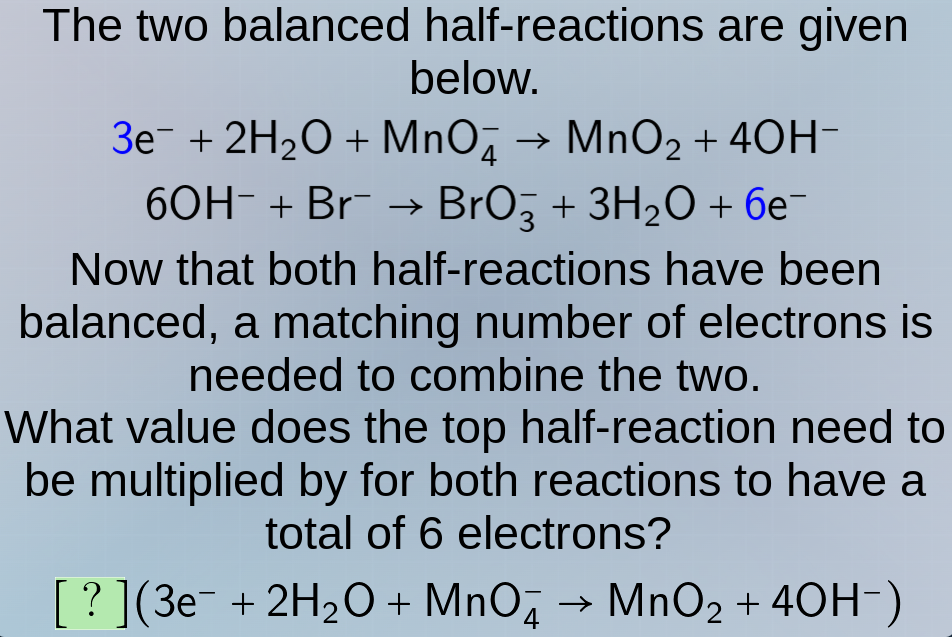
the two balanced half-reactions are given below.
\\(3\mathrm{e}^- + 2\mathrm{h}_2\mathrm{o} + \mathrm{mno}_4^- \
ightarrow \mathrm{mno}_2 + 4\mathrm{oh}^-\\)
\\(6\mathrm{oh}^- + \mathrm{br}^- \
ightarrow \mathrm{bro}_3^- + 3\mathrm{h}_2\mathrm{o} + 6\mathrm{e}^-\\)
now that both half-reactions have been balanced, a matching number of electrons is needed to combine the two.
what value does the top half-reaction need to be multiplied by for both reactions to have a total of 6 electrons?
\\(?(3\mathrm{e}^- + 2\mathrm{h}_2\mathrm{o} + \mathrm{mno}_4^- \
ightarrow \mathrm{mno}_2 + 4\mathrm{oh}^-)\\)
Step1: Identify electrons in top reaction
Top half - reaction has \(3e^-\).
Step2: Calculate multiplier for 6 electrons
Let the multiplier be \(x\). We want \(3x = 6\). Solving for \(x\), we divide both sides by 3: \(x=\frac{6}{3}=2\).

Snap & solve any problem in the app
Get step-by-step solutions on Sovi AI
Photo-based solutions with guided steps
Explore more problems and detailed explanations
2