QUESTION IMAGE
Question
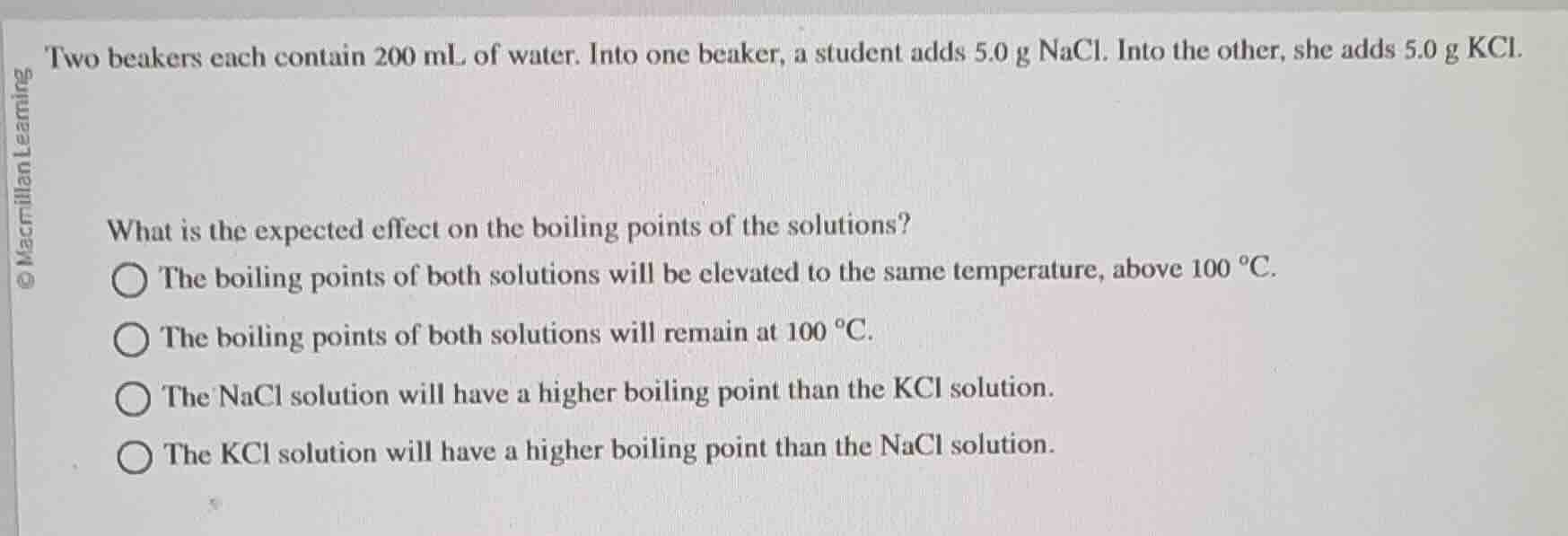
two beakers each contain 200 ml of water. into one beaker, a student adds 5.0 g nacl. into the other, she adds 5.0 g kcl.
what is the expected effect on the boiling points of the solutions?
○ the boiling points of both solutions will be elevated to the same temperature, above 100 °c.
○ the boiling points of both solutions will remain at 100 °c.
○ the nacl solution will have a higher boiling point than the kcl solution.
○ the kcl solution will have a higher boiling point than the nacl solution.
Step1: Recall boiling point elevation formula
Boiling point elevation is given by $\Delta T_b = i \times K_b \times m$, where $i$ = van't Hoff factor, $K_b$ = boiling point elevation constant (same for solvent water), $m$ = molality of solution.
Step2: Determine van't Hoff factor
Both NaCl and KCl are 1:1 ionic compounds, so $i=2$ for both (they dissociate into 2 ions each in water).
Step3: Calculate moles of each solute
Molar mass of NaCl: $22.99 + 35.45 = 58.44\ \text{g/mol}$
Moles of NaCl: $\frac{5.0\ \text{g}}{58.44\ \text{g/mol}} \approx 0.0856\ \text{mol}$
Molar mass of KCl: $39.10 + 35.45 = 74.55\ \text{g/mol}$
Moles of KCl: $\frac{5.0\ \text{g}}{74.55\ \text{g/mol}} \approx 0.0671\ \text{mol}$
Step4: Compare molality values
Molality $m = \frac{\text{moles of solute}}{\text{kg of solvent}}$. Solvent mass is same (200 mL water = 0.200 kg) for both. Since moles of NaCl > moles of KCl, molality of NaCl > molality of KCl.
Step5: Compare boiling point elevation
Since $i$ and $K_b$ are equal, higher molality leads to larger $\Delta T_b$. So NaCl solution has larger boiling point elevation, meaning its boiling point is higher than KCl solution.

Snap & solve any problem in the app
Get step-by-step solutions on Sovi AI
Photo-based solutions with guided steps
Explore more problems and detailed explanations
The NaCl solution will have a higher boiling point than the KCl solution.