QUESTION IMAGE
Question
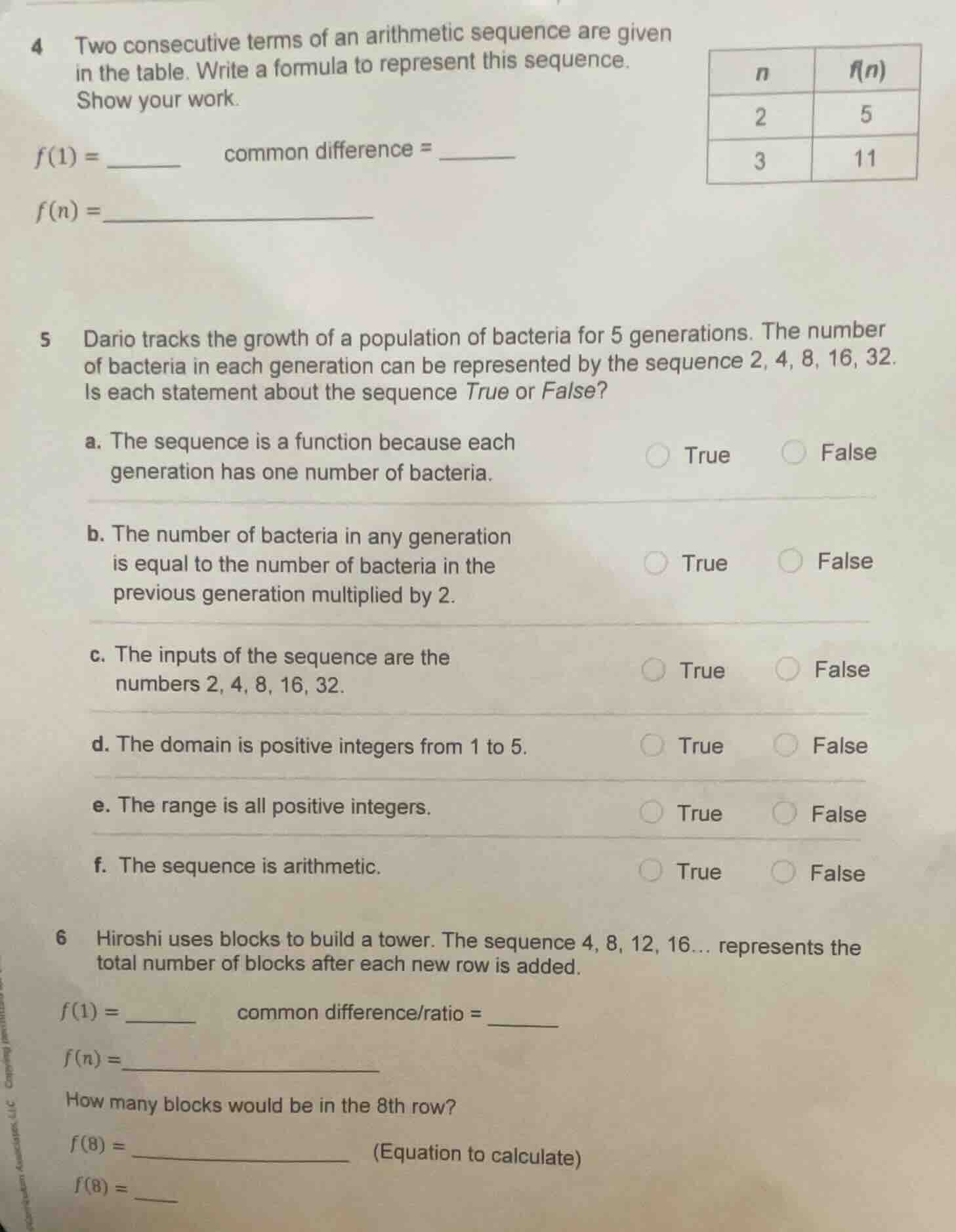
4 two consecutive terms of an arithmetic sequence are given in the table. write a formula to represent this sequence. show your work. f(1) = ____ common difference = __ f(n) = __________ n | f(n) 2 | 5 3 | 11 5 dario tracks the growth of a population of bacteria for 5 generations. the number of bacteria in each generation can be represented by the sequence 2, 4, 8, 16, 32. is each statement about the sequence true or false? a. the sequence is a function because each generation has one number of bacteria. true false b. the number of bacteria in any generation is equal to the number of bacteria in the previous generation multiplied by 2. true false c. the inputs of the sequence are the numbers 2, 4, 8, 16, 32. true false d. the domain is positive integers from 1 to 5. true false e. the range is all positive integers. true false f. the sequence is arithmetic. true false 6 hiroshi uses blocks to build a tower. the sequence 4, 8, 12, 16... represents the total number of blocks after each new row is added. f(1) = __ common difference/ratio = __ f(n) = __________ how many blocks would be in the 8th row? f(8) = __________ (equation to calculate) f(8) = __

Snap & solve any problem in the app
Get step-by-step solutions on Sovi AI
Photo-based solutions with guided steps
Explore more problems and detailed explanations
- $f(1) = -1$; common difference $= 6$; $f(n) = 6n - 7$
- a. True; b. True; c. False; d. True; e. False; f. False
- $f(1) = 4$; common difference $= 4$; $f(n) = 4n$; $f(8) = 4(8)$; $f(8) = 32$