QUESTION IMAGE
Question
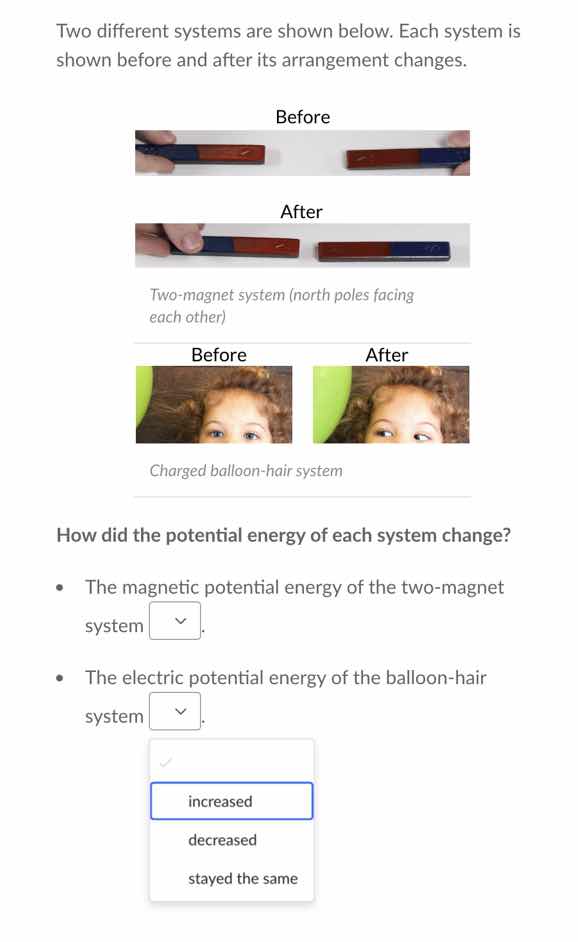
two different systems are shown below. each system is shown before and after its arrangement changes.
two - magnet system (north poles facing each other)
charged balloon - hair system
how did the potential energy of each system change?
- the magnetic potential energy of the two - magnet system
- the electric potential energy of the balloon - hair system
increased
decreased
stayed the same
For the two - magnet system:
When two magnets have their north poles facing each other, they repel. In the "Before" state, the magnets are relatively far apart, and in the "After" state, they are brought closer (due to the arrangement change, but since like poles repel, to bring them closer, we have to do work against the magnetic force of repulsion). The work done on the system is stored as magnetic potential energy. So, as the magnets are moved closer (against the repulsive force), the magnetic potential energy of the two - magnet system increases.
For the balloon - hair system:
A charged balloon and hair (after charging, the balloon and hair have opposite charges or the same? Wait, when you rub a balloon on hair, the balloon becomes charged (say, negative) and the hair becomes positively charged (or vice - versa, depending on the materials). Initially, in the "Before" state, the balloon is probably not as close to the hair, and in the "After" state, the balloon - hair interaction (attraction, since opposite charges attract) causes the hair to be attracted to the balloon. Wait, no, in the image, the hair is moving towards the balloon? Wait, actually, when a charged balloon is brought near hair, the hair is attracted. But in terms of potential energy: electric potential energy between two charges is given by $U=\frac{kq_1q_2}{r}$, where $r$ is the distance between them. If the charges are opposite (attractive), as the distance $r$ decreases (the balloon and hair get closer), the potential energy decreases (because for attractive forces, when objects move towards each other, potential energy decreases, similar to gravitational potential energy when an object falls towards the Earth). Wait, no, let's think again. When you have two objects with opposite charges, the force between them is attractive. If we move them closer together (from a larger $r$ to a smaller $r$), the work is done by the electric force (since the force is attractive, the force and displacement are in the same direction), so the potential energy of the system decreases. Alternatively, if the balloon and hair are becoming more separated? Wait, no, looking at the images: in the "Before" the hair is more spread, and in the "After" the hair is attracted towards the balloon? Wait, maybe I got it wrong. Wait, the key is: for magnetic potential energy with like poles (north - north), repulsion. To move them closer, we do work, so PE increases. For electric: if the balloon and hair are oppositely charged, when they are attracted and move closer, the electric potential energy decreases (because the force is attractive, so as they move towards each other, the potential energy decreases, similar to how gravitational potential energy decreases when a mass falls towards the Earth). So the electric potential energy of the balloon - hair system decreases.

Snap & solve any problem in the app
Get step-by-step solutions on Sovi AI
Photo-based solutions with guided steps
Explore more problems and detailed explanations
- The magnetic potential energy of the two - magnet system: increased
- The electric potential energy of the balloon - hair system: decreased