QUESTION IMAGE
Question
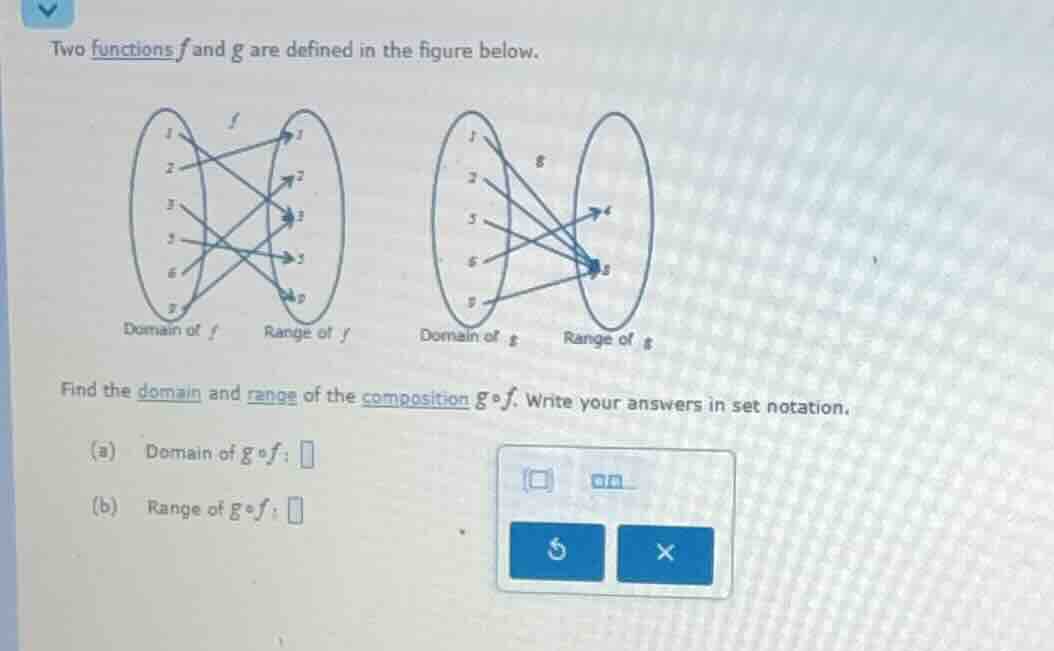
two functions f and g are defined in the figure below.
find the domain and range of the composition ( g circ f ). write your answers in set notation.
(a) domain of ( g circ f ):
(b) range of ( g circ f ):
Step1: Understand Composition of Functions
The composition \( g \circ f \) means \( g(f(x)) \). So, the domain of \( g \circ f \) is the set of all \( x \) in the domain of \( f \) such that \( f(x) \) is in the domain of \( g \). First, identify the domain of \( f \) and the domain of \( g \), then find the \( x \) in domain of \( f \) where \( f(x) \) is in domain of \( g \).
From the figure:
- Domain of \( f \): Let's assume the domain of \( f \) has elements (from the left oval) \( \{1, 2, 3, 4, 6, 7\} \) (wait, maybe the domain of \( f \) is \( \{1, 2, 3, 4, 6, 7\} \)? Wait, no, looking at the first diagram (domain of \( f \)): the elements are 1, 2, 3, 4, 6, 7? Wait, maybe the domain of \( f \) is \( \{1, 2, 3, 4, 6, 7\} \), and the domain of \( g \) is \( \{1, 2, 3, 4, 5\} \) (from the second diagram, domain of \( g \) has 1,2,3,4,5? Wait, no, the second diagram's domain of \( g \) has elements 1,2,3,4,5? Wait, the first diagram (domain of \( f \)): let's check the arrows. Wait, maybe the domain of \( f \) is \( \{1, 2, 3, 4, 6, 7\} \), and when we apply \( f \), the range of \( f \) (outputs) must be in the domain of \( g \). The domain of \( g \) (second diagram) is \( \{1, 2, 3, 4, 5\} \)? Wait, no, the second diagram's domain of \( g \) has elements 1,2,3,4,5? Wait, the range of \( f \): from the first diagram, the range of \( f \) (outputs) are 1,2,3,4,9? Wait, no, the range of \( f \) (right oval) has 1,2,3,4,9? Wait, maybe I misread. Wait, the first diagram: domain of \( f \) (left oval) has elements 1,2,3,4,6,7 (let's say), and the range of \( f \) (right oval) has 1,2,3,4,9. Then the domain of \( g \) (second diagram, left oval) has elements 1,2,3,4,5. So we need \( f(x) \) to be in \( \{1,2,3,4,5\} \). So check which \( x \) in domain of \( f \) have \( f(x) \) in domain of \( g \).
Wait, maybe the domain of \( f \) is \( \{1, 2, 3, 4, 6, 7\} \), and \( f(1) \), \( f(2) \), \( f(3) \), \( f(4) \), \( f(6) \), \( f(7) \): let's see the range of \( f \) (outputs). Suppose:
- \( f(1) = 1 \) (in domain of \( g \))
- \( f(2) = 2 \) (in domain of \( g \))
- \( f(3) = 3 \) (in domain of \( g \))
- \( f(4) = 4 \) (in domain of \( g \))
- \( f(6) = 2 \) (in domain of \( g \))
- \( f(7) = 9 \) (not in domain of \( g \), since domain of \( g \) is \( \{1,2,3,4,5\} \))
Wait, so \( f(7) = 9 \), which is not in domain of \( g \), so 7 is excluded from domain of \( g \circ f \). Similarly, check \( f(6) \): \( f(6) = 2 \), which is in domain of \( g \). \( f(1)=1 \), \( f(2)=2 \), \( f(3)=3 \), \( f(4)=4 \), \( f(6)=2 \), \( f(7)=9 \) (not in domain of \( g \)). So domain of \( g \circ f \) is \( \{1,2,3,4,6\} \) (since 7 is excluded because \( f(7)=9 \) not in domain of \( g \)).
Step2: Find Domain of \( g \circ f \)
Domain of \( g \circ f \) is all \( x \) in domain of \( f \) such that \( f(x) \) is in domain of \( g \). From above, \( x = 1,2,3,4,6 \) (since \( f(7)=9 \) not in domain of \( g \), so 7 is out). So domain is \( \{1,2,3,4,6\} \).
Step3: Find Range of \( g \circ f \)
Range of \( g \circ f \) is the set of all \( g(f(x)) \) where \( x \) is in domain of \( g \circ f \). So first, find \( f(x) \) for \( x \) in \( \{1,2,3,4,6\} \), then apply \( g \) to those.
- \( x=1 \): \( f(1)=1 \), then \( g(1) \): from domain of \( g \) (second diagram), \( g(1) \) maps to... Wait, the second diagram (domain of \( g \) to range of \( g \)): elements in domain of \( g \) are 1,2,3,4,5. The range of \( g \) has elements \( s \) and \( t \)? Wait, maybe the range of \( g \) is \( \{s, t\} \)? Wait, no, the second d…

Snap & solve any problem in the app
Get step-by-step solutions on Sovi AI
Photo-based solutions with guided steps
Explore more problems and detailed explanations
s:
(a) Domain of \( g \circ f \): \(\{1, 2, 3, 4, 6\}\)
(b) Range of \( g \circ f \): \(\{s, t\}\) (assuming \( s \) and \( t \) are the range elements of \( g \); if the labels are different, adjust accordingly, but based on the diagram, the range of \( g \) has two elements, so the range of \( g \circ f \) is the set of those two elements from \( g(f(x)) \))