QUESTION IMAGE
Question
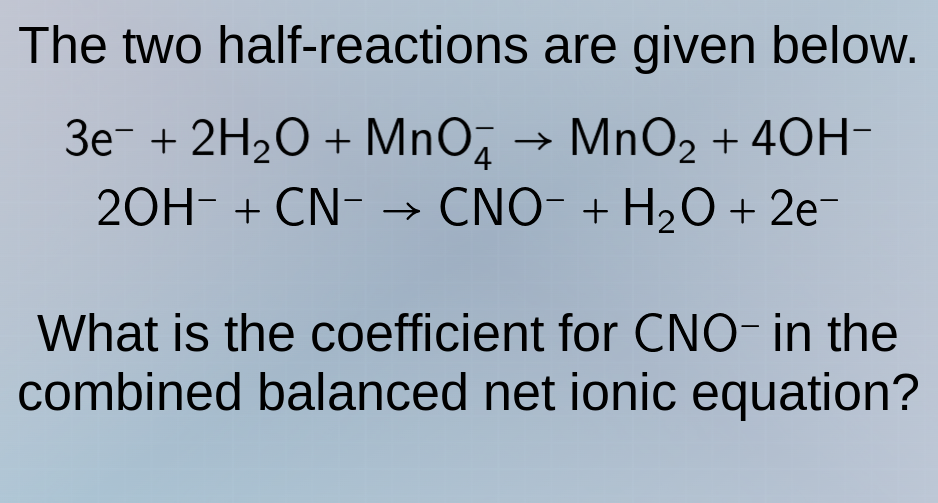
the two half-reactions are given below.
3e⁻ + 2h₂o + mno₄⁻ → mno₂ + 4oh⁻
2oh⁻ + cn⁻ → cno⁻ + h₂o + 2e⁻
what is the coefficient for cno⁻ in the combined balanced net ionic equation?
Step1: Balance electrons in half - reactions
The first half - reaction (reduction) has 3 electrons gained: \(3e^-+2H_2O + MnO_4^-
ightarrow MnO_2 + 4OH^-\)
The second half - reaction (oxidation) has 2 electrons lost: \(2OH^-+CN^-
ightarrow CNO^-+H_2O + 2e^-\)
To balance the number of electrons, we find the least common multiple of 3 and 2, which is 6.
Multiply the first half - reaction by 2: \(2\times(3e^-+2H_2O + MnO_4^-
ightarrow MnO_2 + 4OH^-)\) gives \(6e^-+4H_2O + 2MnO_4^-
ightarrow 2MnO_2 + 8OH^-\)
Multiply the second half - reaction by 3: \(3\times(2OH^-+CN^-
ightarrow CNO^-+H_2O + 2e^-)\) gives \(6OH^-+3CN^-
ightarrow 3CNO^-+3H_2O + 6e^-\)
Step2: Combine the two half - reactions
Now, we add the two modified half - reactions together. The electrons (\(6e^-\)) will cancel out.
For the \(H_2O\) terms: \(4H_2O\) (from the first reaction) and \(3H_2O\) (from the second reaction, but on the product side, so we subtract it from the reactant side) gives \(4H_2O- 3H_2O=H_2O\) on the reactant side.
For the \(OH^-\) terms: \(8OH^-\) (from the first reaction) and \(6OH^-\) (from the second reaction, on the reactant side) gives \(8OH^--6OH^- = 2OH^-\) on the product side.
For the \(MnO_4^-\) term: \(2MnO_4^-\) (reactant)
For the \(CN^-\) term: \(3CN^-\) (reactant)
For the \(MnO_2\) term: \(2MnO_2\) (product)
For the \(CNO^-\) term: \(3CNO^-\) (product)
The combined reaction is: \(2MnO_4^-+3CN^-+H_2O
ightarrow 2MnO_2 + 3CNO^-+2OH^-\)

Snap & solve any problem in the app
Get step-by-step solutions on Sovi AI
Photo-based solutions with guided steps
Explore more problems and detailed explanations
3