QUESTION IMAGE
Question
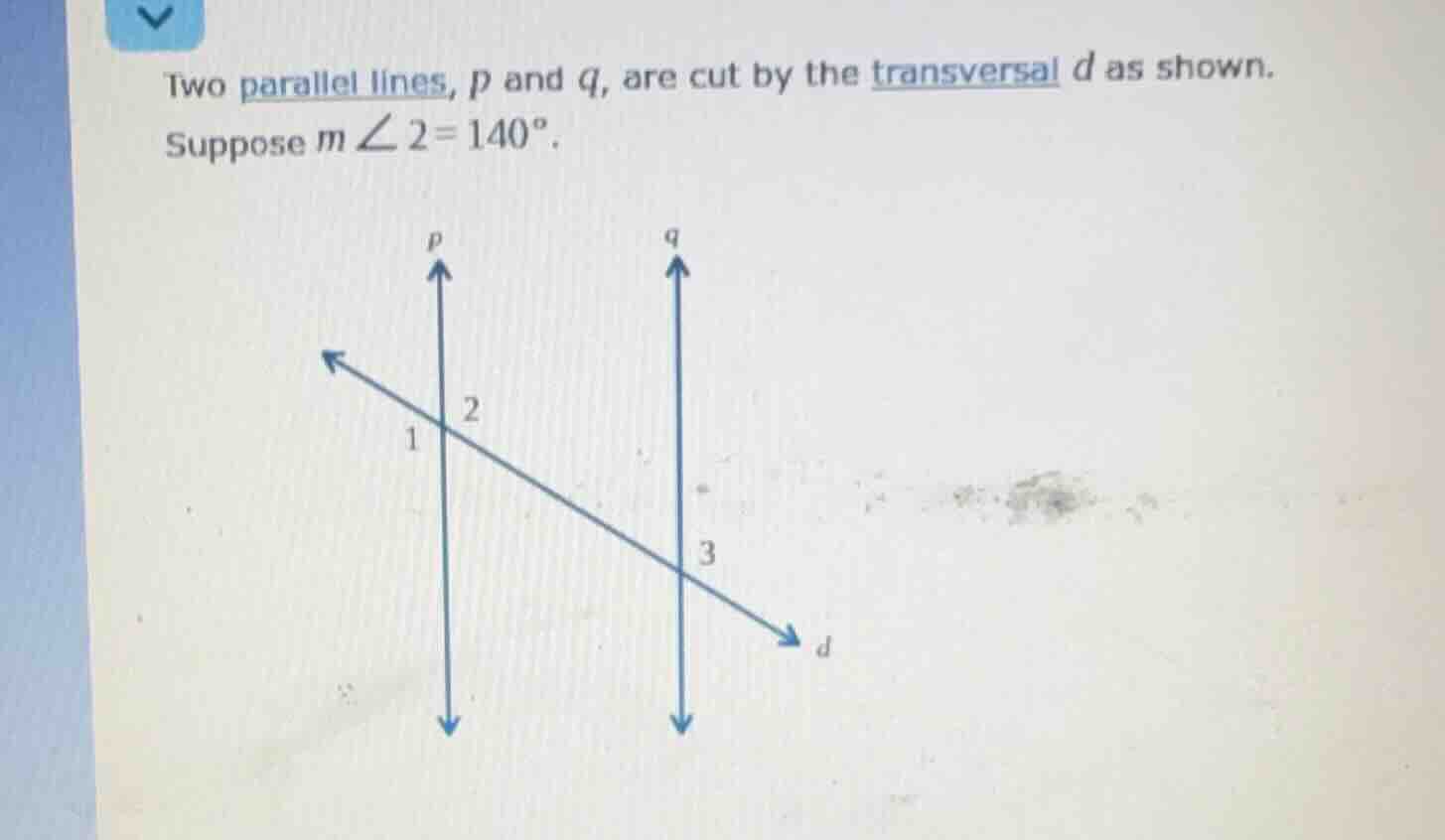
two parallel lines, p and q, are cut by the transversal d as shown. suppose m ∠ 2 = 140°.
Response
Assuming we need to find \( m\angle1 \) and \( m\angle3 \) (common related questions):
For \( m\angle1 \):
Step1: Identify linear pair
\( \angle1 \) and \( \angle2 \) form a linear pair, so their measures sum to \( 180^\circ \).
\( m\angle1 + m\angle2 = 180^\circ \)
Step2: Substitute \( m\angle2 = 140^\circ \)
\( m\angle1 + 140^\circ = 180^\circ \)
\( m\angle1 = 180^\circ - 140^\circ = 40^\circ \)
For \( m\angle3 \):
Step1: Identify corresponding angles (since \( p \parallel q \), transversal \( d \))
\( \angle1 \) and \( \angle3 \) are corresponding angles, so they are equal.
\( m\angle3 = m\angle1 \)
Step2: Substitute \( m\angle1 = 40^\circ \)
\( m\angle3 = 40^\circ \)

Snap & solve any problem in the app
Get step-by-step solutions on Sovi AI
Photo-based solutions with guided steps
Explore more problems and detailed explanations
(if finding \( m\angle1 \)): \( 40^\circ \)