QUESTION IMAGE
Question
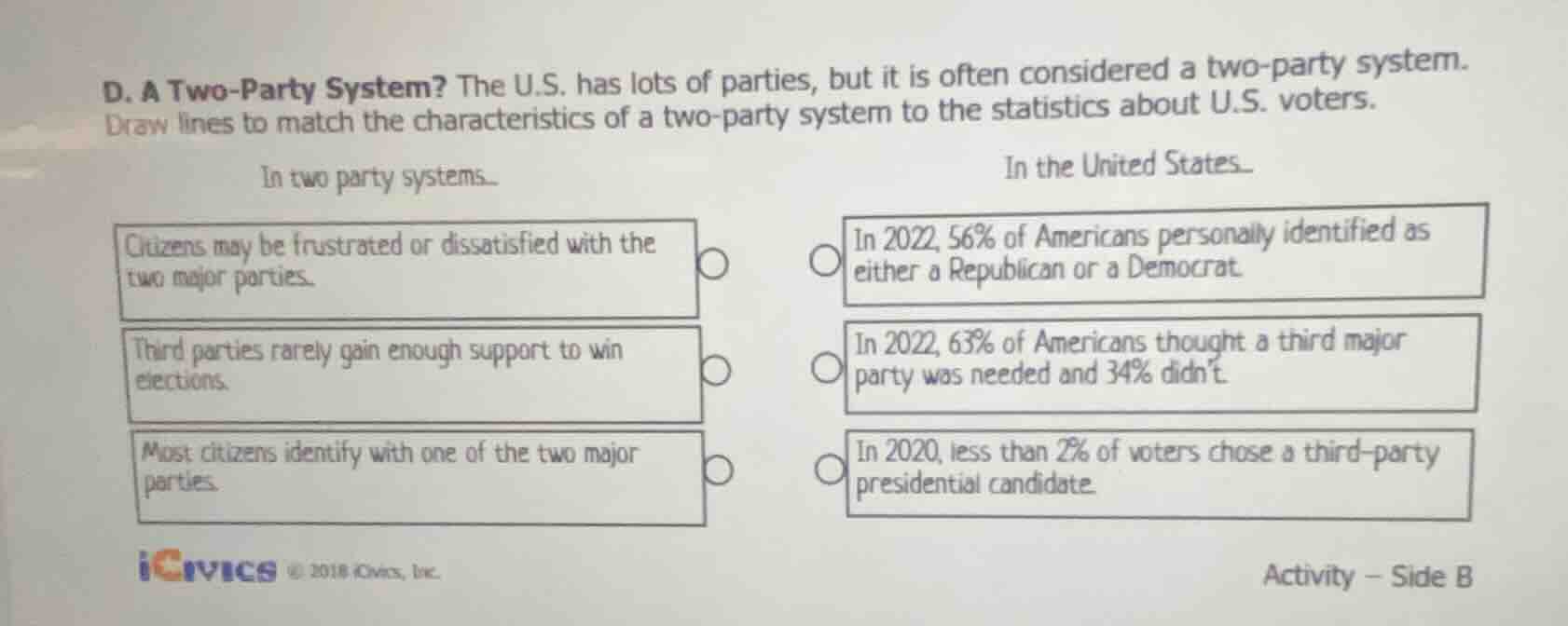
d. a two - party system? the u.s. has lots of parties, but it is often considered a two - party system. draw lines to match the characteristics of a two - party system to the statistics about u.s. voters.
in two party systems...
citizens may be frustrated or dissatisfied with the two major parties.
third parties rarely gain enough support to win elections.
most citizens identify with one of the two major parties.
in the united states...
in 2022, 56% of americans personally identified as either a republican or a democrat.
in 2022, 63% of americans thought a third major party was needed and 34% didnt.
in 2020, less than 2% of voters chose a third - party presidential candidate.
To solve the matching, we analyze each characteristic of two - party systems and find the corresponding U.S. voter statistic:
- For the characteristic "Citizens may be frustrated or dissatisfied with the two major parties", we look for a statistic that shows dissatisfaction. The statistic "In 2022, 63% of Americans thought a third major party was needed and 34% didn’t" indicates that a majority wanted a third party, which implies dissatisfaction with the two major parties.
- For "Third parties rarely gain enough support to win elections", we need a statistic about third - party support in elections. "In 2020, less than 2% of voters chose a third - party presidential candidate" shows that third - party candidates have very little support in presidential elections, so this matches.
- For "Most citizens identify with one of the two major parties", we look for a statistic about citizens identifying with the two major parties. "In 2022, 56% of Americans personally identified as either a Republican or a Democrat" shows that a significant portion of Americans identify with the two major parties.

Snap & solve any problem in the app
Get step-by-step solutions on Sovi AI
Photo-based solutions with guided steps
Explore more problems and detailed explanations
- "Citizens may be frustrated or dissatisfied with the two major parties" → "In 2022, 63% of Americans thought a third major party was needed and 34% didn’t"
- "Third parties rarely gain enough support to win elections" → "In 2020, less than 2% of voters chose a third - party presidential candidate"
- "Most citizens identify with one of the two major parties" → "In 2022, 56% of Americans personally identified as either a Republican or a Democrat"