QUESTION IMAGE
Question
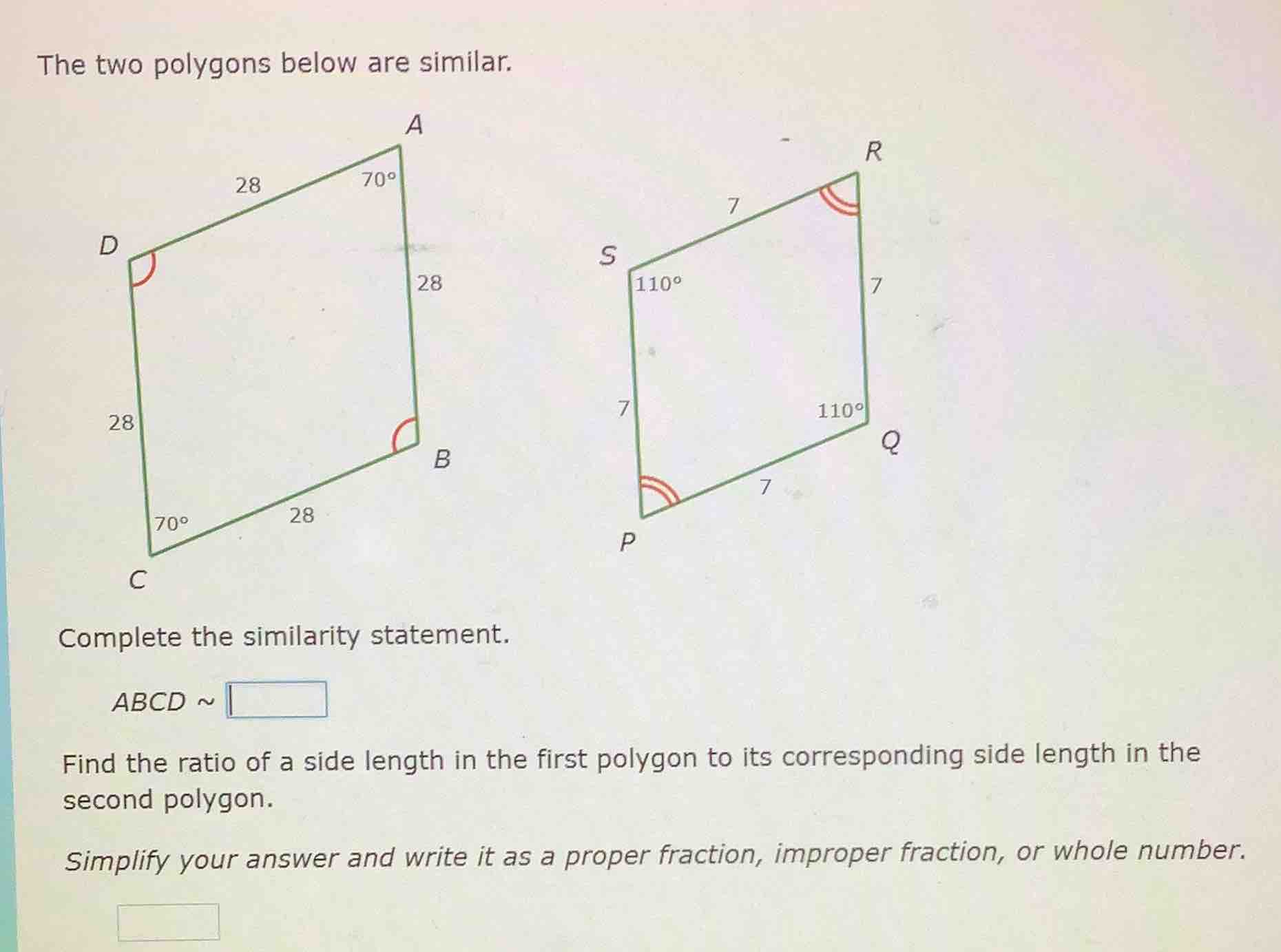
the two polygons below are similar.
complete the similarity statement.
abcd ~
find the ratio of a side length in the first polygon to its corresponding side length in the second polygon.
simplify your answer and write it as a proper fraction, improper fraction, or whole number.
Part 1: Completing the Similarity Statement
To determine the similarity statement, we match corresponding angles. In \(ABCD\), angles at \(A\) and \(C\) are \(70^\circ\), and angles at \(B\) and \(D\) are \(110^\circ\) (since consecutive angles in a parallelogram are supplementary: \(180 - 70 = 110\)). In the second polygon, angles at \(R\) and \(P\) match the \(70^\circ\)-type angles, and angles at \(Q\) and \(S\) match the \(110^\circ\)-type angles. By matching vertices with equal angles, \(A\) ( \(70^\circ\)) corresponds to \(R\), \(B\) ( \(110^\circ\)) corresponds to \(Q\), \(C\) ( \(70^\circ\)) corresponds to \(P\), and \(D\) ( \(110^\circ\)) corresponds to \(S\). Thus, \(ABCD \sim RQPS\).
Step1: Identify Corresponding Sides
A side in \(ABCD\) (e.g., \(AB = 28\)) corresponds to a side in \(RQPS\) (e.g., \(RQ = 7\)).
Step2: Calculate the Ratio
The ratio of a side in the first polygon to the corresponding side in the second is \(\frac{28}{7}\).
Step3: Simplify the Ratio
Simplify \(\frac{28}{7}\) to get \(4\).

Snap & solve any problem in the app
Get step-by-step solutions on Sovi AI
Photo-based solutions with guided steps
Explore more problems and detailed explanations
\(RQPS\)