QUESTION IMAGE
Question
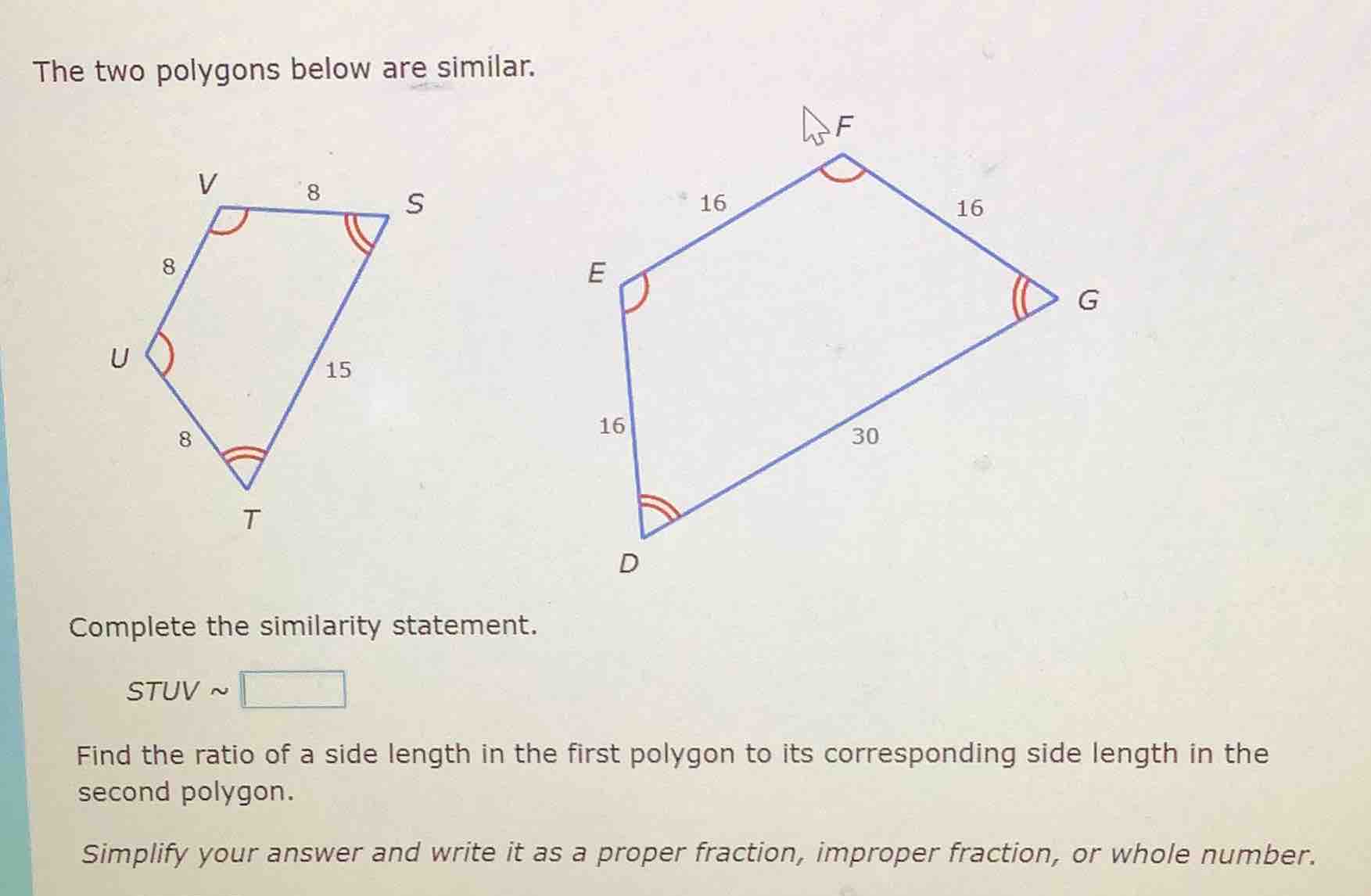
the two polygons below are similar.
complete the similarity statement.
stuv ~
find the ratio of a side length in the first polygon to its corresponding side length in the second polygon.
simplify your answer and write it as a proper fraction, improper fraction, or whole number.
Part 1: Completing the Similarity Statement
To determine the similarity statement, we match corresponding angles (marked with the same number of arcs) and sides. In the first polygon \( STUV \), the sides \( SV = 8 \), \( ST = 15 \), \( TU = 8 \), \( UV = 8 \). In the second polygon, sides \( FG = 16 \), \( GD = 30 \), \( DE = 16 \), \( EF = 16 \). By matching angles (arcs) and sides, we see that \( S \) corresponds to \( G \), \( T \) to \( D \), \( U \) to \( E \), \( V \) to \( F \). So the similarity statement is \( STUV \sim GDEF \).
Step1: Identify Corresponding Sides
We take a pair of corresponding sides. For example, \( SV = 8 \) (from \( STUV \)) and \( FG = 16 \) (from \( GDEF \)), or \( ST = 15 \) and \( GD = 30 \), or \( TU = 8 \) and \( DE = 16 \), or \( UV = 8 \) and \( EF = 16 \).
Step2: Calculate the Ratio
Using \( SV = 8 \) and \( FG = 16 \), the ratio is \( \frac{8}{16} \). Simplifying this fraction, we divide numerator and denominator by 8: \( \frac{8\div8}{16\div8}=\frac{1}{2} \). We can also check with \( ST = 15 \) and \( GD = 30 \): \( \frac{15}{30}=\frac{1}{2} \), which confirms the ratio.

Snap & solve any problem in the app
Get step-by-step solutions on Sovi AI
Photo-based solutions with guided steps
Explore more problems and detailed explanations
\( GDEF \)