QUESTION IMAGE
Question
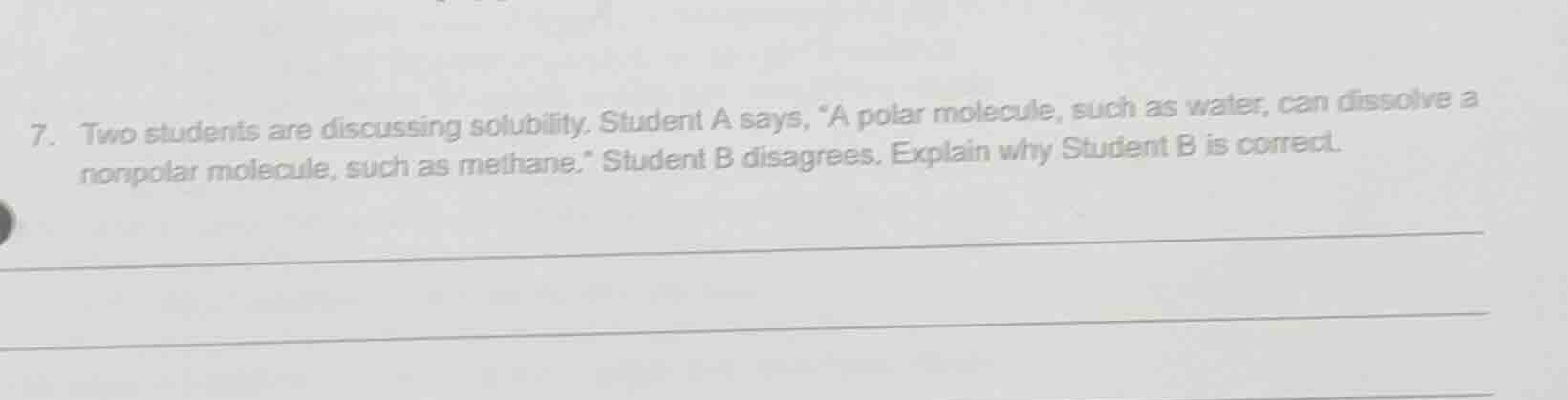
- two students are discussing solubility. student a says, “a polar molecule, such as water, can dissolve a nonpolar molecule, such as methane.” student b disagrees. explain why student b is correct.
Solubility follows the rule "like dissolves like": polar solvents interact favorably with polar solutes, while nonpolar solvents interact with nonpolar solutes. Water (polar) has strong dipole-dipole and hydrogen bonding interactions. Methane (nonpolar) only has weak London dispersion forces. The polar water molecules cannot effectively surround and separate nonpolar methane molecules, so methane does not dissolve in water.

Snap & solve any problem in the app
Get step-by-step solutions on Sovi AI
Photo-based solutions with guided steps
Explore more problems and detailed explanations
Student B is correct because solubility follows the "like dissolves like" principle. Polar water molecules (which rely on dipole-dipole and hydrogen bonding interactions) cannot form favorable interactions with nonpolar methane molecules (which only have weak London dispersion forces), so water cannot dissolve methane.