QUESTION IMAGE
Question
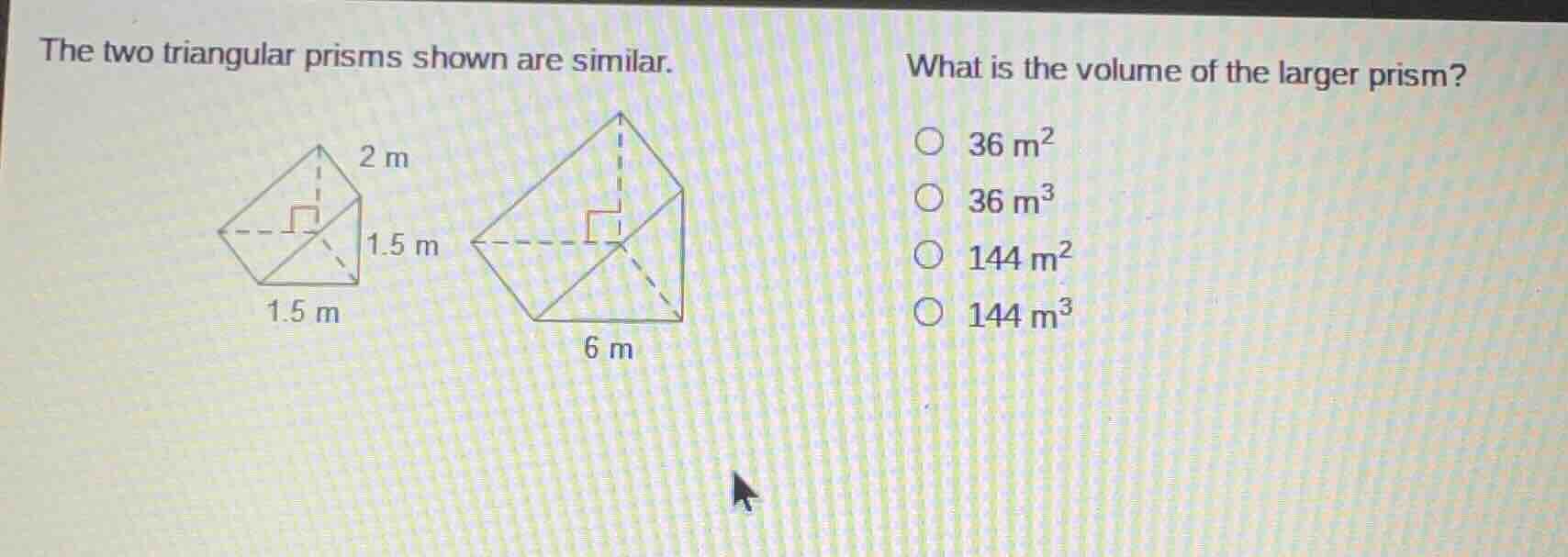
the two triangular prisms shown are similar. what is the volume of the larger prism? 36 m² 36 m³ 144 m² 144 m³
Step1: Find the scale factor
The corresponding sides of the two similar prisms: the base side of the smaller prism is \(1.5\) m, and the base side of the larger prism is \(6\) m. The scale factor \(k\) is \(\frac{6}{1.5}=4\).
Step2: Recall the volume ratio of similar solids
For similar solids, the ratio of their volumes is the cube of the scale factor. Let \(V_1\) be the volume of the smaller prism and \(V_2\) be the volume of the larger prism. So \(\frac{V_2}{V_1}=k^3\).
Step3: Calculate the volume of the smaller prism
The volume of a triangular prism is \(V = \text{Base Area}\times\text{Height}\). The base is a triangle with base \(1.5\) m and height \(1.5\) m, so the base area \(A=\frac{1}{2}\times1.5\times1.5 = 1.125\) \(m^2\). The height of the prism (the length of the prism) is \(2\) m. Then \(V_1=1.125\times2 = 2.25\) \(m^3\).
Step4: Calculate the volume of the larger prism
Since \(k = 4\), \(k^3=64\)? Wait, no, wait, wait, I made a mistake. Wait, the scale factor is \(4\)? Wait, \(6\div1.5 = 4\), yes. But wait, let's recalculate the smaller prism's volume. Wait, the triangular base: the base of the triangle is \(1.5\) m, the height of the triangle is \(1.5\) m? Wait, no, looking at the diagram, the smaller prism: the triangular face has base \(1.5\) m, height (the height of the triangle) \(1.5\) m? Wait, no, maybe the base of the triangle is \(1.5\) m, and the height of the triangle is \(1.5\) m, and the length of the prism (the distance along the prism) is \(2\) m. So volume of triangular prism is \(\frac{1}{2}\times\text{base of triangle}\times\text{height of triangle}\times\text{length of prism}\). So \(V_1=\frac{1}{2}\times1.5\times1.5\times2\). Let's calculate that: \(\frac{1}{2}\times1.5\times1.5\times2=1.5\times1.5 = 2.25\) \(m^3\).
Now, the scale factor \(k = \frac{6}{1.5}=4\). So the ratio of volumes is \(k^3=4^3 = 64\)? Wait, that can't be, because the options are 36, 144. Wait, maybe I misidentified the corresponding sides. Wait, maybe the height of the triangle in the smaller prism is \(1.5\) m, and in the larger prism, the height of the triangle is also scaled by 4? Wait, no, maybe the length of the prism (the side labeled 2 m in the smaller) and the corresponding side in the larger? Wait, no, let's re - examine.
Wait, maybe the two prisms: the smaller one has a base triangle with base \(1.5\) m, height of triangle \(1.5\) m, and the length of the prism (the distance perpendicular to the triangle) is \(2\) m. The larger one has a base triangle with base \(6\) m (since \(1.5\times4 = 6\)), height of triangle \(1.5\times4=6\) m? Wait, no, that doesn't make sense. Wait, maybe the scale factor is \(4\), but let's use another approach.
Wait, the volume of a triangular prism is \(V=\frac{1}{2}bhl\), where \(b\) is the base of the triangle, \(h\) is the height of the triangle, and \(l\) is the length of the prism.
For the smaller prism: \(b = 1.5\) m, \(h = 1.5\) m, \(l = 2\) m. So \(V_1=\frac{1}{2}\times1.5\times1.5\times2=\frac{1}{2}\times1.5\times3 = 2.25\) \(m^3\).
For similar prisms, if the scale factor of linear dimensions is \(k\), then volume scale factor is \(k^3\). But wait, maybe the linear scale factor is \(\frac{6}{1.5}=4\)? Wait, no, maybe the length of the prism (the side labeled 2 m in the smaller) and the corresponding side in the larger? Wait, no, the base of the triangle in the smaller is \(1.5\) m, in the larger is \(6\) m, so scale factor \(k = 4\). Then volume of larger is \(V_2=V_1\times k^3=2.25\times64 = 144\) \(m^3\). Wait, that matches the option \(144\ m^3\).
Wait, let's…

Snap & solve any problem in the app
Get step-by-step solutions on Sovi AI
Photo-based solutions with guided steps
Explore more problems and detailed explanations
\(144\ m^3\) (the option is D. \(144\ m^3\))