QUESTION IMAGE
Question
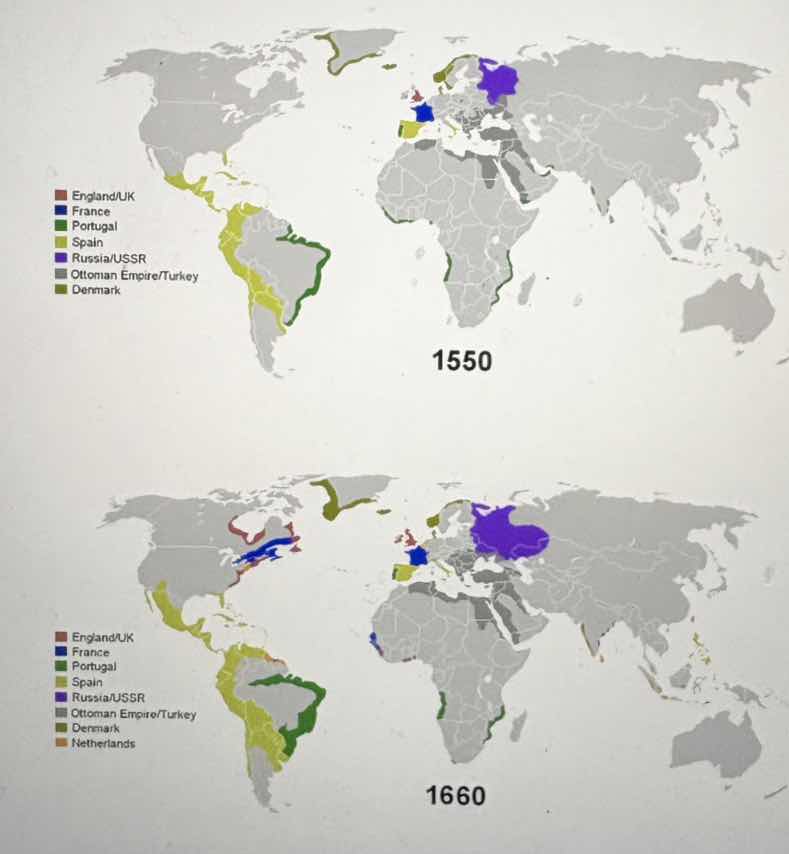
two world maps labeled 1550 (top) and 1660 (bottom). each has a legend with colored regions: 1550 legend: england/uk (brown), france (blue), portugal (green), spain (yellow), russia/ussr (purple), ottoman empire/turkey (gray), denmark (olive). 1660 legend: adds netherlands (brown). maps show colonial/territorial changes (e.g., north america, africa, asia, europe) between 1550 - 1660.
To analyze this problem, we focus on the changes in the territorial claims or colonial holdings of different countries between 1550 and 1660 as shown on the maps.
Step 1: Identify the countries and their territories in 1550
- Spain: Has significant territorial presence in the Americas (yellow regions).
- Portugal: Has territorial claims in parts of South America (green regions).
- England/UK: Minimal or no visible territorial claims in the Americas in 1550.
- France: Minimal or no visible territorial claims in the Americas in 1550.
- Russia/USSR: Territorial presence in Europe (purple region).
- Ottoman Empire/Turkey: Territorial presence in the Middle East and parts of Europe (gray regions).
- Denmark: Some territorial presence in the Arctic region (yellow-green region).
Step 2: Identify the changes by 1660
- England/UK: Now has territorial claims in North America (red region).
- France: Now has territorial claims in North America (blue region).
- Netherlands: Newly visible with territorial claims (brown region), likely in parts of the Americas or other regions.
- Spain: Still has significant territorial presence in the Americas but with some changes in the extent or neighboring territories.
- Portugal: Still has territorial claims in South America but with possible changes in the extent.
- Russia/USSR: Has expanded its territorial presence in Europe (larger purple region).
- Ottoman Empire/Turkey: Maintains its territorial presence with possible minor changes.
- Denmark: Maintains its territorial presence in the Arctic region.
Step 3: Analyze the main changes
The most notable changes are the emergence of territorial claims by England/UK, France, and the Netherlands in the Americas (and possibly other regions) by 1660, which were not as prominent or existent in 1550. Also, Russia/USSR has expanded its territory in Europe.
Step 4: Interpret the historical context
These changes reflect the era of European colonial expansion. Between 1550 and 1660, European powers like England, France, and the Netherlands began to establish colonies in the Americas, challenging the earlier dominance of Spain and Portugal. Russia was also expanding its influence in Europe during this period.

Snap & solve any problem in the app
Get step-by-step solutions on Sovi AI
Photo-based solutions with guided steps
Explore more problems and detailed explanations
The main changes between 1550 and 1660 include the emergence of territorial claims by England/UK, France, and the Netherlands in the Americas (and other regions), the expansion of Russia/USSR's territory in Europe, and continued presence (with some changes) of Spain, Portugal, the Ottoman Empire/Turkey, and Denmark. This represents the era of European colonial expansion and power shifts.