QUESTION IMAGE
Question
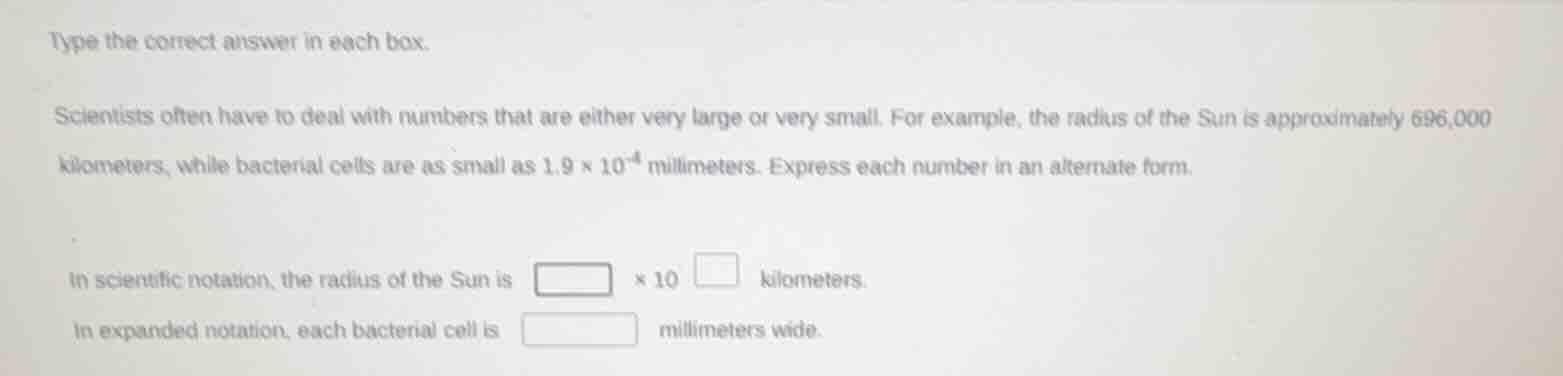
type the correct answer in each box. scientists often have to deal with numbers that are either very large or very small. for example, the radius of the sun is approximately 696,000 kilometers, while bacterial cells are as small as $1.9 \times 10^{-4}$ millimeters. express each number in an alternate form. in scientific notation, the radius of the sun is $\square \times 10^{\square}$ kilometers. in expanded notation, each bacterial cell is $\square$ millimeters wide.
Step1: Convert 696000 to scientific notation
To convert a number to scientific notation \( a \times 10^n \), we need to move the decimal point so that \( 1 \leq |a| < 10 \). For 696000, moving the decimal point 5 places to the left gives \( 6.96 \), and the exponent \( n \) is 5. So \( 696000 = 6.96\times10^{5} \).
Step2: Expand \( 1.9\times10^{-4} \)
Recall that \( 10^{-4}=\frac{1}{10^{4}} = 0.0001 \). Multiply 1.9 by 0.0001: \( 1.9\times0.0001 = 0.00019 \).

Snap & solve any problem in the app
Get step-by-step solutions on Sovi AI
Photo-based solutions with guided steps
Explore more problems and detailed explanations
In scientific notation, the radius of the Sun is \( 6.96 \times 10^{5} \) kilometers.
In expanded notation, each bacterial cell is \( 0.00019 \) millimeters wide.