QUESTION IMAGE
Question
uncommon schools | change history
name:
date:
unit 4– heat transfer practice homework
team:
- temperature is a measure of:
- heat flows from an object with temperature to an object with temperature.
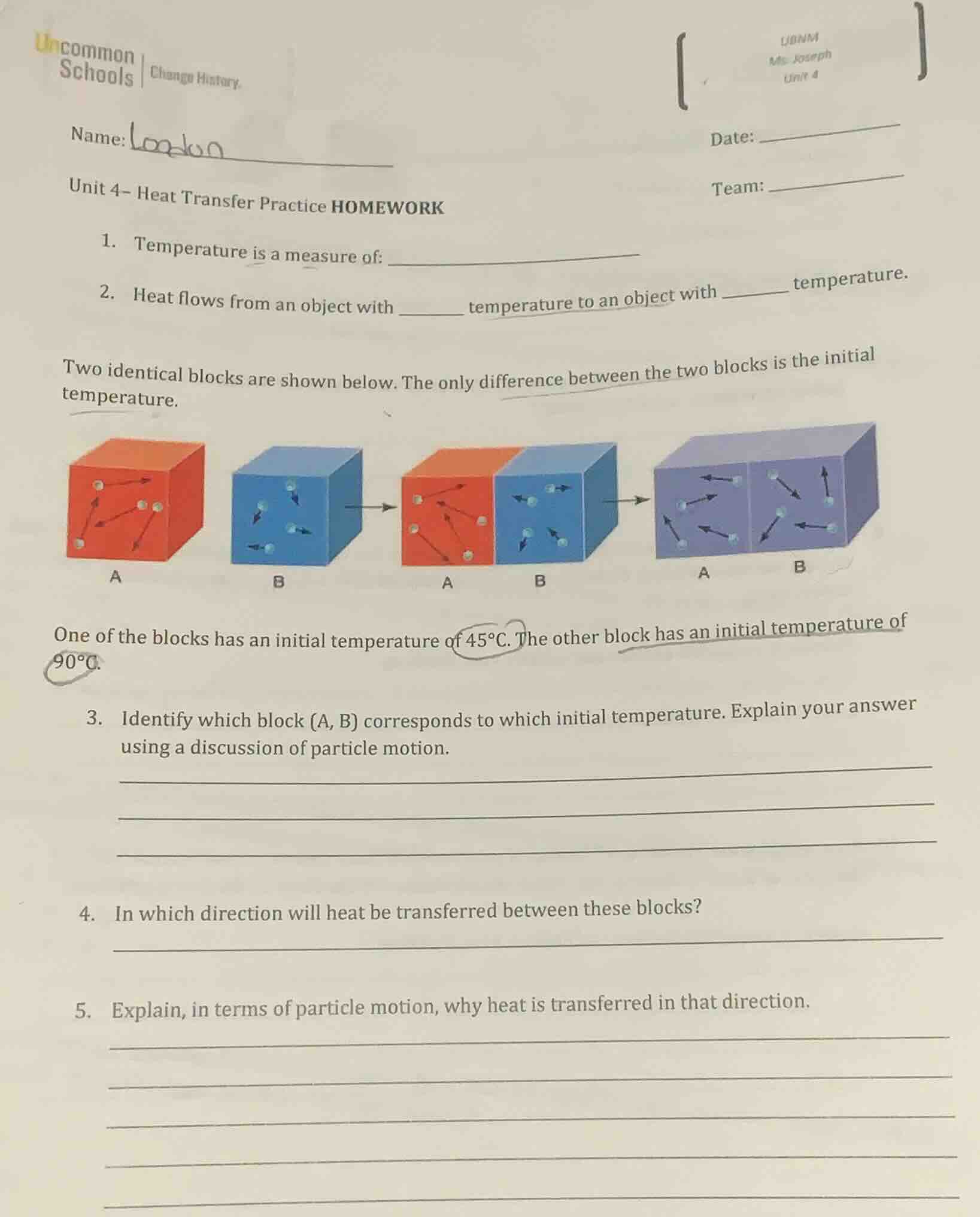
two identical blocks are shown below. the only difference between the two blocks is the initial temperature.
images of two blocks a (red) and b (blue), then a and b together, then both purple
one of the blocks has an initial temperature of 45°c. the other block has an initial temperature of 90°c.
- identify which block (a, b) corresponds to which initial temperature. explain your answer using a discussion of particle motion.
- in which direction will heat be transferred between these blocks?
- explain, in terms of particle motion, why heat is transferred in that direction.
Brief Explanations
- Temperature quantifies the average kinetic energy of an object's particles, which relates to how fast the particles move.
- Heat is energy that transfers due to a temperature difference, moving from warmer to cooler objects to reach thermal equilibrium.
- Higher temperature means particles have greater average kinetic energy, so they move faster and with more energy. Block A's particles show more vigorous motion, matching the higher initial temperature.
- Heat always flows from the object with higher temperature to the one with lower temperature to balance particle kinetic energy.
- When objects touch, high-energy particles from the warmer block collide with lower-energy particles from the cooler block, transferring energy until their average kinetic energies (temperatures) are equal.

Snap & solve any problem in the app
Get step-by-step solutions on Sovi AI
Photo-based solutions with guided steps
Explore more problems and detailed explanations
- the average kinetic energy of particles in an object
- higher; lower
- Block A has an initial temperature of 90°C, Block B has an initial temperature of 45°C. Block A's particles move faster and with more energy, which corresponds to a higher temperature (greater average kinetic energy).
- Heat will be transferred from Block A to Block B.
- The faster-moving, higher-energy particles in Block A (90°C) collide with the slower, lower-energy particles in Block B (45°C). These collisions transfer kinetic energy from the higher-energy particles to the lower-energy ones, causing heat to flow from A to B until the average kinetic energy (temperature) of particles in both blocks is equal.