QUESTION IMAGE
Question
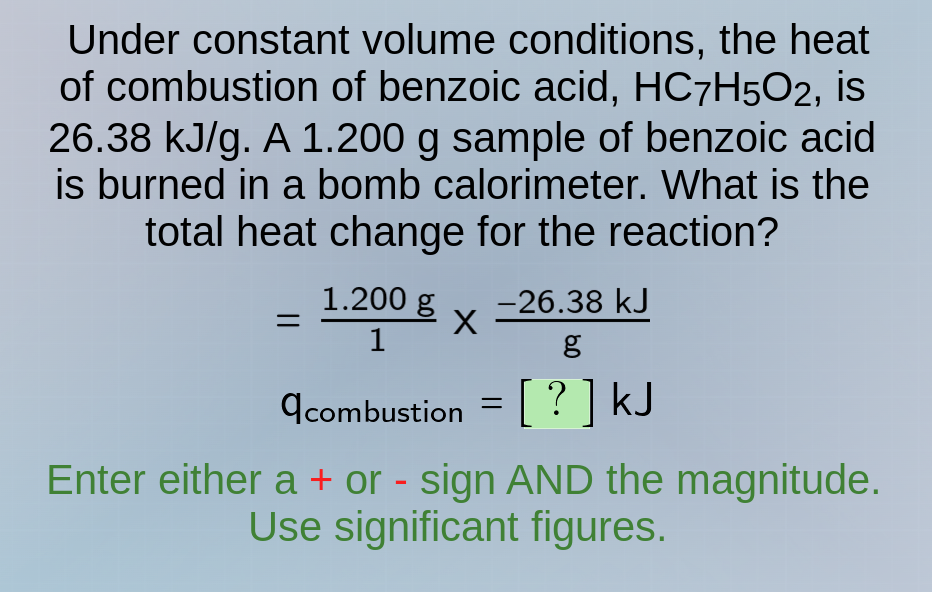
under constant volume conditions, the heat of combustion of benzoic acid, hc₇h₅o₂, is 26.38 kj/g. a 1.200 g sample of benzoic acid is burned in a bomb calorimeter. what is the total heat change for the reaction?
= (1.200 g / 1) × (-26.38 kj / g)
q₍combustion₎ = ? kj
enter either a + or - sign and the magnitude.
use significant figures.
Step1: Multiply the mass by the heat per gram
We have the mass of benzoic acid as \(1.200\space g\) and the heat of combustion per gram as \(-26.38\space kJ/g\). To find the total heat change, we multiply the mass by the heat per gram.
The formula used is \(q_{combustion}=\text{mass} \times \text{heat per gram}\), so we calculate \(1.200\space g\times\frac{-26.38\space kJ}{g}\).
Step2: Perform the multiplication
When we multiply \(1.200\) by \(-26.38\), we get:
\(1.200\times(-26.38)= - 31.656\)
Since the given values have four significant figures (1.200 has four and 26.38 has four), our answer should also have four significant figures. But let's check the calculation again. Wait, 1.200 26.38: 1.20026 = 31.2, 1.2000.38 = 0.456, so total is 31.2 + 0.456 = 31.656. So with the negative sign, it's -31.66 (rounded to four significant figures? Wait, 1.200 is four, 26.38 is four, so the product should have four significant figures. Wait, 1.200 26.38: let's do the multiplication properly. 1.200 26.38 = (1 + 0.2 + 0.000)26.38 = 26.38 + 5.276 + 0.000 = 31.656. So the result is -31.66 kJ? Wait, no, 1.200 26.38: 1.200 26.38. Let's use a calculator approach: 26.38 1.2 = 31.656. So yes, 31.656, and with the negative sign, -31.66? Wait, but maybe we just do the multiplication as is. Wait, the problem says to use significant figures. 1.200 has four, 26.38 has four, so the answer should have four. So 1.200 (-26.38) = -31.656, which rounds to -31.66? Wait, no, 31.656 with four significant figures: the first four digits are 3,1,6,5, the next is 6, which is more than 5, so we round up the 5 to 6? Wait, no, 31.656: the number is -31.656. Let's count the significant figures. 1.200 has four, 26.38 has four, so the product should have four. So -31.66? Wait, no, 31.656: the digits are 3 (1st), 1 (2nd), 6 (3rd), 5 (4th), 6 (5th). So when rounding to four significant figures, we look at the fifth digit, which is 6, so we round the fourth digit (5) up to 6. So -31.66? Wait, but maybe the problem just wants the direct multiplication. Let's check: 1.200 26.38 = 31.656, so with the negative sign, it's -31.66? Wait, but let's see the given formula: \(\frac{1.200\space g}{1}\times\frac{-26.38\space kJ}{g}\). The grams cancel out, and we have 1.200 (-26.38) kJ. So 1.200 26.38 = 31.656, so the result is -31.66 kJ? Wait, but maybe the problem expects us to just multiply 1.200 by -26.38. Let's do that: 1.200 (-26.38) = -31.656. Now, considering significant figures: 1.200 has four, 26.38 has four, so the answer should have four. So -31.66? Wait, no, 31.656 rounded to four significant figures is -31.66? Wait, 31.656: the first four significant figures are 3,1,6,5. The next digit is 6, which is greater than 5, so we round the 5 up to 6, making it 31.66. So the heat change is -31.66 kJ? Wait, but let's check again. 1.200 26.38: 1.2 26.38 = 31.656. Yes. So the answer is -31.66 kJ? Wait, but maybe the problem allows for four significant figures, so -31.66? Or maybe -31.66 is correct. Wait, let's see: 1.200 g is four sig figs, 26.38 kJ/g is four sig figs, so the product should have four sig figs. So -31.66 kJ.

Snap & solve any problem in the app
Get step-by-step solutions on Sovi AI
Photo-based solutions with guided steps
Explore more problems and detailed explanations
-31.66