QUESTION IMAGE
Question
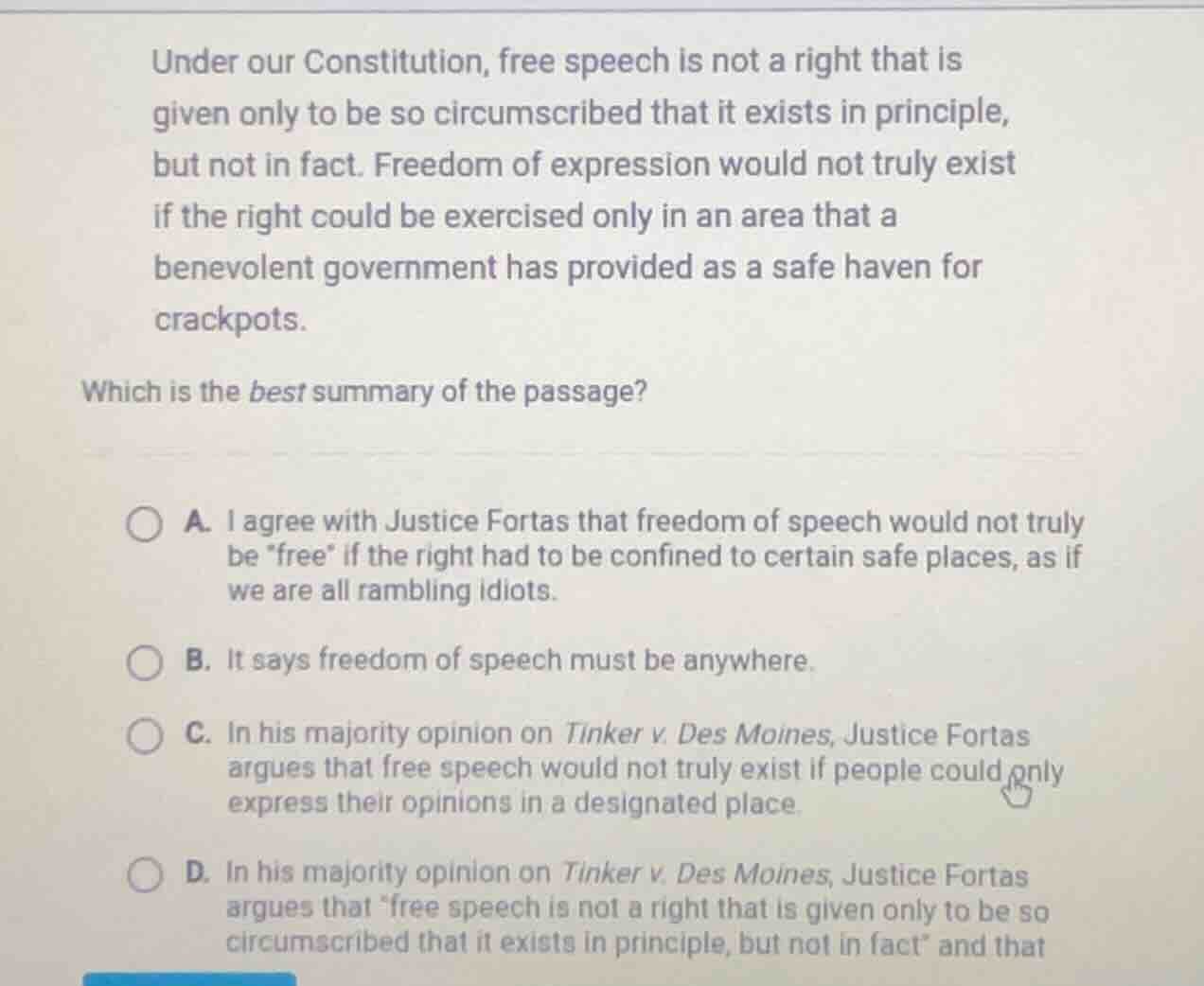
under our constitution, free speech is not a right that is given only to be so circumscribed that it exists in principle, but not in fact. freedom of expression would not truly exist if the right could be exercised only in an area that a benevolent government has provided as a safe haven for crackpots. which is the best summary of the passage? a. i agree with justice fortas that freedom of speech would not truly be \free\ if the right had to be confined to certain safe places, as if we are all rambling idiots. b. it says freedom of speech must be anywhere. c. in his majority opinion on tinker v. des moines, justice fortas argues that free speech would not truly exist if people could only express their opinions in a designated place. d. in his majority opinion on tinker v. des moines, justice fortas argues that \free speech is not a right that is given only to be so circumscribed that it exists in principle, but not in fact\ and that
The passage states that constitutional free speech cannot be merely theoretical, restricted only to government-designated "safe" spaces, as that would negate true freedom of expression.
- Option A adds an unstated personal agreement and derogatory language not in the original text.
- Option B is overly simplistic and does not capture the core point about circumscribed, theoretical vs. actual freedom.
- Option C accurately summarizes the key argument: true free speech does not exist if expression is limited to only designated places, matching the passage's core claim.
- Option D is incomplete as it cuts off before finishing the argument.

Snap & solve any problem in the app
Get step-by-step solutions on Sovi AI
Photo-based solutions with guided steps
Explore more problems and detailed explanations
C. In his majority opinion on Tinker v. Des Moines, Justice Fortas argues that free speech would not truly exist if people could only express their opinions in a designated place.