QUESTION IMAGE
Question
understanding governments and economies
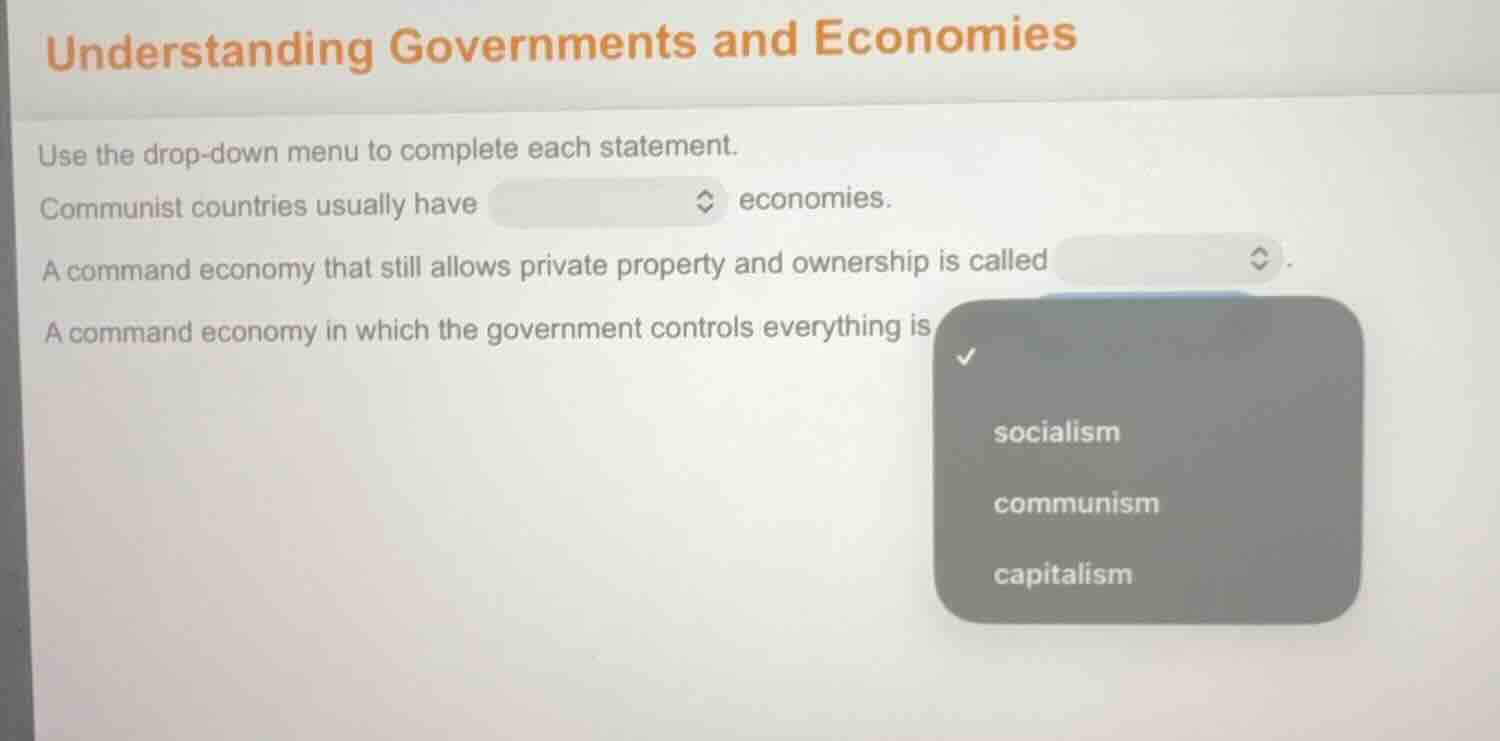
use the drop - down menu to complete each statement.
communist countries usually have economies.
a command economy that still allows private property and ownership is called .
a command economy in which the government controls everything is
(options: socialism, communism, capitalism)
First statement:
Communist countries are characterized by a command economy where the government makes economic decisions, and the typical economic system associated with communism is a command (or communist - style) economy. So "Communist countries usually have command (or communist) economies" (but from the dropdown for the third statement, for the first blank, the relevant economic system linked to communist countries in terms of the options and economic theory: Communist countries usually have command economies, and in the context of the dropdowns, for the third statement, the one where government controls everything is communism. For the first statement, the economic system of communist countries is command (and in terms of the options' logic, the first blank would be filled with a term related to command economy, and communist countries typically have command economies, and the third statement's correct option for "A command economy in which the government controls everything is" is communism. For the second statement: A command economy that still allows private property and ownership is socialism (as socialism has a command - like economy but with some private property allowed, while communism has no private property and full government control, capitalism is market - based).
First blank (Communist countries usually have ____ economies):
Communist countries have command economies, and in the context of the options' logic (since the third statement is about communism as full government control), the first blank should be "command" but from the dropdown options' relation, the economic system of communist countries is a command economy, and the term related here in the options' set (for the third statement we see communism as the full control one). So for the first statement, the answer is that communist countries usually have command (or communist - style) economies, and in the context of the options provided (for the third statement), the first blank's answer is related to command, but in the given dropdown for the third statement, the options are socialism, communism, capitalism. So re - evaluating:
- Communist countries usually have command (but in the options' context, the economic system type: communist countries have command economies, and the term related to the options: the third statement is about communism as the full - control command economy. So the first blank: Communist countries usually have command (but if we have to use the options' terms, maybe the first blank is "communist" - style, but the options for the third statement are socialism, communism, capitalism. Let's re - analyze each statement:
- Statement 1: Communist countries usually have command economies (but the dropdown for the first statement is not shown, but the third statement's dropdown is shown. Wait, the user's image shows three statements:
- Communist countries usually have [dropdown] economies.
- A command economy that still allows private property and ownership is called [dropdown].
- A command economy in which the government controls everything is [dropdown with options socialism, communism, capitalism, and a checkmark, but let's solve each:
- Statement 3: A command economy where government controls everything is communism (because in communism, the government (or state) controls all production, property, etc., no private property.
- Statement 2: A command economy that allows private property is socialism (socialism has a planned/command - like economy but with some private property allowed, unlike communism which has none,…

Snap & solve any problem in the app
Get step-by-step solutions on Sovi AI
Photo-based solutions with guided steps
Explore more problems and detailed explanations
s:
- Communist countries usually have \boxed{command} (or \boxed{communist} - style) economies. (But based on the options' context for statement 3, the first blank is related to communist - style, so \boxed{communist} - style or \boxed{command}.)
- A command economy that still allows private property and ownership is called \boxed{socialism}.
- A command economy in which the government controls everything is \boxed{communism}.
(Note: For the first statement, if the dropdown options are similar to the third, but since the first dropdown is not shown, we use economic theory. Communist countries have command economies, so the first blank is "command" or "communist" - related. The second statement: socialism (as it has command - like planning but allows some private property). The third statement: communism (full government control, no private property).)