QUESTION IMAGE
Question
understanding theorems
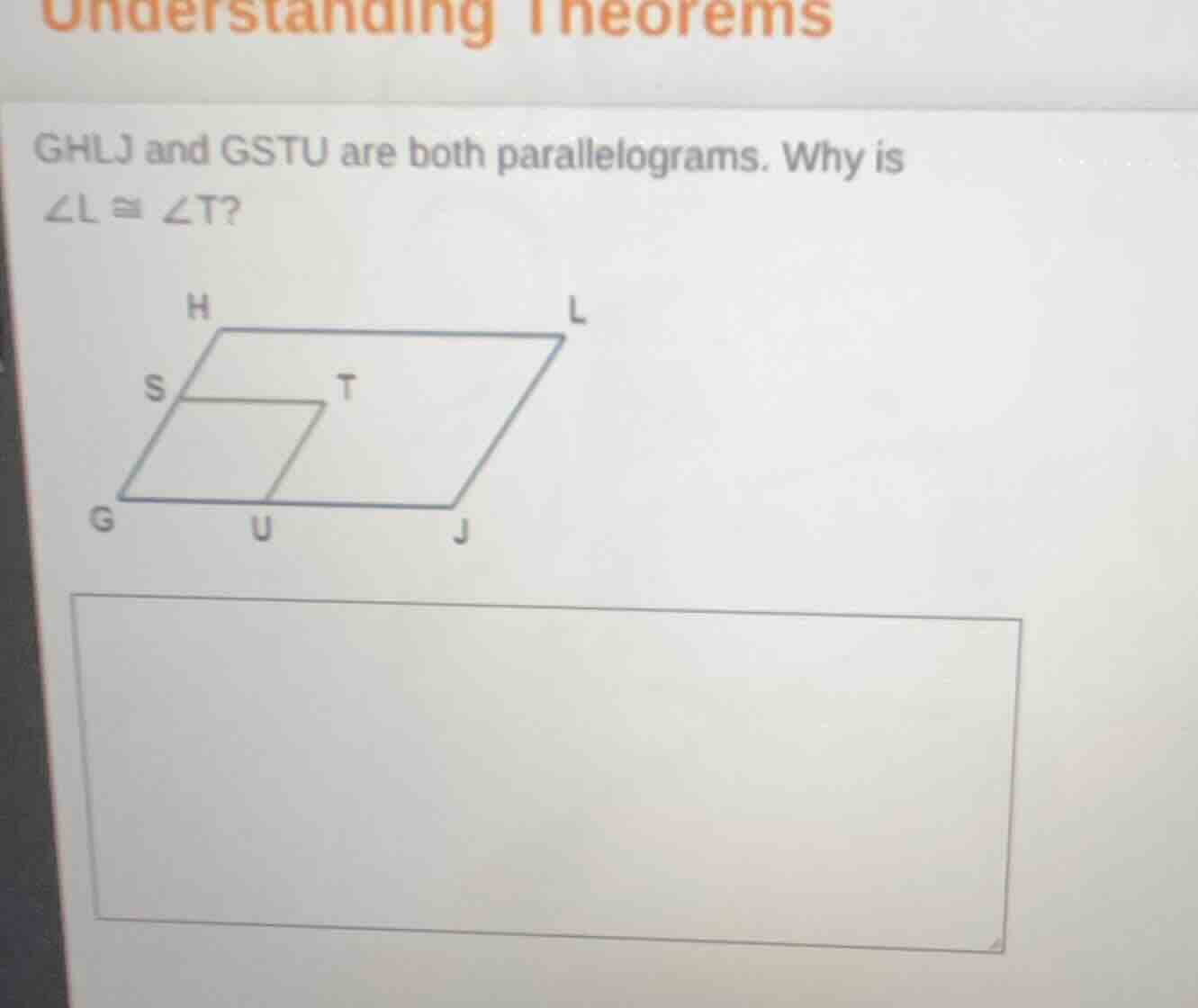
ghlj and gstu are both parallelograms. why is
$\angle l \cong \angle t$?
image of two parallelograms ghlj and gstu, with s on gh, t inside ghlj, u on gj, and j on the base of ghlj
blank box for answer
Brief Explanations
- In parallelogram \(GHLJ\), opposite angles are congruent, so \(\angle L \cong \angle G\).
- In parallelogram \(GSTU\), opposite angles are congruent, so \(\angle T \cong \angle G\).
- By the transitive property of congruence, if \(\angle L \cong \angle G\) and \(\angle T \cong \angle G\), then \(\angle L \cong \angle T\).

Snap & solve any problem in the app
Get step-by-step solutions on Sovi AI
Photo-based solutions with guided steps
Explore more problems and detailed explanations
\(\angle L \cong \angle T\) because both angles are congruent to \(\angle G\) (opposite angles of a parallelogram are congruent), so they are congruent to each other by the transitive property of congruence.