QUESTION IMAGE
Question
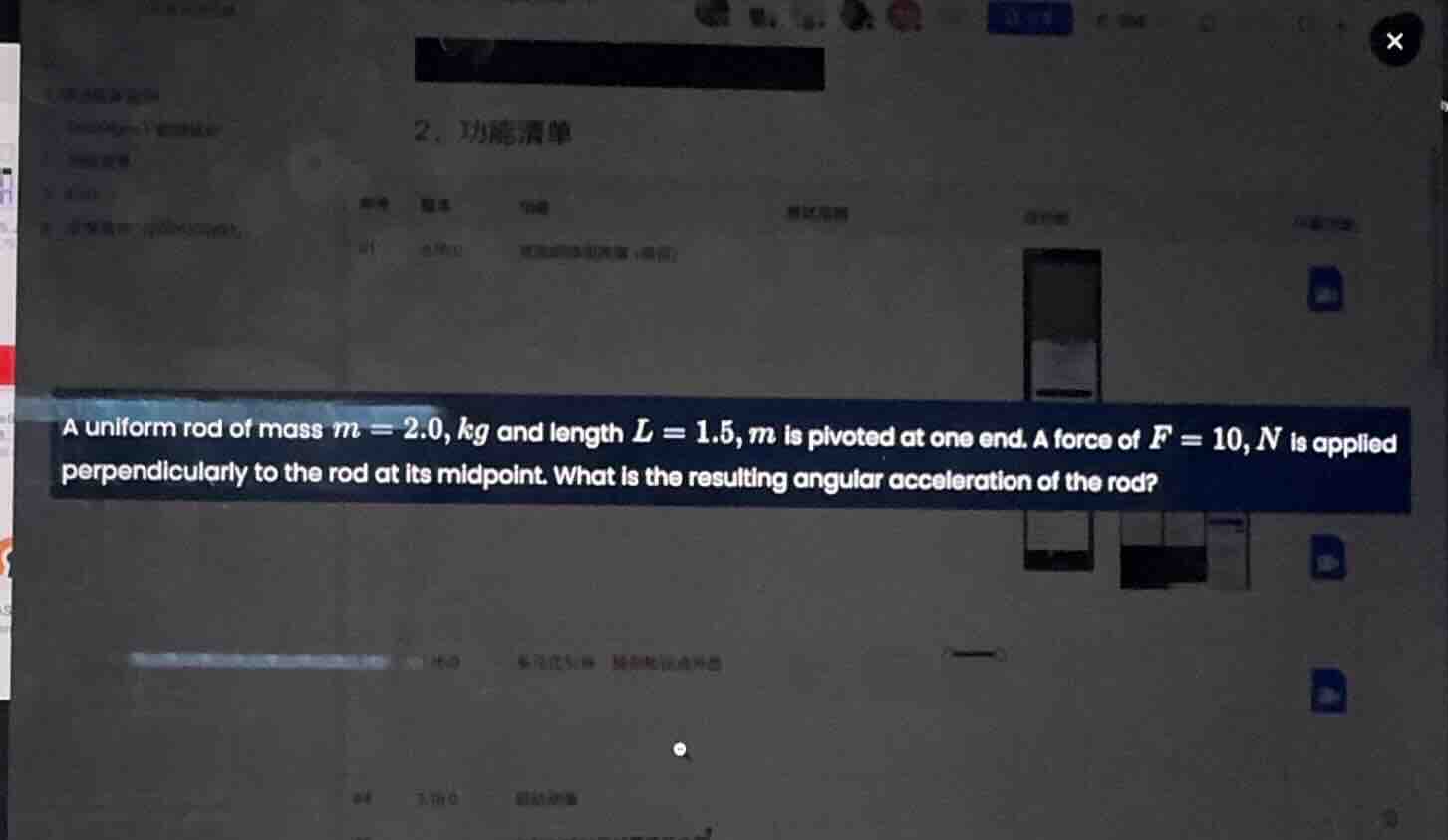
a uniform rod of mass $m = 2.0, kg$ and length $l = 1.5, m$ is pivoted at one end. a force of $f = 10, n$ is applied perpendicularly to the rod at its midpoint. what is the resulting angular acceleration of the rod?
Step1: Recall Torque and Moment of Inertia Formulas
Torque \(\tau = rF\sin\theta\), here \(\theta = 90^\circ\), so \(\sin\theta = 1\), and \(r=\frac{L}{2}\) (mid - point). Moment of inertia of a rod pivoted at one end is \(I=\frac{1}{3}mL^{2}\). Also, \(\tau = I\alpha\), so \(\alpha=\frac{\tau}{I}\).
Step2: Calculate Torque
\(r = \frac{L}{2}=\frac{1.5}{2}=0.75\space m\), \(F = 10\space N\). Then \(\tau=rF=(0.75)(10)=7.5\space N\cdot m\).
Step3: Calculate Moment of Inertia
\(m = 2.0\space kg\), \(L = 1.5\space m\). \(I=\frac{1}{3}mL^{2}=\frac{1}{3}\times2.0\times(1.5)^{2}=\frac{1}{3}\times2.0\times2.25 = 1.5\space kg\cdot m^{2}\).
Step4: Calculate Angular Acceleration
Using \(\alpha=\frac{\tau}{I}\), substitute \(\tau = 7.5\space N\cdot m\) and \(I = 1.5\space kg\cdot m^{2}\). \(\alpha=\frac{7.5}{1.5}=5\space rad/s^{2}\).

Snap & solve any problem in the app
Get step-by-step solutions on Sovi AI
Photo-based solutions with guided steps
Explore more problems and detailed explanations
The angular acceleration of the rod is \(5\space rad/s^{2}\)