QUESTION IMAGE
Question
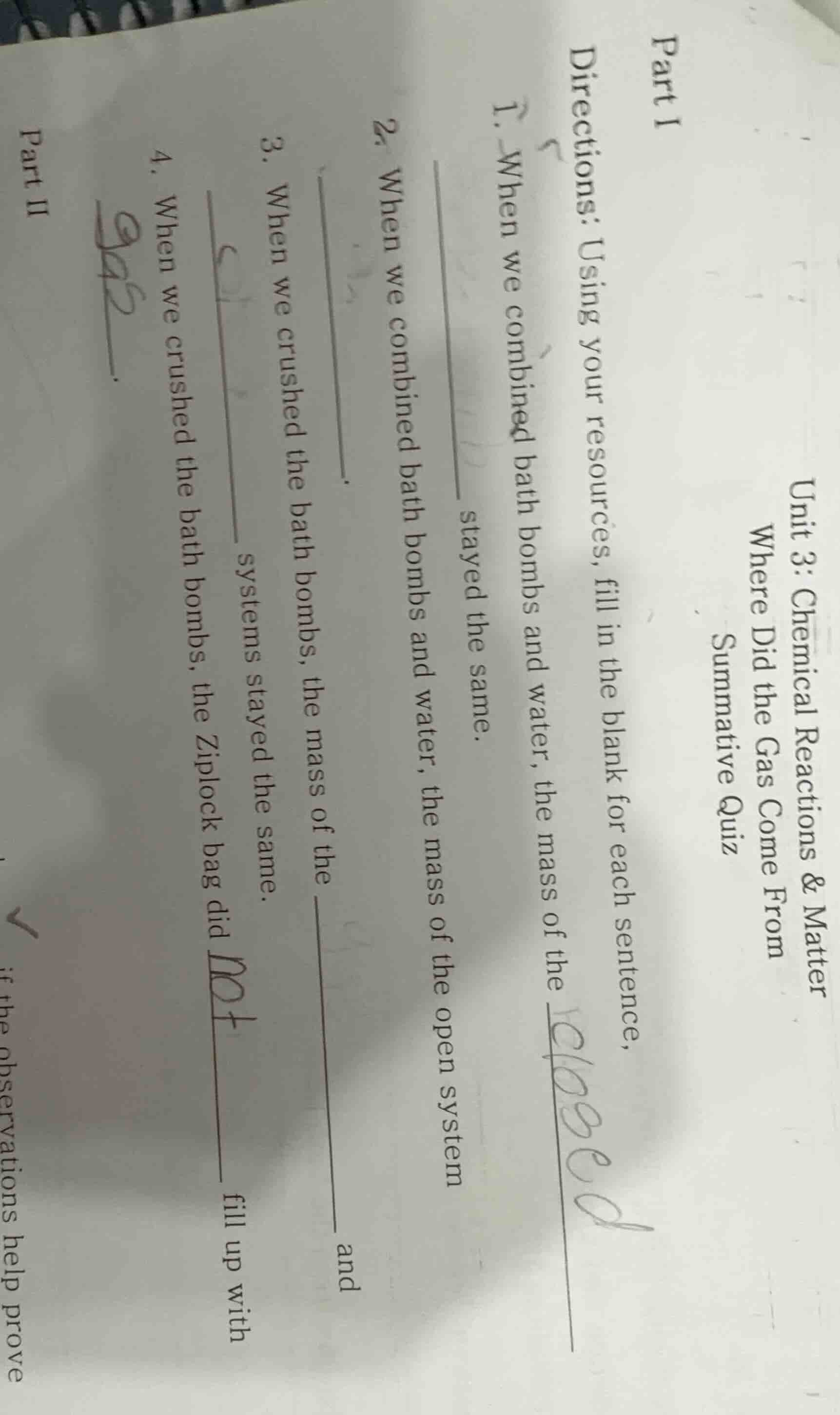
unit 3: chemical reactions & matter
where did the gas come from
summative quiz
part i
directions: using your resources, fill in the blank for each sentence,
- when we combined bath bombs and water, the mass of the
stayed the same.
- when we combined bath bombs and water, the mass of the open system
.
- when we crushed the bath bombs, the mass of the
and
systems stayed the same.
- when we crushed the bath bombs, the ziplock bag did
fill up with
.
part ii
if the observations help prove
To solve these fill - in - the - blank questions, we rely on the principles of chemical reactions and the law of conservation of mass, as well as the concepts of open and closed systems.
Question 1
In a closed system, the law of conservation of mass states that mass is neither created nor destroyed. So when we combine bath bombs and water in a closed system, the mass of the system stayed the same.
So the answer for the blank is "closed".
Question 2
In an open system, matter can be exchanged with the surroundings. When we combine bath bombs and water in an open system, the mass of the system changed (usually decreased as gas is released).
So the answer for the blank is "changed".
Question 3
When we crush bath bombs, we are only changing the physical state (breaking into smaller pieces) of the bath bombs. According to the law of conservation of mass, the mass of the bath bombs (the substance) and the system (if we consider the crushed bath bombs as a system) stayed the same.
So the answer for the blank is "bath bombs (or the substance)".
Question 4
When we crush the bath bombs, if the system is a Ziplock bag (a closed system for the solid bath bomb pieces), the Ziplock bag did not fill up with anything new in terms of mass addition (since we just crushed it, no new matter is added or removed from the bag's internal system of the bath bomb pieces). But if we consider the gas released when it reacts with water (but in the crushing step, it's just physical change), the Ziplock bag (if we later add water and it's a closed system for the reaction) would fill up with gas when the chemical reaction occurs. But for the crushing step alone, the Ziplock bag did not fill up with anything (in terms of new matter from outside) just due to crushing. However, if we consider the reaction after crushing (when water is added), the Ziplock bag (if sealed) would fill up with gas. But based on the context of crushing (physical change), the Ziplock bag did not fill up with anything new from outside. But if we consider the reaction, the answer would be "gas". Given the context of the quiz about chemical reactions and matter, the most appropriate answer here (considering the reaction after crushing) is that the Ziplock bag filled up with "gas". But for the crushing step, the answer is that the Ziplock bag did not fill up with anything new from outside. However, based on the flow of the questions (relating to chemical reactions), the intended answer is likely "gas" (when the crushed bath bombs react with water in the bag).
Final Answers
- closed
- changed
- bath bombs (or the substance)
- gas (or did not fill up with anything new from outside depending on interpretation, but gas is more in line with chemical reaction context)

Snap & solve any problem in the app
Get step-by-step solutions on Sovi AI
Photo-based solutions with guided steps
Explore more problems and detailed explanations
To solve these fill - in - the - blank questions, we rely on the principles of chemical reactions and the law of conservation of mass, as well as the concepts of open and closed systems.
Question 1
In a closed system, the law of conservation of mass states that mass is neither created nor destroyed. So when we combine bath bombs and water in a closed system, the mass of the system stayed the same.
So the answer for the blank is "closed".
Question 2
In an open system, matter can be exchanged with the surroundings. When we combine bath bombs and water in an open system, the mass of the system changed (usually decreased as gas is released).
So the answer for the blank is "changed".
Question 3
When we crush bath bombs, we are only changing the physical state (breaking into smaller pieces) of the bath bombs. According to the law of conservation of mass, the mass of the bath bombs (the substance) and the system (if we consider the crushed bath bombs as a system) stayed the same.
So the answer for the blank is "bath bombs (or the substance)".
Question 4
When we crush the bath bombs, if the system is a Ziplock bag (a closed system for the solid bath bomb pieces), the Ziplock bag did not fill up with anything new in terms of mass addition (since we just crushed it, no new matter is added or removed from the bag's internal system of the bath bomb pieces). But if we consider the gas released when it reacts with water (but in the crushing step, it's just physical change), the Ziplock bag (if we later add water and it's a closed system for the reaction) would fill up with gas when the chemical reaction occurs. But for the crushing step alone, the Ziplock bag did not fill up with anything (in terms of new matter from outside) just due to crushing. However, if we consider the reaction after crushing (when water is added), the Ziplock bag (if sealed) would fill up with gas. But based on the context of crushing (physical change), the Ziplock bag did not fill up with anything new from outside. But if we consider the reaction, the answer would be "gas". Given the context of the quiz about chemical reactions and matter, the most appropriate answer here (considering the reaction after crushing) is that the Ziplock bag filled up with "gas". But for the crushing step, the answer is that the Ziplock bag did not fill up with anything new from outside. However, based on the flow of the questions (relating to chemical reactions), the intended answer is likely "gas" (when the crushed bath bombs react with water in the bag).
Final Answers
- closed
- changed
- bath bombs (or the substance)
- gas (or did not fill up with anything new from outside depending on interpretation, but gas is more in line with chemical reaction context)