QUESTION IMAGE
Question
unit: exponential and logarithmic functions
progress:
the movement of the progress bar may be uneven because questions can be worth more or less (including zero) depending on your answer.
question id: 140490
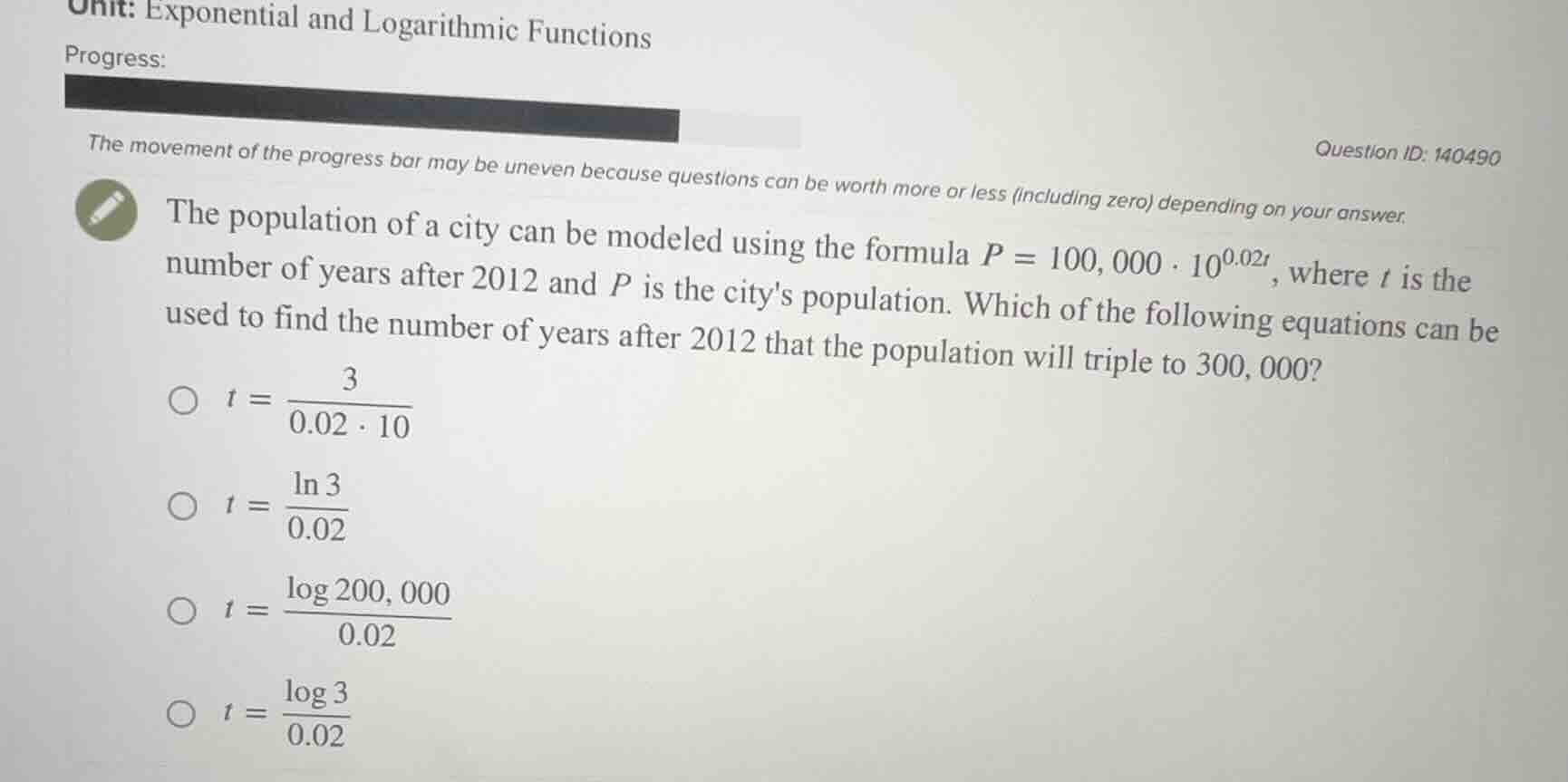
the population of a city can be modeled using the formula $p = 100,000 \cdot 10^{0.02t}$, where $t$ is the number of years after 2012 and $p$ is the citys population. which of the following equations can be used to find the number of years after 2012 that the population will triple to 300,000?
\\( \bigcirc \\ t = \dfrac{3}{0.02 \cdot 10} \\)
\\( \bigcirc \\ t = \dfrac{\ln 3}{0.02} \\)
\\( \bigcirc \\ t = \dfrac{\log 200,000}{0.02} \\)
\\( \bigcirc \\ t = \dfrac{\log 3}{0.02} \\)
Step1: Set up the equation
We know the population formula is \( P = 100,000\cdot10^{0.02t} \), and we want to find \( t \) when \( P = 300,000 \). So substitute \( P = 300,000 \) into the formula:
\( 300,000 = 100,000\cdot10^{0.02t} \)
Step2: Simplify the equation
Divide both sides by \( 100,000 \):
\( \frac{300,000}{100,000}=10^{0.02t} \)
\( 3 = 10^{0.02t} \)
Step3: Take logarithm on both sides
Since the base of the exponential is 10, we can take the common logarithm (log base 10) on both sides. Recall that \( \log(a^b)=b\log(a) \), so:
\( \log(3)=\log(10^{0.02t}) \)
\( \log(3)=0.02t\cdot\log(10) \)
Step4: Solve for \( t \)
We know that \( \log(10) = 1 \), so the equation becomes:
\( \log(3)=0.02t \)
Then, divide both sides by \( 0.02 \) to solve for \( t \):
\( t=\frac{\log(3)}{0.02} \)

Snap & solve any problem in the app
Get step-by-step solutions on Sovi AI
Photo-based solutions with guided steps
Explore more problems and detailed explanations
\( t = \dfrac{\log 3}{0.02} \) (the fourth option: \( t = \dfrac{\log 3}{0.02} \))