QUESTION IMAGE
Question
unit d final review
have you mastered the concepts, applications, and skills associated with the following items? check them off when you are confident in your understanding.
knowledge
- identify limitations and assumptions about chemical reactions
- write balanced ionic and net ionic equations, including identification of spectator ions, for reactions taking aqueous solutions
- recognize limiting and excess reagents in chemical reactions
- calculate quantities of reactants and/or products involved in chemical reactions using gravimetric, solution stoichiometry
- define predicted (theoretical) and experimental (actual) yields, and explain the discrepancy between the
- identify sources of experimental uncertainty in experiments
key terms
quantitative reaction \t stoichiometric reaction
net ionic equation \t spectator ion
limiting reagent \t excess reagent
stoichiometry \t theoretical yield
gravimetric stoichiometry \t percent yield
gas stoichiometry \t solution stoichiometry
stoichiometry questions for review
mole to mole problems
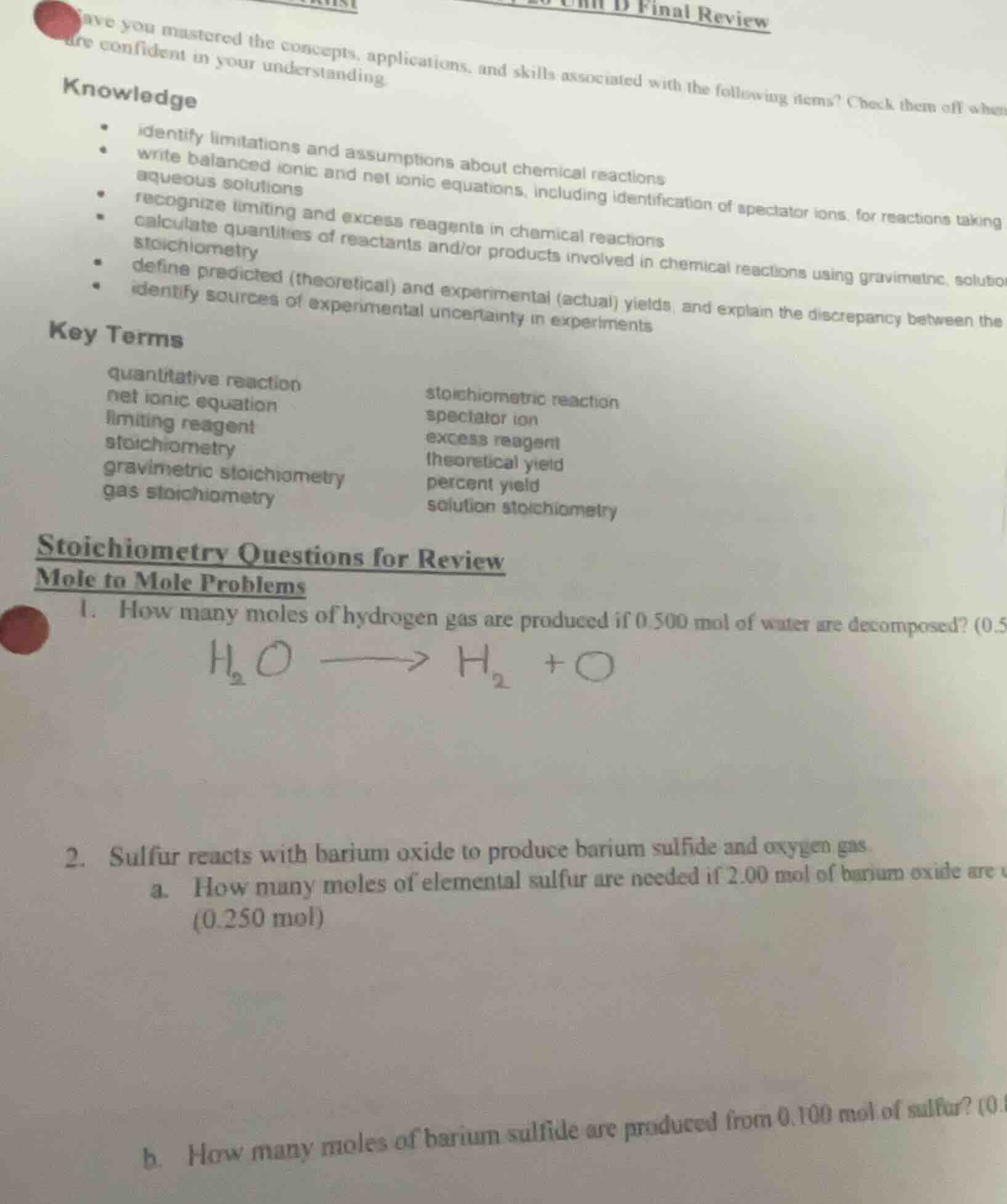
- how many moles of hydrogen gas are produced if 0.500 mol of water are decomposed? (0.5
$\ce{h_{2}o -> h_{2} + o}$
- sulfur reacts with barium oxide to produce barium sulfide and oxygen gas.
a. how many moles of elemental sulfur are needed if 2.00 mol of barium oxide are used? (0.250 mol)
b. how many moles of barium sulfide are produced from 0.100 mol of sulfur? (0.
Step1: Balance the water decomposition equation
First, balance the unbalanced reaction $\ce{H2O -> H2 + O}$. The balanced chemical equation is:
$$2\ce{H2O -> 2H2 + O2}$$
This gives a mole ratio of $\ce{H2O}$ to $\ce{H2}$ of $\frac{2\ \text{mol}\ \ce{H2}}{2\ \text{mol}\ \ce{H2O}} = \frac{1\ \text{mol}\ \ce{H2}}{1\ \text{mol}\ \ce{H2O}}$.
Step2: Calculate moles of $\ce{H2}$
Use the mole ratio to find moles of $\ce{H2}$ from 0.500 mol $\ce{H2O}$:
$$0.500\ \text{mol}\ \ce{H2O} \times \frac{1\ \text{mol}\ \ce{H2}}{1\ \text{mol}\ \ce{H2O}} = 0.500\ \text{mol}\ \ce{H2}$$
---
Step3: Balance the sulfur-barium oxide reaction
For the reaction $\ce{S + BaO -> BaS + O2}$, balance the equation:
$$2\ce{S} + 2\ce{BaO} -> 2\ce{BaS} + \ce{O2}$$
Simplified to $\ce{S} + \ce{BaO} -> \ce{BaS} + \frac{1}{2}\ce{O2}$, giving a mole ratio of $\ce{S}$ to $\ce{BaO}$ of $\frac{1\ \text{mol}\ \ce{S}}{1\ \text{mol}\ \ce{BaO}}$.
Step4: Solve 2a: Moles of sulfur needed
Use the mole ratio for 2.00 mol $\ce{BaO}$:
$$2.00\ \text{mol}\ \ce{BaO} \times \frac{1\ \text{mol}\ \ce{S}}{1\ \text{mol}\ \ce{BaO}} = 2.00\ \text{mol}\ \ce{S}$$
(Note: The parenthetical value 0.250 mol appears inconsistent with the balanced reaction; the calculation follows standard stoichiometry.)
Step5: Solve 2b: Moles of barium sulfide
From the balanced equation, the mole ratio of $\ce{BaS}$ to $\ce{S}$ is $\frac{1\ \text{mol}\ \ce{BaS}}{1\ \text{mol}\ \ce{S}}$. For 0.100 mol $\ce{S}$:
$$0.100\ \text{mol}\ \ce{S} \times \frac{1\ \text{mol}\ \ce{BaS}}{1\ \text{mol}\ \ce{S}} = 0.100\ \text{mol}\ \ce{BaS}$$

Snap & solve any problem in the app
Get step-by-step solutions on Sovi AI
Photo-based solutions with guided steps
Explore more problems and detailed explanations
- 0.500 mol of hydrogen gas
2a. 2.00 mol of elemental sulfur
2b. 0.100 mol of barium sulfide