QUESTION IMAGE
Question
unit 2 learning checkpoint 1
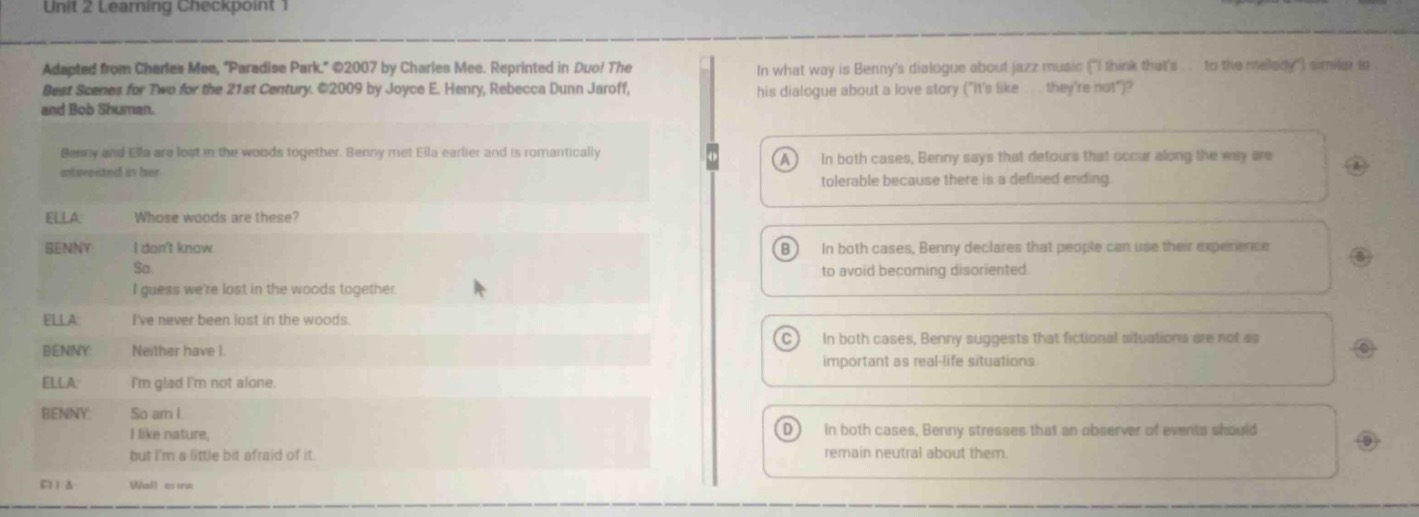
adapted from charles mee, “paradise park.” ©2007 by charles mee. reprinted in duet the best scenes for two for the 21st century. ©2009 by joyce e. henry, rebecca dunn jaroff, and bob shuman.
benny and ella are lost in the woods together. benny met ella earlier and is romantically interested in her
ella: whose woods are these?
benny: i dont know.
so
i guess were lost in the woods together.
ella: ive never been lost in the woods.
benny: neither have i.
ella: im glad im not alone.
benny: so am i.
i like nature,
but im a little bit afraid of it.
in what way is benny’s dialogue about jazz music (“i think that’s... to the melody”) similar to his dialogue about a love story (“it’s like... they’re not”)?
a in both cases, benny says that detours that occur along the way are tolerable because there is a defined ending
b in both cases, benny declares that people can use their experience to avoid becoming disoriented.
c in both cases, benny suggests that fictional situations are not as important as real - life situations
d in both cases, benny stresses that an observer of events should remain neutral about them.
To solve this, we analyze each option:
- Option A: For jazz, detours (like improvisations) are tolerable as there's a melody (defined ending); for the love story, detours (complications) are tolerable as there's an intended end (they're not not in love, so a defined romantic end). This matches the similarity.
- Option B: The dialogues don't focus on using experience to avoid disorientation.
- Option C: There's no comparison between fictional and real - life situations.
- Option D: Benny isn't talking about observers remaining neutral.

Snap & solve any problem in the app
Get step-by-step solutions on Sovi AI
Photo-based solutions with guided steps
Explore more problems and detailed explanations
A. In both cases, Benny says that detours that occur along the way are tolerable because there is a defined ending