QUESTION IMAGE
Question
unit 3 lesson 6 cumulative practice problems
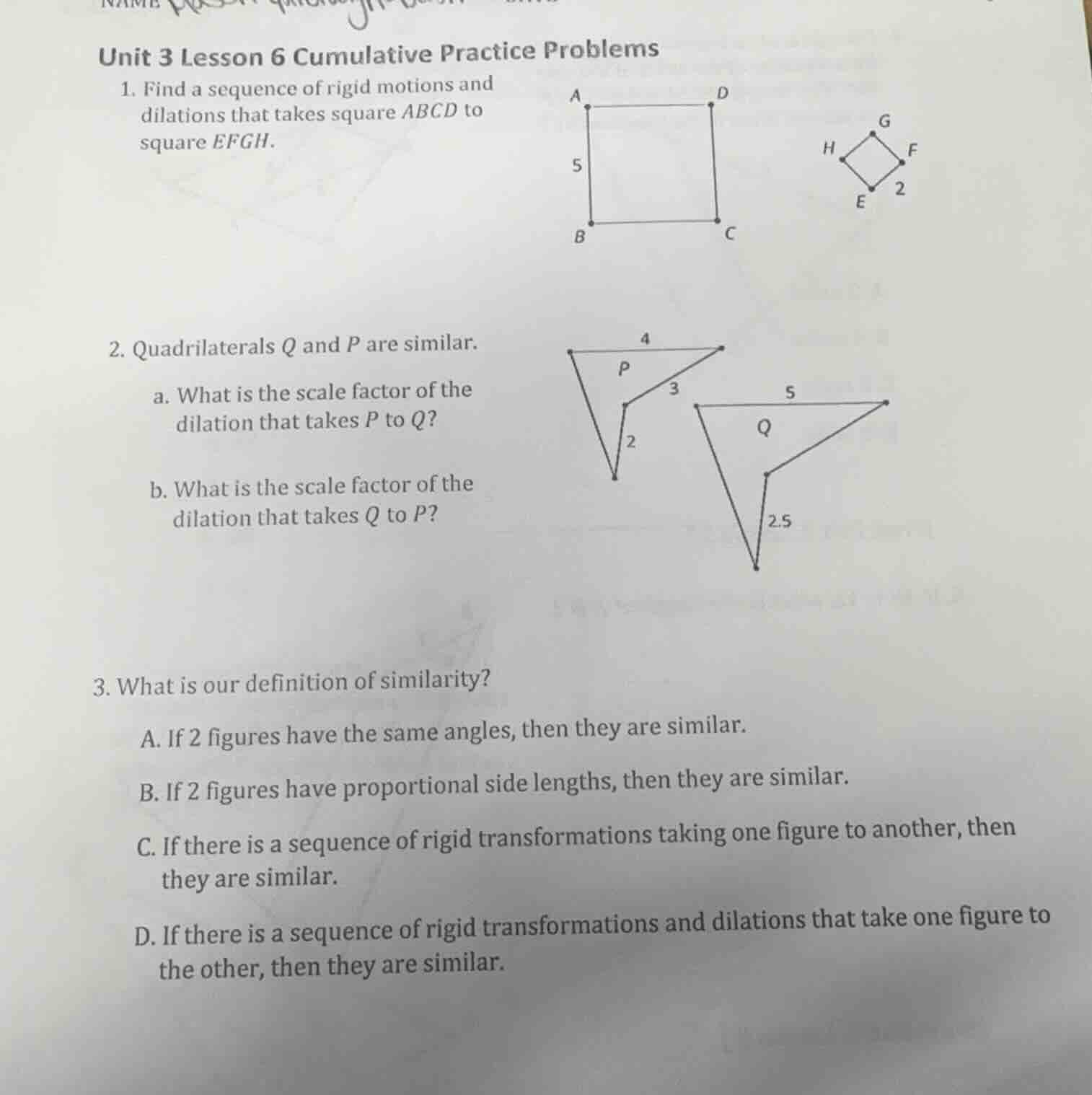
- find a sequence of rigid motions and dilations that takes square abcd to square efgh.
- quadrilaterals q and p are similar.
a. what is the scale factor of the dilation that takes p to q?
b. what is the scale factor of the dilation that takes q to p?
- what is our definition of similarity?
a. if 2 figures have the same angles, then they are similar.
b. if 2 figures have proportional side lengths, then they are similar.
c. if there is a sequence of rigid transformations taking one figure to another, then they are similar.
d. if there is a sequence of rigid transformations and dilations that take one figure to the other, then they are similar.
Question 1
Step1: Identify the side lengths
Square \(ABCD\) has side length \(5\), square \(EFGH\) has side length \(2\). First, we can perform a dilation with center at a suitable point (e.g., the origin or a vertex) with scale factor \(k=\frac{2}{5}\) to square \(ABCD\) to get a square with side length \(2\).
Step2: Perform rigid motions
After dilation, we can perform translations, rotations, or reflections (rigid motions) to map the dilated square to square \(EFGH\). For example, translate the dilated square so that corresponding vertices align, and rotate if necessary to match the orientation of \(EFGH\).
Step1: Identify corresponding sides
For quadrilaterals \(P\) and \(Q\), corresponding sides: in \(P\) side length \(4\) (top), \(3\) (right), \(2\) (left); in \(Q\) side length \(5\) (top), \(2.5\) (left). Let's take the top sides: \(P\) has length \(4\), \(Q\) has length \(5\). Or left sides: \(P\) has \(2\), \(Q\) has \(2.5\).
Step2: Calculate scale factor
Scale factor \(k=\frac{\text{length in } Q}{\text{length in } P}\). Using left sides: \(k = \frac{2.5}{2}=\frac{5}{4}=1.25\).
Step1: Identify corresponding sides
Now, from \(Q\) to \(P\), we use the reciprocal of the scale factor from \(P\) to \(Q\).
Step2: Calculate scale factor
Scale factor \(k=\frac{\text{length in } P}{\text{length in } Q}\). Using left sides: \(k=\frac{2}{2.5}=\frac{4}{5}=0.8\).

Snap & solve any problem in the app
Get step-by-step solutions on Sovi AI
Photo-based solutions with guided steps
Explore more problems and detailed explanations
A dilation with scale factor \(\frac{2}{5}\) (centered at a vertex or origin) followed by rigid motions (translation, rotation, reflection) to map the dilated square to \(EFGH\).