QUESTION IMAGE
Question
from unit 6, lesson 1
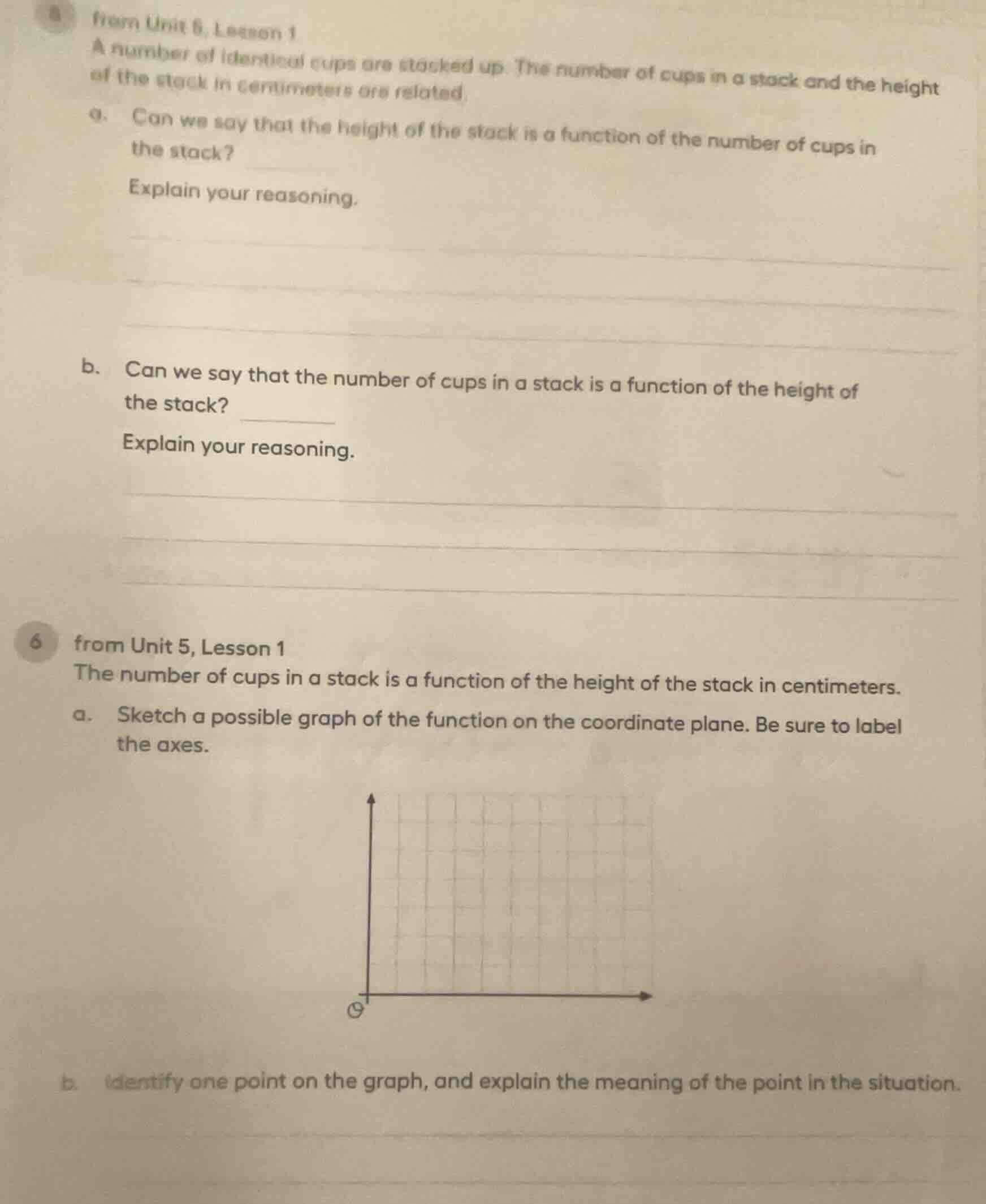
a number of identical cups are stacked up. the number of cups in a stack and the height of the stack in centimeters are related.
a. can we say that the height of the stack is a function of the number of cups in the stack?
explain your reasoning.
b. can we say that the number of cups in a stack is a function of the height of the stack?
explain your reasoning.
from unit 5, lesson 1
the number of cups in a stack is a function of the height of the stack in centimeters.
a. sketch a possible graph of the function on the coordinate plane. be sure to label the axes.
b. identify one point on the graph, and explain the meaning of the point in the situation.
Part 4 (a)
To determine if height is a function of the number of cups, we use the definition of a function: for each input (number of cups), there is exactly one output (height). Since the cups are identical, each number of cups will correspond to a unique height (as stacking more cups adds a consistent amount to the height). So, for any number of cups, there's one height.
To check if the number of cups is a function of height, we use the function definition: each height (input) must have exactly one number of cups (output). Since identical cups are stacked, a specific height will correspond to a unique number of cups (as each cup adds a fixed height increment). So, for any height, there's one number of cups.
The function relates the number of cups (let's say \( n \)) to the height (\( h \)) of the stack. Let's assume each cup has a base height \( b \) and a rim height \( r \) (the extra height when stacking, but for simplicity, if we consider the height increases linearly with the number of cups, the graph will be a line. Let's define the x - axis as "height of stack (cm)" and the y - axis as "number of cups". When there are 0 cups, height is 0. For 1 cup, height is, say, \( h_1 \), for 2 cups, \( h_2=h_1 + \Delta h \) (where \( \Delta h \) is the height added by each additional cup). So the graph is a linear graph starting at the origin (0,0) and increasing with a positive slope. We label the x - axis "Height of Stack (cm)" and y - axis "Number of Cups".

Snap & solve any problem in the app
Get step-by-step solutions on Sovi AI
Photo-based solutions with guided steps
Explore more problems and detailed explanations
Yes. For each number of cups (input), there is exactly one height (output) because identical cups stacked will have a unique height for a given number of cups.