QUESTION IMAGE
Question
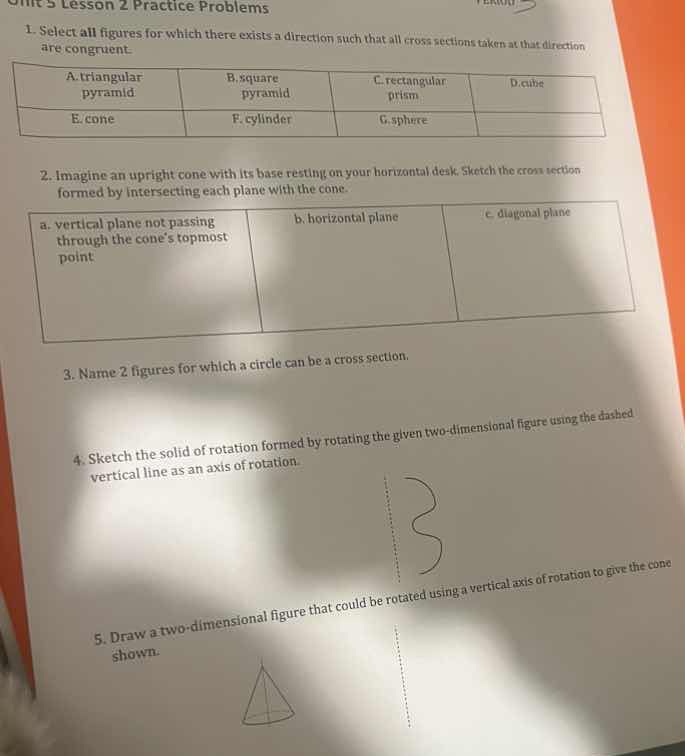
unit 5 lesson 2 practice problems
- select all figures for which there exists a direction such that all cross sections taken at that direction
are congruent.
a. triangular pyramid
b. square pyramid
c. rectangular prism
d. cube
e. cone
f. cylinder
g. sphere
- imagine an upright cone with its base resting on your horizontal desk. sketch the cross section
formed by intersecting each plane with the cone.
a. vertical plane not passing through the cone’s topmost point
b. horizontal plane
c. diagonal plane
- name 2 figures for which a circle can be a cross section.
- sketch the solid of rotation formed by rotating the given two - dimensional figure using the dashed
vertical line as an axis of rotation.
- draw a two - dimensional figure that could be rotated using a vertical axis of rotation to give the cone
shown.
Step1: Analyze congruent cross-sections
For each shape, check if a direction exists where all cross-sections are congruent:
- A. Triangular pyramid: No such direction.
- B. Square pyramid: No such direction.
- C. Rectangular prism: Cross-sections perpendicular to length/width/height are congruent rectangles.
- D. Cube: All cross-sections perpendicular to any edge are congruent squares.
- E. Cone: Only cross-sections parallel to the base are congruent circles.
- F. Cylinder: Cross-sections parallel to the base are congruent circles; cross-sections perpendicular to the axis are congruent rectangles.
- G. Sphere: All cross-sections (any direction) are congruent circles.
Step2: Solve cross-section sketches for cone
- a. Vertical plane not passing through apex: Forms an ellipse (or hyperbola segment, but for upright cone, non-apex vertical cut is an ellipse-like curved quadrilateral, specifically a parabola segment if the plane is parallel to the side, but general non-parallel, non-apex vertical cut is an ellipse).
- b. Horizontal plane: Forms a circle (congruent to other horizontal cross-sections, smaller as you move up).
- c. Diagonal plane: Forms an ellipse (or a hyperbola if the plane is steeper than the cone's side, but general diagonal cut is an ellipse).
Step3: Name shapes with circular cross-sections
Identify 3D shapes that can be cut to make a circle:
- Cylinder (cuts parallel to base)
- Sphere (any cut)
- Cone (cuts parallel to base)
Step4: Sketch solid of rotation
The curved figure "S" rotated around a vertical dashed axis forms a solid where each point on the curve traces a circle around the axis, creating a symmetric, hourglass-like 3D shape with rounded, connected lobes.
Step5: Identify 2D shape for cone rotation
A right triangle, where one leg is the vertical axis of rotation, and the other leg is the radius of the cone's base, rotating this triangle 360° around the vertical leg forms a cone.

Snap & solve any problem in the app
Get step-by-step solutions on Sovi AI
Photo-based solutions with guided steps
Explore more problems and detailed explanations
- C. rectangular prism, D. cube, E. cone, F. cylinder, G. sphere
2.
a. Sketch: A curved, elongated oval (parabola/ellipse segment) that tapers toward the base of the cone, not reaching the apex.
b. Sketch: A circle centered on the cone's vertical axis, smaller than the base if cut above the base.
c. Sketch: An ellipse (tilted oval) that intersects the cone's side and base.
- Example answers: Cylinder, Sphere (or Cone)
- Sketch: A 3D shape symmetric around the vertical axis, with two rounded, bulbous sections connected by a narrower middle, matching the rotation of the "S" curve.
- Sketch: A right triangle, with one vertical leg (the axis of rotation) and one horizontal leg (the radius of the cone's base), and the hypotenuse sloping from the top of the vertical leg to the end of the horizontal leg.