QUESTION IMAGE
Question
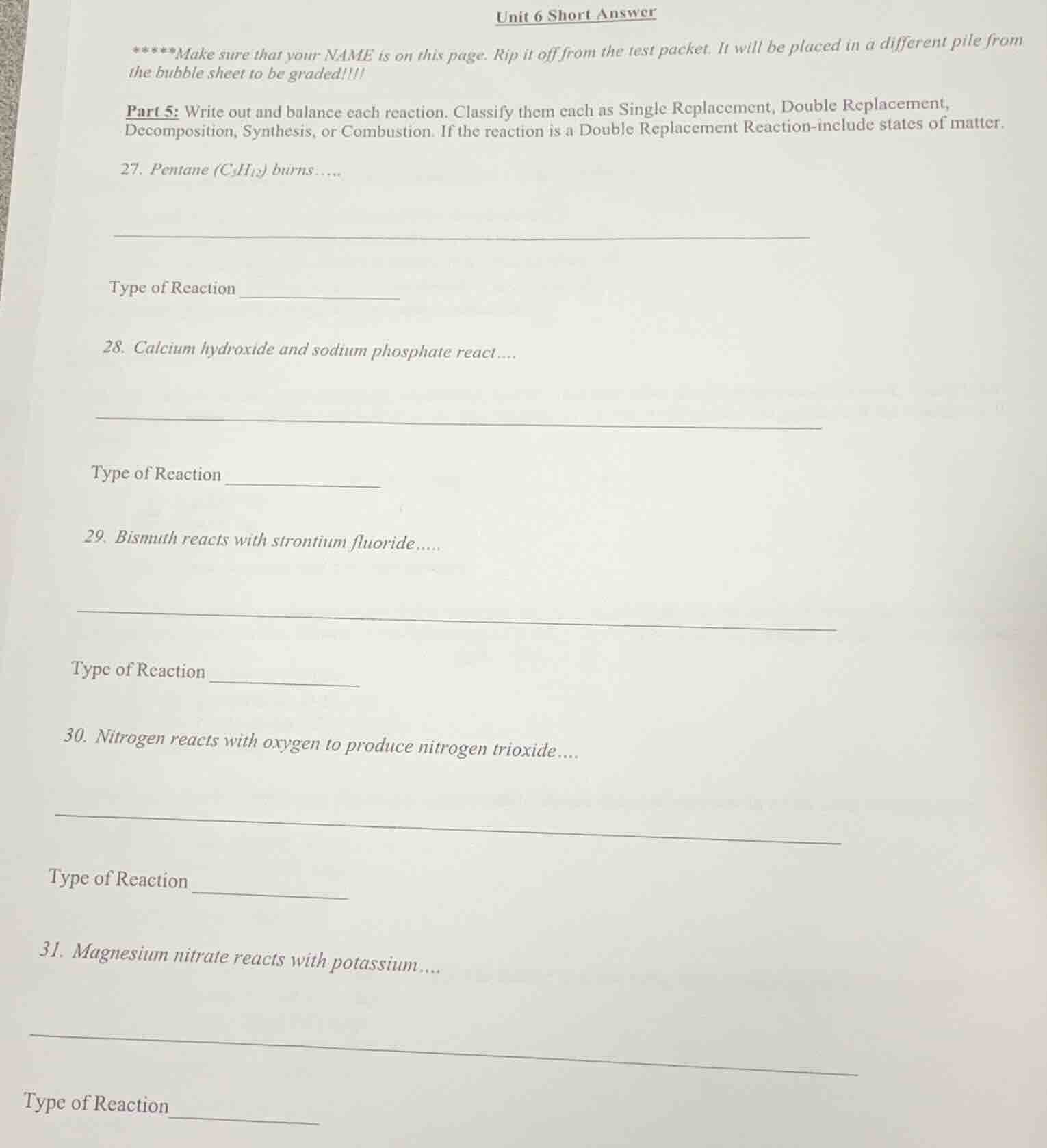
unit 6 short answer
****make sure that your name is on this page. rip it off from the test packet. it will be placed in a different pile from the bubble sheet to be graded!!!
part 5: write out and balance each reaction. classify them each as single replacement, double replacement, decomposition, synthesis, or combustion. if the reaction is a double replacement reaction - include states of matter.
- pentane (c₅h₁₂) burns.....
_________________________
type of reaction ____________
- calcium hydroxide and sodium phosphate react....
_________________________
type of reaction ____________
- bismuth reacts with strontium fluoride.....
_________________________
type of reaction ____________
- nitrogen reacts with oxygen to produce nitrogen trioxide....
_________________________
type of reaction ____________
- magnesium nitrate reacts with potassium....
_________________________
type of reaction ____________
Question 27: Pentane ($\boldsymbol{C_5H_{12}}$) burns....
Step 1: Write the unbalanced reaction
Combustion of hydrocarbons (like pentane) in oxygen produces carbon dioxide and water. So the unbalanced reaction is:
$C_5H_{12} + O_2
ightarrow CO_2 + H_2O$
Step 2: Balance the carbon atoms
There are 5 C in $C_5H_{12}$, so we put a coefficient of 5 in front of $CO_2$:
$C_5H_{12} + O_2
ightarrow 5CO_2 + H_2O$
Step 3: Balance the hydrogen atoms
There are 12 H in $C_5H_{12}$, so we put a coefficient of 6 in front of $H_2O$ (since $2 \times 6 = 12$):
$C_5H_{12} + O_2
ightarrow 5CO_2 + 6H_2O$
Step 4: Balance the oxygen atoms
On the right, we have $5 \times 2 + 6 \times 1 = 10 + 6 = 16$ O atoms. So we put a coefficient of 8 in front of $O_2$ (since $2 \times 8 = 16$):
$C_5H_{12}(l) + 8O_2(g)
ightarrow 5CO_2(g) + 6H_2O(g)$
Step 5: Classify the reaction
Combustion reactions involve a substance reacting with oxygen to produce oxides (and energy). So this is a Combustion reaction.
Step 1: Write the unbalanced reaction (Double Replacement)
Calcium hydroxide: $Ca(OH)_2$; Sodium phosphate: $Na_3PO_4$. Products are calcium phosphate ($Ca_3(PO_4)_2$) and sodium hydroxide ($NaOH$).
Unbalanced: $Ca(OH)_2 + Na_3PO_4
ightarrow Ca_3(PO_4)_2 + NaOH$
Step 2: Balance calcium atoms
There are 3 Ca in $Ca_3(PO_4)_2$, so put 3 in front of $Ca(OH)_2$:
$3Ca(OH)_2 + Na_3PO_4
ightarrow Ca_3(PO_4)_2 + NaOH$
Step 3: Balance phosphate atoms
There are 2 $PO_4^{3-}$ in $Ca_3(PO_4)_2$, so put 2 in front of $Na_3PO_4$:
$3Ca(OH)_2 + 2Na_3PO_4
ightarrow Ca_3(PO_4)_2 + NaOH$
Step 4: Balance sodium atoms
There are $2 \times 3 = 6$ Na in $2Na_3PO_4$, so put 6 in front of $NaOH$:
$3Ca(OH)_2 + 2Na_3PO_4
ightarrow Ca_3(PO_4)_2 + 6NaOH$
Step 5: Check states of matter (Double Replacement)
$Ca(OH)_2$ (aq/s), $Na_3PO_4$ (aq), $Ca_3(PO_4)_2$ (s, insoluble), $NaOH$ (aq). So:
$3Ca(OH)_2(aq) + 2Na_3PO_4(aq)
ightarrow Ca_3(PO_4)_2(s) + 6NaOH(aq)$
Step 6: Classify the reaction
Double Replacement (ions swap: $Ca^{2+}$ with $PO_4^{3-}$, $Na^+$ with $OH^-$).
Step 1: Write the unbalanced reaction (Single Replacement)
Bismuth (Bi) is a metal, strontium fluoride ($SrF_2$) has $Sr^{2+}$ and $F^-$. For Single Replacement, Bi must be more reactive than Sr to displace it. But Bi is less reactive than Sr (Sr is in Group 2, more reactive than Bi in Group 15). So no reaction occurs.
Step 2: Classify the reaction
Since Bi is less reactive than Sr, it cannot displace Sr from $SrF_2$. So no reaction. If we assume a reaction (for practice, but reactivity matters), the unbalanced would be $Bi + SrF_2
ightarrow BiF_3 + Sr$, but Bi is less reactive, so no reaction.

Snap & solve any problem in the app
Get step-by-step solutions on Sovi AI
Photo-based solutions with guided steps
Explore more problems and detailed explanations
Balanced Reaction: $\boldsymbol{C_5H_{12}(l) + 8O_2(g)
ightarrow 5CO_2(g) + 6H_2O(g)}$
Type of Reaction: Combustion