QUESTION IMAGE
Question
unit 6 stoichiometry
name:
show all work for credit including labeling the equation with the given and unknown. box your final
answer, including units. round answer to 2 places after the decimal.
1 mole = molar mass (calculate from the periodic table)
1 mole = 22.4 l
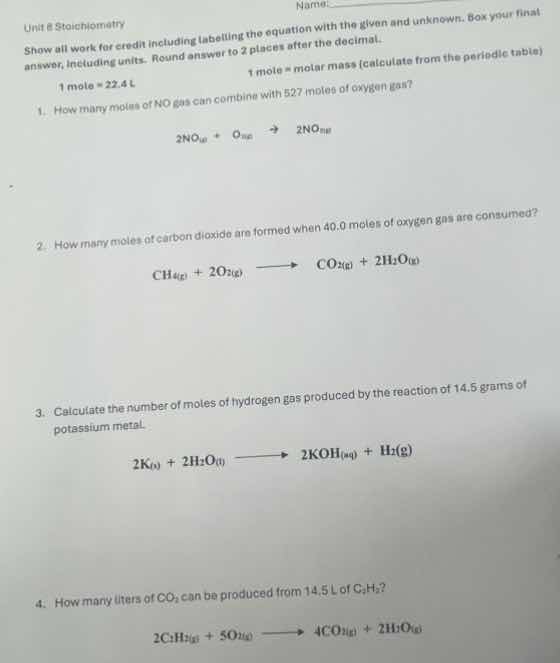
- how many moles of no gas can combine with 527 moles of oxygen gas?
\t\t\t\t\t2no$_{(g)}$ + o$_{2(g)}$ $
ightarrow$ 2no$_{2(g)}$
- how many moles of carbon dioxide are formed when 40.0 moles of oxygen gas are consumed?
\t\t\t\t\tch$_{4(g)}$ + 2o$_{2(g)}$ $longrightarrow$ co$_{2(g)}$ + 2h$_2$o$_{(g)}$
- calculate the number of moles of hydrogen gas produced by the reaction of 14.5 grams of
potassium metal.
\t\t\t\t\t2k$_{(s)}$ + 2h$_2$o$_{(l)}$ $longrightarrow$ 2koh$_{(aq)}$ + h$_2$(g)
- how many liters of co$_2$ can be produced from 14.5 l of c$_2$h$_2$?
\t\t\t\t\t2c$_2$h$_{2(g)}$ + 5o$_{2(g)}$ $longrightarrow$ 4co$_{2(g)}$ + 2h$_2$o$_{(g)}$
Step1: Molar ratio identification
From $2NO_{(g)} + O_{2(g)}
ightarrow 2NO_{2(g)}$, the mole ratio of $NO$ to $O_2$ is $\frac{2\ \text{mol }NO}{1\ \text{mol }O_2}$
Step2: Calculate moles of NO
$\text{Moles of }NO = 527\ \text{mol }O_2 \times \frac{2\ \text{mol }NO}{1\ \text{mol }O_2} = 1054.00\ \text{mol}$
---
Step1: Molar ratio identification
From $CH_{4(g)} + 2O_{2(g)}
ightarrow CO_{2(g)} + 2H_2O_{(g)}$, the mole ratio of $CO_2$ to $O_2$ is $\frac{1\ \text{mol }CO_2}{2\ \text{mol }O_2}$
Step2: Calculate moles of $CO_2$
$\text{Moles of }CO_2 = 40.0\ \text{mol }O_2 \times \frac{1\ \text{mol }CO_2}{2\ \text{mol }O_2} = 20.00\ \text{mol}$
---
Step1: Find molar mass of K
From periodic table, molar mass of K = $39.10\ \text{g/mol}$
Step2: Calculate moles of K
$\text{Moles of }K = \frac{14.5\ \text{g}}{39.10\ \text{g/mol}} \approx 0.3708\ \text{mol}$
Step3: Molar ratio identification
From $2K_{(s)} + 2H_2O_{(l)}
ightarrow 2KOH_{(aq)} + H_{2(g)}$, the mole ratio of $H_2$ to $K$ is $\frac{1\ \text{mol }H_2}{2\ \text{mol }K}$
Step4: Calculate moles of $H_2$
$\text{Moles of }H_2 = 0.3708\ \text{mol }K \times \frac{1\ \text{mol }H_2}{2\ \text{mol }K} \approx 0.19\ \text{mol}$
---
Step1: Molar ratio identification
From $2C_2H_{2(g)} + 5O_{2(g)}
ightarrow 4CO_{2(g)} + 2H_2O_{(g)}$, the volume ratio of $CO_2$ to $C_2H_2$ is $\frac{4\ \text{L }CO_2}{2\ \text{L }C_2H_2}$
Step2: Calculate volume of $CO_2$
$\text{Volume of }CO_2 = 14.5\ \text{L }C_2H_2 \times \frac{4\ \text{L }CO_2}{2\ \text{L }C_2H_2} = 29.00\ \text{L}$

Snap & solve any problem in the app
Get step-by-step solutions on Sovi AI
Photo-based solutions with guided steps
Explore more problems and detailed explanations
- $\boldsymbol{1054.00}$ moles of NO
- $\boldsymbol{20.00}$ moles of $CO_2$
- $\boldsymbol{0.19}$ moles of $H_2$
- $\boldsymbol{29.00}$ liters of $CO_2$