QUESTION IMAGE
Question
unit 1 – vocabulary matching
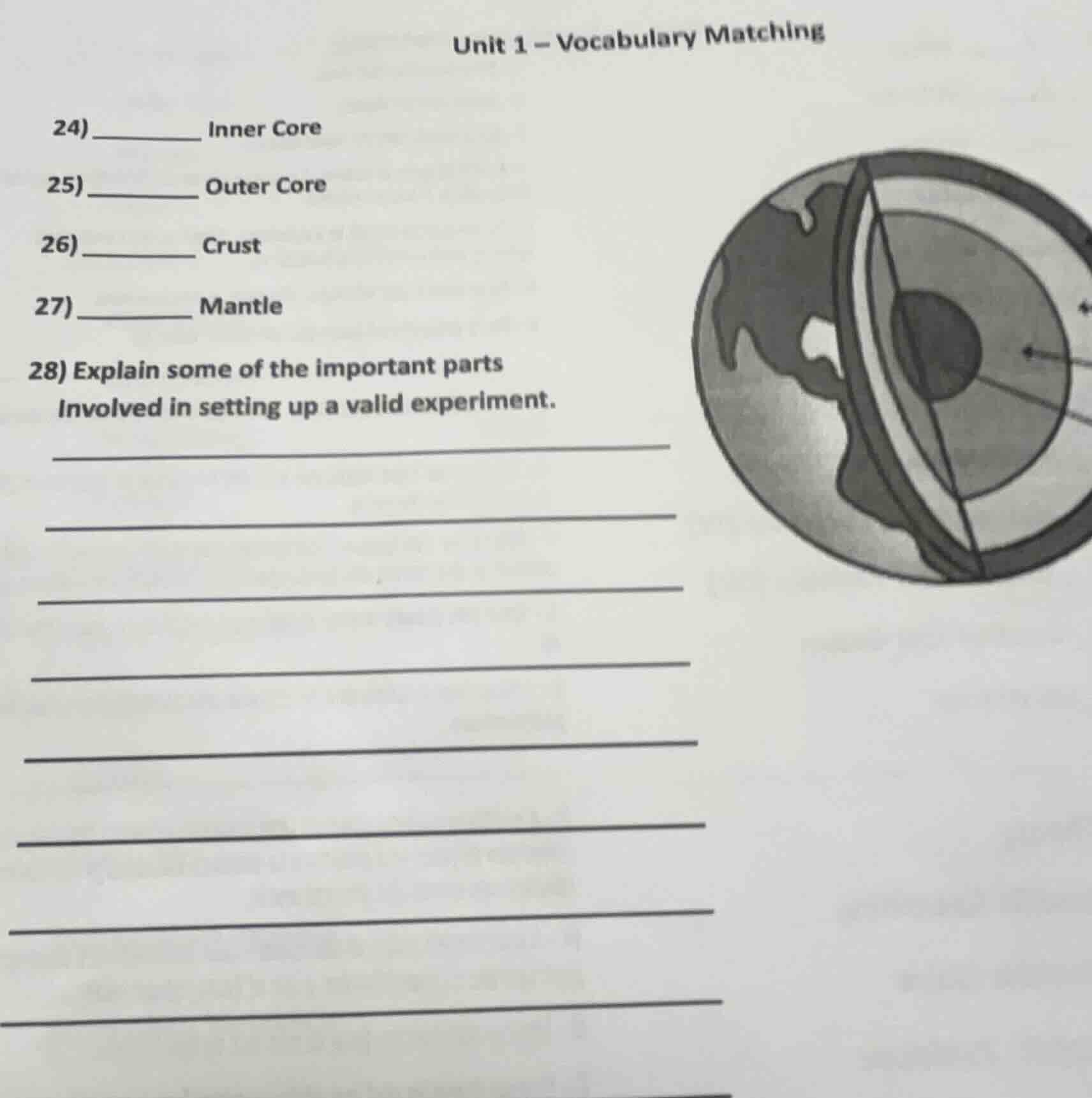
- _______ inner core
- _______ outer core
- _______ crust
- _______ mantle
- explain some of the important parts
involved in setting up a valid experiment.
_____________________________________
_____________________________________
_____________________________________
_____________________________________
_____________________________________
_____________________________________
_____________________________________
_____________________________________
For questions 24 - 27 (Vocabulary Matching, assuming typical Earth structure terms):
- Inner Core: The solid, innermost layer of the Earth, composed mainly of iron and nickel, with extremely high temperature and pressure.
- Outer Core: A liquid layer surrounding the inner core, also composed mainly of iron and nickel, responsible for generating the Earth's magnetic field.
- Crust: The outermost, thin, solid layer of the Earth, divided into continental (thicker, less dense) and oceanic (thinner, denser) crusts, where we live and most geological activities on the surface occur.
- Mantle: The layer between the crust and the core, the thickest layer of the Earth, composed of semi - molten rock (magma in some regions), and is responsible for convection currents that drive plate tectonics.
For question 28:
To set up a valid experiment, several key parts are involved:
- Hypothesis: A testable prediction or statement about the relationship between variables. It guides the experiment, e.g., "Increasing light intensity will increase the rate of photosynthesis in plants."
- Variables:
- Independent Variable (IV): The factor that the experimenter deliberately changes or manipulates. For example, in a plant growth experiment, the amount of water given to plants can be the IV.
- Dependent Variable (DV): The factor that is measured or observed and is expected to change in response to the IV. In the same plant growth experiment, the height of the plants is the DV.
- Controlled Variables: Factors that are kept constant throughout the experiment to ensure that only the IV is affecting the DV. For example, in the plant growth experiment, factors like temperature, light intensity (if not the IV), and type of soil should be controlled.
- Experimental and Control Groups:
- Experimental Group: The group in which the IV is changed or manipulated. For example, if we are testing the effect of a new fertilizer on plant growth, the plants that receive the new fertilizer are in the experimental group.
- Control Group: The group that is treated identically to the experimental group except that the IV is not applied (or is applied in a standard way). In the fertilizer example, the plants that receive the old (or no) fertilizer are in the control group. This allows for comparison to determine if the IV has an effect.
- Replication: Conducting the experiment multiple times (either with multiple samples in each group or repeating the entire experiment) to ensure that the results are consistent and not due to chance. For example, in a drug - testing experiment, testing the drug on multiple patients (replication within the experiment) or repeating the entire drug - testing process with different batches of the drug (repeating the experiment) helps to validate the results.
- Data Collection and Analysis: Using appropriate methods to collect data (e.g., measuring plant height with a ruler, counting the number of bacteria in a culture with a microscope) and then using statistical or other analytical methods to determine if there are significant differences or relationships between variables. For example, using a t - test to compare the average height of plants in the experimental and control groups.
For the vocabulary matching (24 - 27), the answers would be based on the standard definitions of Earth's layers:
- Inner Core - The solid, central part of the Earth, mainly iron - nickel, highest density and temperature.
- Outer Core - Liquid layer around inner core, iron - nickel, generates Earth's magnetic field.
- Crust - Outermost, thin, solid layer (continental and oceanic).
- Mantle - Layer between crust and core, thick, semi - molten, drives plate tectonics via convection.
For question 28, the explanation above details the important parts of a valid experiment.

Snap & solve any problem in the app
Get step-by-step solutions on Sovi AI
Photo-based solutions with guided steps
Explore more problems and detailed explanations
To set up a valid experiment, several key parts are involved:
- Hypothesis: A testable prediction or statement about the relationship between variables. It guides the experiment, e.g., "Increasing light intensity will increase the rate of photosynthesis in plants."
- Variables:
- Independent Variable (IV): The factor that the experimenter deliberately changes or manipulates. For example, in a plant growth experiment, the amount of water given to plants can be the IV.
- Dependent Variable (DV): The factor that is measured or observed and is expected to change in response to the IV. In the same plant growth experiment, the height of the plants is the DV.
- Controlled Variables: Factors that are kept constant throughout the experiment to ensure that only the IV is affecting the DV. For example, in the plant growth experiment, factors like temperature, light intensity (if not the IV), and type of soil should be controlled.
- Experimental and Control Groups:
- Experimental Group: The group in which the IV is changed or manipulated. For example, if we are testing the effect of a new fertilizer on plant growth, the plants that receive the new fertilizer are in the experimental group.
- Control Group: The group that is treated identically to the experimental group except that the IV is not applied (or is applied in a standard way). In the fertilizer example, the plants that receive the old (or no) fertilizer are in the control group. This allows for comparison to determine if the IV has an effect.
- Replication: Conducting the experiment multiple times (either with multiple samples in each group or repeating the entire experiment) to ensure that the results are consistent and not due to chance. For example, in a drug - testing experiment, testing the drug on multiple patients (replication within the experiment) or repeating the entire drug - testing process with different batches of the drug (repeating the experiment) helps to validate the results.
- Data Collection and Analysis: Using appropriate methods to collect data (e.g., measuring plant height with a ruler, counting the number of bacteria in a culture with a microscope) and then using statistical or other analytical methods to determine if there are significant differences or relationships between variables. For example, using a t - test to compare the average height of plants in the experimental and control groups.
For the vocabulary matching (24 - 27), the answers would be based on the standard definitions of Earth's layers:
- Inner Core - The solid, central part of the Earth, mainly iron - nickel, highest density and temperature.
- Outer Core - Liquid layer around inner core, iron - nickel, generates Earth's magnetic field.
- Crust - Outermost, thin, solid layer (continental and oceanic).
- Mantle - Layer between crust and core, thick, semi - molten, drives plate tectonics via convection.
For question 28, the explanation above details the important parts of a valid experiment.