QUESTION IMAGE
Question
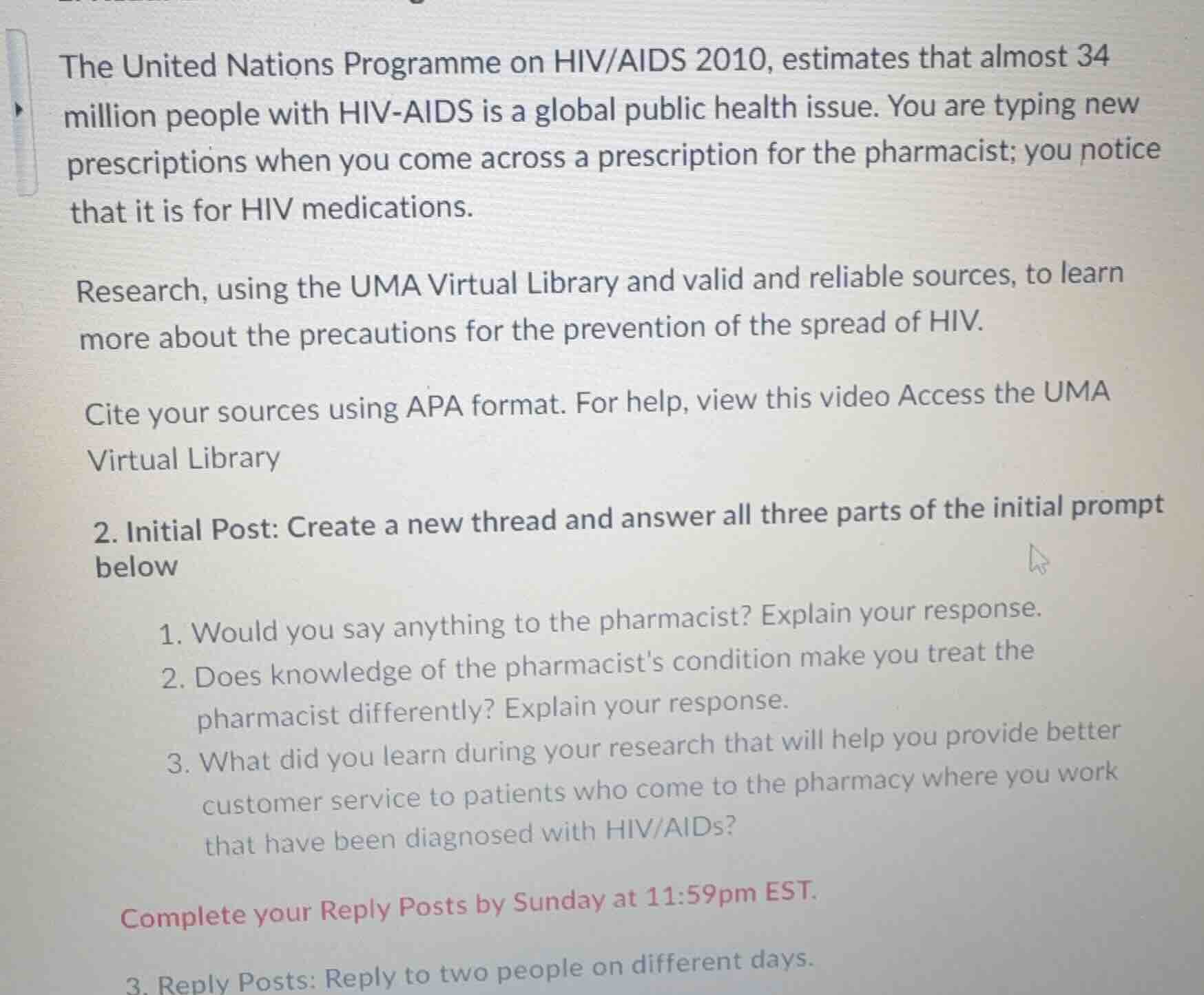
the united nations programme on hiv/aids 2010, estimates that almost 34 million people with hiv-aids is a global public health issue. you are typing new prescriptions when you come across a prescription for the pharmacist; you notice that it is for hiv medications.
research, using the uma virtual library and valid and reliable sources, to learn more about the precautions for the prevention of the spread of hiv.
cite your sources using apa format. for help, view this video access the uma virtual library
- initial post: create a new thread and answer all three parts of the initial prompt below
- would you say anything to the pharmacist? explain your response.
- does knowledge of the pharmacists condition make you treat the pharmacist differently? explain your response.
- what did you learn during your research that will help you provide better customer service to patients who come to the pharmacy where you work that have been diagnosed with hiv/aids?
complete your reply posts by sunday at 11:59pm est.
- reply posts: reply to two people on different days.
- For the first question: Patient confidentiality is a core ethical principle in healthcare. Disclosing the pharmacist's HIV status without their consent violates this principle, so no unsolicited comment is appropriate.
- For the second question: Healthcare providers must uphold non-discrimination standards. Knowledge of a colleague's HIV status does not justify differential treatment, as HIV transmission in a pharmacy setting is preventable with standard precautions.
- For the third question: Key research takeaways include proper use of personal protective equipment (PPE) for potential exposure to bodily fluids, the importance of non-judgmental, empathetic communication to support treatment adherence, and the fact that HIV is not transmitted through casual contact, which informs respectful interaction.
Sources:
Centers for Disease Control and Prevention. (2023). HIV Transmission. https://www.cdc.gov/hiv/basics/transmission.html
American Pharmacists Association. (2021). Ethical Principles of Pharmacists. https://www.pharmacist.com/ethical-principles-pharmacists

Snap & solve any problem in the app
Get step-by-step solutions on Sovi AI
Photo-based solutions with guided steps
Explore more problems and detailed explanations
- No, I would not say anything to the pharmacist. Patient (and in this case, colleague-patient) confidentiality is a fundamental ethical obligation in healthcare, and disclosing or commenting on their HIV status without their explicit permission would violate this standard.
- No, knowledge of the pharmacist's condition would not make me treat them differently. Healthcare settings require non-discriminatory treatment of all individuals, and HIV transmission in a pharmacy environment is avoidable with standard infection control practices. Differential treatment would be unethical and potentially discriminatory.
- From research, I learned that HIV is only transmitted through specific bodily fluid exposures (not casual contact), so I can interact with HIV-positive patients confidently and respectfully without fear of accidental transmission. I also learned that empathetic, non-stigmatizing communication helps patients feel supported, which can improve their medication adherence. Additionally, proper use of PPE (like gloves when handling items that may have bodily fluids) is a simple, effective precaution to prevent transmission in the pharmacy setting, which I can implement to keep both patients and staff safe.