QUESTION IMAGE
Question
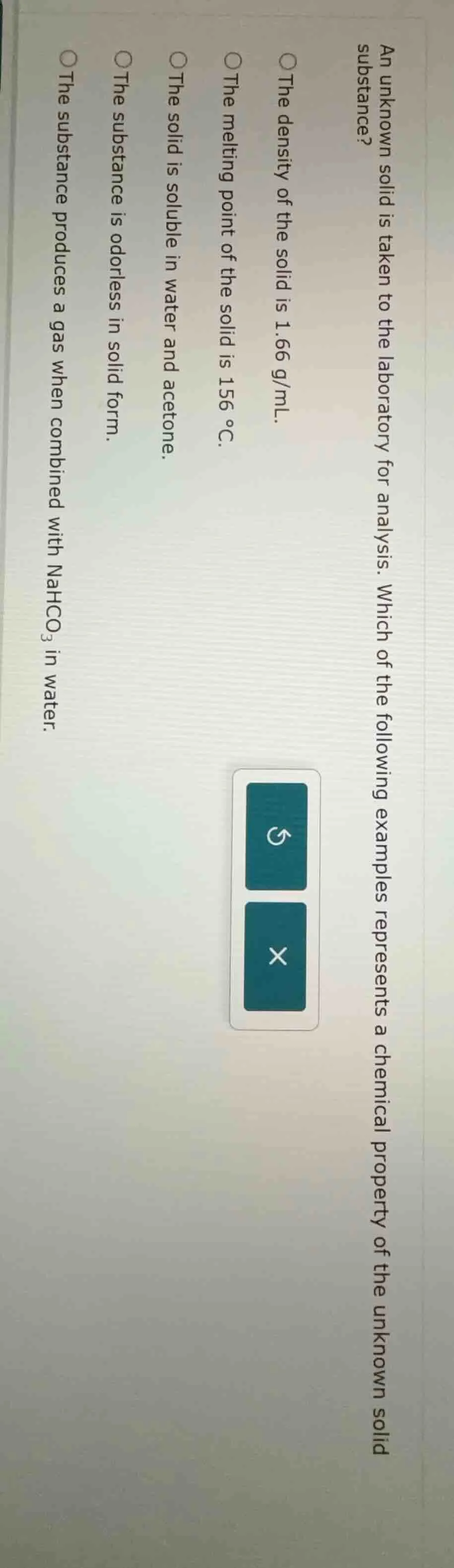
an unknown solid is taken to the laboratory for analysis. which of the following examples represents a chemical property of the unknown solid substance?
the density of the solid is 1.66 g/ml.
the melting point of the solid is 156 °c.
the solid is soluble in water and acetone.
the substance is odorless in solid form.
the substance produces a gas when combined with nahco₃ in water.
Brief Explanations
To determine the chemical property, we analyze each option:
- Density (1.66 g/mL) is a physical property (related to mass/volume, no chemical change).
- Melting point (156 °C) is a physical property (phase change, no new substance).
- Solubility in water/acetone is a physical property (dissolving, no new substance).
- Odorlessness is a physical property (sensory, no chemical change).
- Reacting with $\ce{NaHCO_{3}}$ to produce gas involves a chemical reaction (new substance, $\ce{CO_{2}}$ likely), so this is a chemical property.

Snap & solve any problem in the app
Get step-by-step solutions on Sovi AI
Photo-based solutions with guided steps
Explore more problems and detailed explanations
The substance produces a gas when combined with $\ce{NaHCO_{3}}$ in water.