QUESTION IMAGE
Question
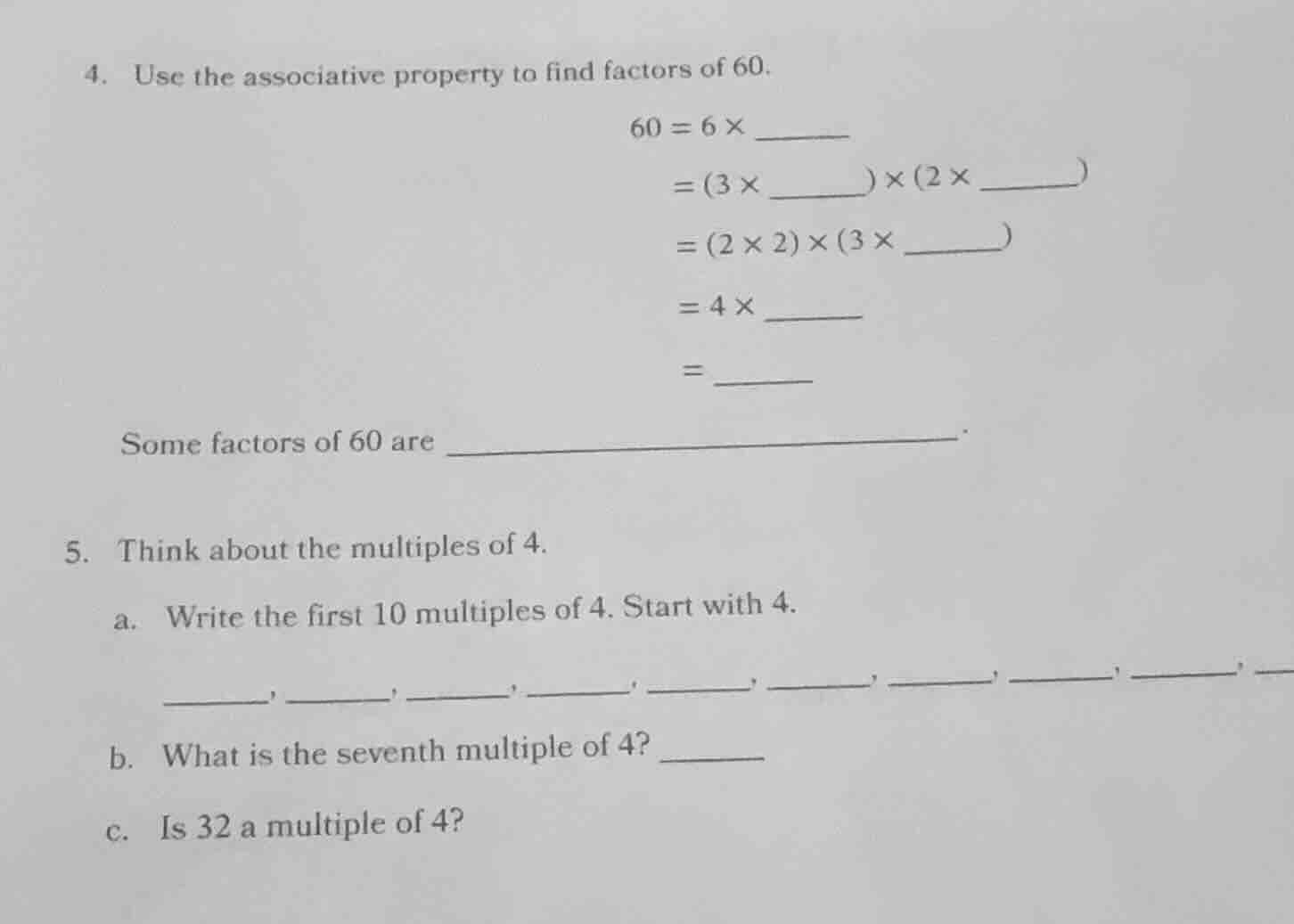
- use the associative property to find factors of 60.
$60 = 6 × \underline{\quad\quad}$
$\quad\quad = (3 × \underline{\quad\quad}) × (2 × \underline{\quad\quad})$
$\quad\quad = (2 × 2) × (3 × \underline{\quad\quad})$
$\quad\quad = 4 × \underline{\quad\quad}$
$\quad\quad = \underline{\quad\quad}$
some factors of 60 are $\underline{\quad\quad}$.
- think about the multiples of 4.
a. write the first 10 multiples of 4. start with 4.
$\underline{\quad\quad}$, $\underline{\quad\quad}$, $\underline{\quad\quad}$, $\underline{\quad\quad}$, $\underline{\quad\quad}$, $\underline{\quad\quad}$, $\underline{\quad\quad}$, $\underline{\quad\quad}$, $\underline{\quad\quad}$, $\underline{\quad\quad}$
b. what is the seventh multiple of 4? $\underline{\quad\quad}$
c. is 32 a multiple of 4?
Question 4
Step1: Find the missing number for \(60 = 6\times\underline{\quad}\)
To find the missing number, we divide 60 by 6. So, \(60\div6 = 10\).
\(60 = 6\times10\)
Step2: Decompose 6 and 10 using associative property
We know that \(6 = 3\times2\) and \(10 = 2\times5\). So, \(60=(3\times2)\times(2\times5)\)
Step3: Rearrange the factors
We can rewrite \((3\times2)\times(2\times5)\) as \((2\times2)\times(3\times5)\) (using the associative property of multiplication which states that \((a\times b)\times c=a\times(b\times c)\) and we can also rearrange the factors as multiplication is commutative).
Step4: Simplify \((2\times2)\times(3\times5)\)
First, \(2\times2 = 4\) and \(3\times5 = 15\), so we have \(4\times15\)
Step5: Calculate \(4\times15\)
\(4\times15=60\)
Step6: Identify the factors
From the above steps, the factors we used are 2, 2, 5, 15, 60 and also the original factors like 6, 10, 3, 2 etc. But the question says "Some factors of 60 are", so we can list the factors we found: 2, 3, 4, 5, 6, 10, 15, 60 (or other relevant factors)
Step1: Recall the definition of multiples
A multiple of a number is the product of that number and an integer. So, to find the multiples of 4, we multiply 4 by 1, 2, 3, ..., 10.
Step2: Calculate the first 10 multiples
- When we multiply 4 by 1: \(4\times1 = 4\)
- When we multiply 4 by 2: \(4\times2 = 8\)
- When we multiply 4 by 3: \(4\times3 = 12\)
- When we multiply 4 by 4: \(4\times4 = 16\)
- When we multiply 4 by 5: \(4\times5 = 20\)
- When we multiply 4 by 6: \(4\times6 = 24\)
- When we multiply 4 by 7: \(4\times7 = 28\)
- When we multiply 4 by 8: \(4\times8 = 32\)
- When we multiply 4 by 9: \(4\times9 = 36\)
- When we multiply 4 by 10: \(4\times10 = 40\)
Step1: Recall the definition of multiples
A multiple of 4 is \(4\times n\) where \(n\) is a positive integer. The seventh multiple means \(n = 7\)
Step2: Calculate the seventh multiple
We calculate \(4\times7=28\)

Snap & solve any problem in the app
Get step-by-step solutions on Sovi AI
Photo-based solutions with guided steps
Explore more problems and detailed explanations
\(60 = 6\times\boldsymbol{10}\)
\(=(3\times\boldsymbol{2})\times(2\times\boldsymbol{5})\)
\(=(2\times 2)\times(3\times\boldsymbol{5})\)
\(= 4\times\boldsymbol{15}\)
\(=\boldsymbol{60}\)
Some factors of 60 are \(\boldsymbol{2, 3, 4, 5, 6, 10, 15, 60}\) (or other valid factors)