QUESTION IMAGE
Question
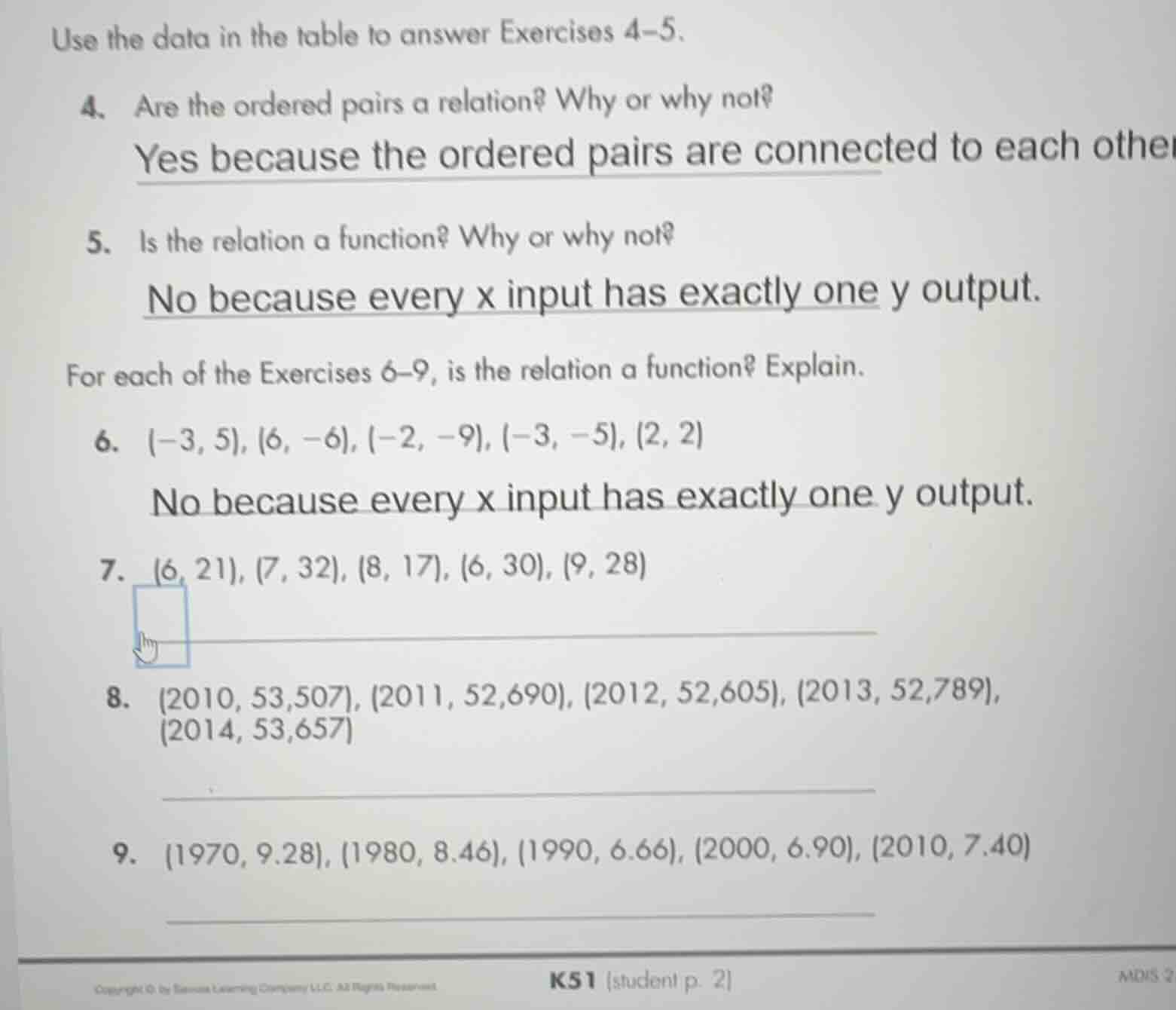
use the data in the table to answer exercises 4–5. 4. are the ordered pairs a relation? why or why not? yes because the ordered pairs are connected to each other 5. is the relation a function? why or why not? no because every x input has exactly one y output. for each of the exercises 6–9, is the relation a function? explain. 6. (-3, 5), (6, -6), (-2, -9), (-3, -5), (2, 2) no because every x input has exactly one y output. 7. (6, 21), (7, 32), (8, 17), (6, 30), (9, 28) 8. (2010, 53,507), (2011, 52,690), (2012, 52,605), (2013, 52,789), (2014, 53,657) 9. (1970, 9.28), (1980, 8.46), (1990, 6.66), (2000, 6.90), (2010, 7.40)
Exercise 7:
Check if any x-value repeats with different y-values. The x-value 6 appears with y=21 and y=30. A function requires each x to have only one y.
Exercise 8:
Check if any x-value (year) repeats. All years are unique, so each x has exactly one y-value.
Exercise 9:
Check if any x-value (year) repeats. All years are unique, so each x has exactly one y-value.

Snap & solve any problem in the app
Get step-by-step solutions on Sovi AI
Photo-based solutions with guided steps
Explore more problems and detailed explanations
- No, because the input x=6 has two different outputs (21 and 30).
- Yes, because every x input (year) has exactly one y output.
- Yes, because every x input (year) has exactly one y output.