QUESTION IMAGE
Question
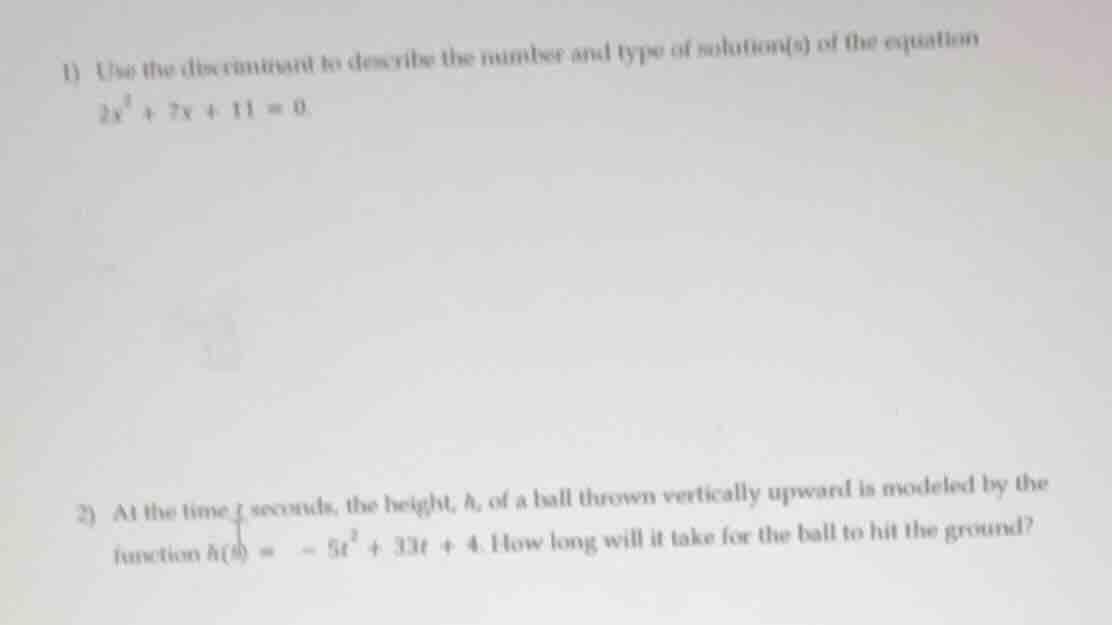
- use the discriminant to describe the number and type of solution(s) of the equation (2x^2 + 7x + 11 = 0).
- at the time (t) seconds, the height, (h), of a ball thrown vertically upward is modeled by the function (h(t) = -5t^2 + 33t + 4). how long will it take for the ball to hit the ground?
Problem 1:
Step1: Recall discriminant formula
For a quadratic equation \(ax^2 + bx + c = 0\), the discriminant \(D = b^2 - 4ac\). Here, \(a = 2\), \(b = 7\), \(c = 11\).
Step2: Calculate discriminant
\(D = 7^2 - 4\times2\times11 = 49 - 88 = -39\).
Step3: Analyze discriminant
Since \(D < 0\), the quadratic equation has two complex (non - real) solutions, which are complex conjugates.
Step1: Understand the problem
When the ball hits the ground, \(h(t)=0\). So we need to solve the quadratic equation \(-5t^{2}+33t + 4 = 0\) for \(t\) (we consider \(t>0\) since time cannot be negative).
Step2: Use quadratic formula
For a quadratic equation \(ax^{2}+bx + c = 0\), the solutions are given by \(t=\frac{-b\pm\sqrt{b^{2}-4ac}}{2a}\). Here, \(a=-5\), \(b = 33\), \(c = 4\).
First, calculate the discriminant \(D=b^{2}-4ac=(33)^{2}-4\times(-5)\times4=1089 + 80 = 1169\).
Then, \(t=\frac{-33\pm\sqrt{1169}}{2\times(-5)}=\frac{-33\pm\sqrt{1169}}{-10}=\frac{33\mp\sqrt{1169}}{10}\).
We have two solutions: \(t_1=\frac{33+\sqrt{1169}}{10}\approx\frac{33 + 34.19}{10}=\frac{67.19}{10}=6.719\) and \(t_2=\frac{33-\sqrt{1169}}{10}\approx\frac{33 - 34.19}{10}=\frac{-1.19}{10}=-0.119\).
Since time cannot be negative, we discard \(t_2\).

Snap & solve any problem in the app
Get step-by-step solutions on Sovi AI
Photo-based solutions with guided steps
Explore more problems and detailed explanations
The equation \(2x^{2}+7x + 11 = 0\) has a discriminant of \(-39\). It has two complex (non - real) solutions (complex conjugates).