QUESTION IMAGE
Question
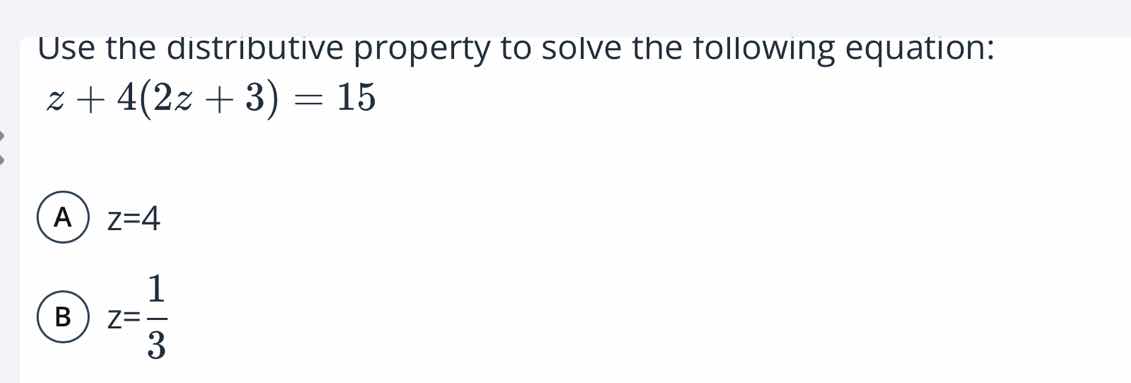
use the distributive property to solve the following equation:
$z + 4(2z + 3) = 15$
a $z=4$
b $z=\dfrac{1}{3}$
Step1: Apply distributive property
The distributive property states that \( a(b + c)=ab+ac \). Applying this to \( 4(2z + 3) \), we get:
\( z+4\times2z + 4\times3=15 \)
\( z + 8z+12 = 15 \)
Step2: Combine like terms
Combine the \( z \) terms: \( z+8z = 9z \), so the equation becomes:
\( 9z+12 = 15 \)
Step3: Subtract 12 from both sides
Subtract 12 from each side to isolate the term with \( z \):
\( 9z+12 - 12=15 - 12 \)
\( 9z=3 \)
Step4: Divide by 9
Divide both sides by 9 to solve for \( z \):
\( z=\frac{3}{9}=\frac{1}{3} \)

Snap & solve any problem in the app
Get step-by-step solutions on Sovi AI
Photo-based solutions with guided steps
Explore more problems and detailed explanations
B. \( z = \frac{1}{3} \)