QUESTION IMAGE
Question
use the drop-down menu to choose whether the following statement is true or false.
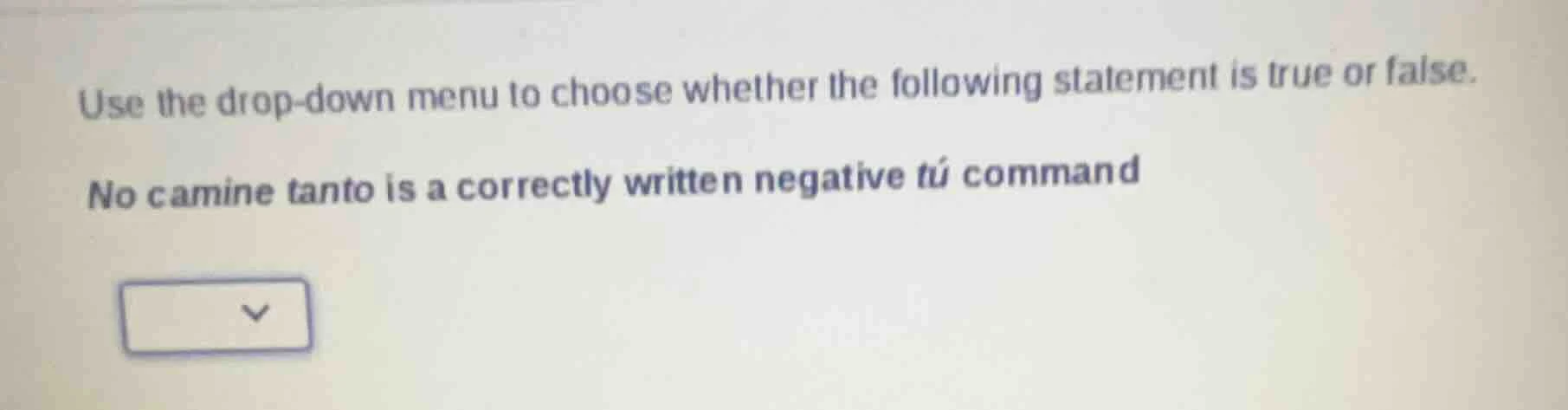
no camine tanto is a correctly written negative tú command
To determine if "No camine tanto" is a correctly written negative tú command, we analyze Spanish command forms. The negative tú command for the verb "caminar" (to walk) is formed by using "no" followed by the tú form of the subjunctive? No, actually, for negative tú commands, we use "no" + the present subjunctive? Wait, no—wait, negative tú commands use "no" + the informal (tú) imperative? No, correction: For regular -ar verbs like "caminar", the negative tú command is "no + (tú) subjunctive"? Wait, no, the negative tú command for "caminar" (regular -ar verb) is formed as follows: The positive tú command is "camina" (informal imperative). The negative tú command is "no + (tú) subjunctive"? Wait, no, actually, for negative commands, the tú form uses the present subjunctive? Wait, no, let's recall: For negative commands (tú, usted, ustedes, nosotros), we use the subjunctive mood. But for tú negative commands, the structure is "no + (tú) subjunctive". Wait, "caminar" is a regular -ar verb. The tú subjunctive of "caminar" is "camines". Wait, but "camine" is the usted subjunctive (or the nosotros subjunctive? No, "camine" is the usted (formal) subjunctive, or the nosotros subjunctive? Wait, no: the conjugation of "caminar" in the subjunctive:
- yo: camine
- tú: camines
- él/ella/usted: camine
- nosotros: caminemos
- vosotros: caminéis
- ellos/ellas/ustedes: caminen
So the negative tú command for "caminar" should be "no camines tanto", not "no camine tanto". "Camine" is the usted (formal) subjunctive, so "no camine tanto" would be a negative usted command, not a tú command. Therefore, the statement is false.

Snap & solve any problem in the app
Get step-by-step solutions on Sovi AI
Photo-based solutions with guided steps
Explore more problems and detailed explanations
False