QUESTION IMAGE
Question
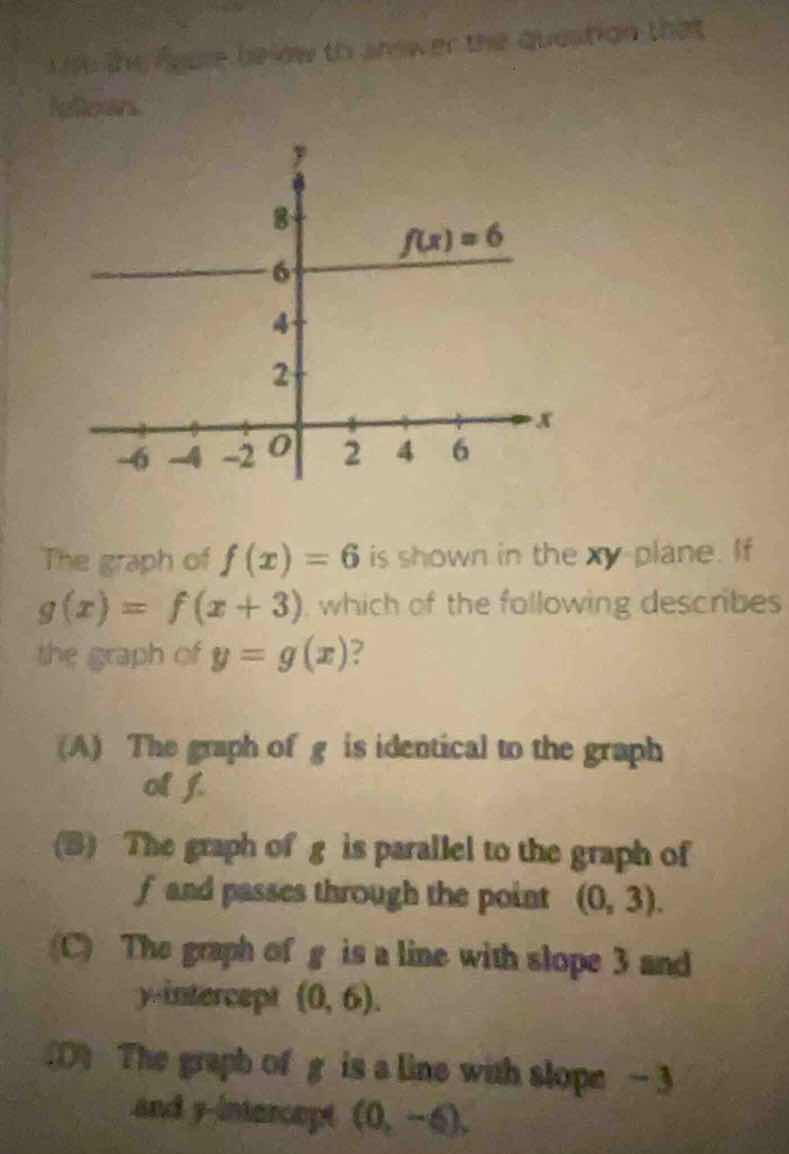
use the figure below to answer the question that follows.
the graph of ( f(x) = 6 ) is shown in the ( xy )-plane. if ( g(x) = f(x + 3) ), which of the following describes the graph of ( y = g(x) )?
(a) the graph of ( g ) is identical to the graph of ( f ).
(b) the graph of ( g ) is parallel to the graph of ( f ) and passes through the point ( (0, 3) ).
(c) the graph of ( g ) is a line with slope 3 and ( y )-intercept ( (0, 6) ).
(d) the graph of ( g ) is a line with slope ( -3 ) and ( y )-intercept ( (0, -6) ).
Step1: Analyze the function \( f(x) \)
The function \( f(x) = 6 \) is a horizontal line (constant function) with a slope of \( 0 \) (since for any \( x \), the \( y \)-value is always \( 6 \)). Its graph is parallel to the \( x \)-axis.
Step2: Analyze the transformation for \( g(x) \)
We are given \( g(x) = f(x + 3) \). This is a horizontal shift of the function \( f(x) \). The rule for horizontal shifts is: if we have \( y = f(x + h) \), the graph of \( f(x) \) is shifted left by \( h \) units when \( h>0 \). Here, \( h = 3 \), so the graph of \( f(x) \) (which is \( y = 6 \)) will be shifted left by \( 3 \) units.
Step3: Determine the properties of \( g(x) \)
Since \( f(x) \) is a horizontal line (slope \( 0 \)), shifting it horizontally (left or right) will not change its slope. So the graph of \( g(x) \) will also be a horizontal line (slope \( 0 \)), meaning it is parallel to the graph of \( f(x) \) (which is also a horizontal line with slope \( 0 \)).
Now let's check the \( y \)-intercept or a point on \( g(x) \). Let's find \( g(0) \):
\( g(0)=f(0 + 3)=f(3) \)
But \( f(x)=6 \) for all \( x \), so \( f(3) = 6 \)? Wait, no, wait. Wait, the original graph of \( f(x) = 6 \) is a horizontal line. When we shift it left by 3 units, the equation of \( g(x) \) is still \( y = 6 \)? Wait, no, that can't be. Wait, no, wait, maybe I made a mistake. Wait, no, \( f(x)=6 \) is a constant function, so \( f(x + 3)=6 \) as well. So the graph of \( g(x) \) is also \( y = 6 \), which is parallel to \( f(x) \)'s graph (\( y = 6 \))? But that's not one of the options. Wait, maybe I misread the options. Wait, let's re - check the options:
Option B says "The graph of \( g \) is parallel to the graph of \( f \) and passes through the point \( (0, 3) \)". Wait, that can't be. Wait, no, maybe I messed up the shift direction. Wait, the transformation \( g(x)=f(x + 3) \) is a shift to the left by 3 units. But \( f(x)=6 \) is a horizontal line. So the graph of \( g(x) \) is also a horizontal line \( y = 6 \), which is parallel to \( f(x) \)'s graph (\( y = 6 \)). But none of the options say that. Wait, maybe there is a mistake in my analysis. Wait, no, let's re - evaluate the options:
Wait, the original graph of \( f(x)=6 \) is a horizontal line. The slope of a horizontal line is \( 0 \). So the graph of \( g(x)=f(x + 3) \) is also a horizontal line (slope \( 0 \)), so it is parallel to the graph of \( f(x) \) (since parallel lines have the same slope). Now let's check the points. Let's find \( g(0) \):
\( g(0)=f(0 + 3)=f(3) \). But \( f(x)=6 \) for all \( x \), so \( f(3) = 6 \). Wait, but option B says it passes through \( (0, 3) \). That's not correct. Wait, maybe I made a mistake in the transformation. Wait, no, \( f(x)=6 \) is a constant function, so any horizontal shift will not change the \( y \)-value. So \( g(x)=6 \) for all \( x \), so the graph of \( g(x) \) is \( y = 6 \), same as \( f(x) \)? But option A says "The graph of \( g \) is identical to the graph of \( f \)". But that would mean option A is correct? But that contradicts my initial thought. Wait, let's check the options again:
Option A: "The graph of \( g \) is identical to the graph of \( f \)".
Option B: "The graph of \( g \) is parallel to the graph of \( f \) and passes through the point \( (0, 3) \)".
Option C: "The graph of \( g \) is a line with slope \( 3 \) and \( y \)-intercept \( (0, 6) \)".
Option D: "The graph of \( g \) is a line with slope \( - 3 \) and \( y \)-intercept \( (0,-6) \)".
Wait, if \( f(x)=6 \) is a horizontal line, then \( g(x)=f(x + 3)…

Snap & solve any problem in the app
Get step-by-step solutions on Sovi AI
Photo-based solutions with guided steps
Explore more problems and detailed explanations
A. The graph of \( g \) is identical to the graph of \( f \).