QUESTION IMAGE
Question
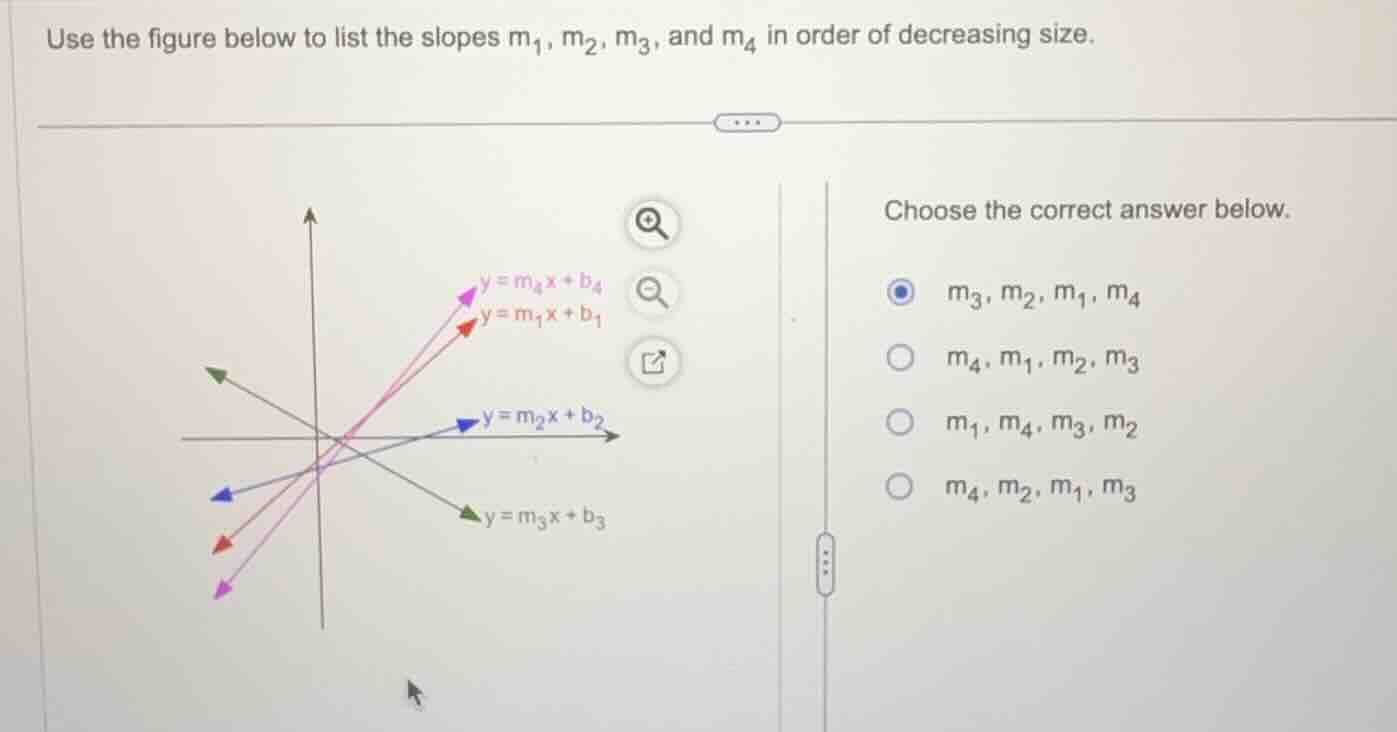
use the figure below to list the slopes ( m_1, m_2, m_3, ) and ( m_4 ) in order of decreasing size.
choose the correct answer below.
( \boldsymbol{m_3, m_2, m_1, m_4} )
( m_4, m_1, m_2, m_3 )
( m_1, m_4, m_3, m_2 )
( m_4, m_2, m_1, m_3 )
Step1: Recall Slope Properties
The slope of a line \( y = mx + b \) determines its steepness and direction. Positive slopes go up from left to right, negative slopes go down. For positive slopes, the larger the slope, the steeper the line. For negative slopes, the more negative (smaller) the slope, the steeper the downward line.
Step2: Analyze Each Line
- \( y = m_4x + b_4 \) and \( y = m_1x + b_1 \): Positive slopes (upward). \( m_4 \) is steeper than \( m_1 \), so \( m_4 > m_1 \).
- \( y = m_2x + b_2 \): Positive, gentle slope (small positive, \( 0 < m_2 < m_1, m_4 \)).
- \( y = m_3x + b_3 \): Negative slope (downward), so \( m_3 < 0 \), the smallest among all.
Step3: Order by Decreasing Size
From largest to smallest: \( m_4 \) (steep positive), \( m_1 \) (less steep positive), \( m_2 \) (gentle positive), \( m_3 \) (negative). Wait, no—wait, the options: Wait, the first option selected was \( m_3, m_2, m_1, m_4 \)? No, wait, no—wait, let's re-express. Wait, no, the correct analysis: Wait, \( m_3 \) is negative (so smallest), \( m_2 \) is small positive, \( m_1 \) is moderate positive, \( m_4 \) is steep positive. Wait, no, the lines: \( y = m_4x \) is the steepest upward, \( m_1 \) next, \( m_2 \) gentle upward, \( m_3 \) downward (negative). So decreasing order (largest to smallest) should be \( m_4, m_1, m_2, m_3 \)? No, wait the options: Wait the first option is \( m_3, m_2, m_1, m_4 \) (but \( m_3 \) is negative, so smallest). Wait, no—wait the user's selected option was \( m_3, m_2, m_1, m_4 \), but that's incorrect. Wait, no, let's re-express:
Wait, the lines: \( y = m_4x \) (purple, steep up), \( y = m_1x \) (red, less steep up), \( y = m_2x \) (blue, gentle up), \( y = m_3x \) (green, down). So slopes: \( m_4 > m_1 > m_2 > 0 > m_3 \). So decreasing order (from largest to smallest) is \( m_4, m_1, m_2, m_3 \), which is the second option. Wait, but the user had a selected option, but maybe a mistake. Wait, the correct order: positive slopes (larger first) then negative. So \( m_4 \) (steepest positive) > \( m_1 \) > \( m_2 \) (gentle positive) > \( m_3 \) (negative). So the order \( m_4, m_1, m_2, m_3 \) is the second option. Wait, but the initial selected option was wrong. Wait, let's check the options again:
Options:
- \( m_3, m_2, m_1, m_4 \) – no, \( m_3 \) is negative (smallest), so this would be increasing, not decreasing.
- \( m_4, m_1, m_2, m_3 \) – yes, because \( m_4 > m_1 > m_2 > m_3 \) (since \( m_3 \) is negative, all positives are larger than it, and \( m_4 \) is largest positive, then \( m_1 \), then \( m_2 \), then \( m_3 \) (negative)).
Wait, but the user's initial selection was the first option, but that's incorrect. Wait, maybe I misread the lines. Let's look at the figure: The green line \( y = m_3x \) is going down (negative slope). The blue line \( y = m_2x \) is going up gently (small positive). The red line \( y = m_1x \) is going up more steeply than blue. The purple line \( y = m_4x \) is going up the steepest. So slopes: \( m_4 \) (steep positive) > \( m_1 \) (less steep positive) > \( m_2 \) (gentle positive) > \( m_3 \) (negative). So decreasing order (largest to smallest) is \( m_4, m_1, m_2, m_3 \), which is the second option.

Snap & solve any problem in the app
Get step-by-step solutions on Sovi AI
Photo-based solutions with guided steps
Explore more problems and detailed explanations
\( m_4, m_1, m_2, m_3 \) (corresponding to the second option: \( m_4, m_1, m_2, m_3 \))