QUESTION IMAGE
Question
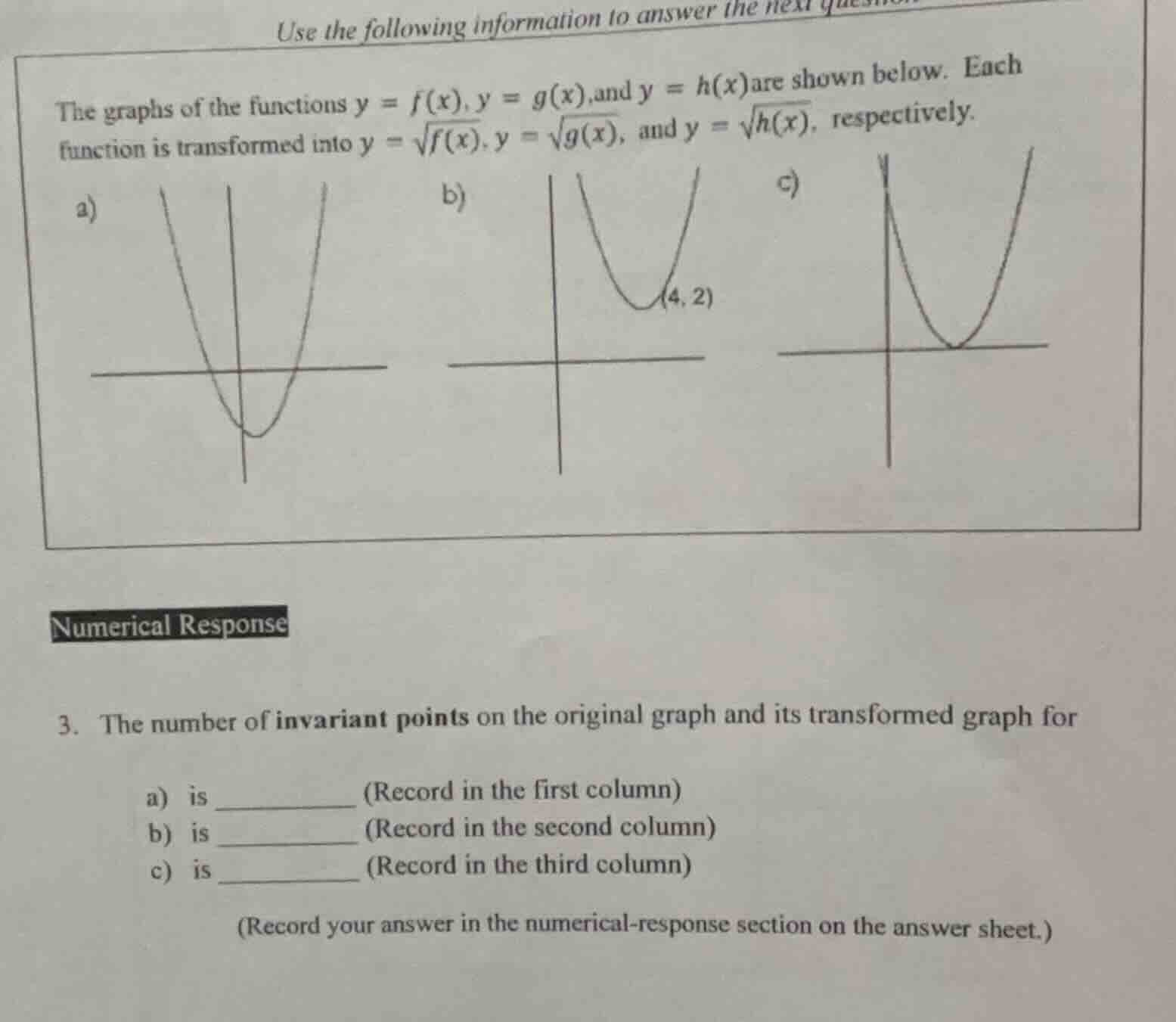
use the following information to answer the next question. the graphs of the functions ( y = f(x) ), ( y = g(x) ), and ( y = h(x) ) are shown below. each function is transformed into ( y = sqrt{f(x)} ), ( y = sqrt{g(x)} ), and ( y = sqrt{h(x)} ), respectively.
numerical response
- the number of invariant points on the original graph and its transformed graph for
a) is ______ (record in the first column)
b) is ______ (record in the second column)
c) is ______ (record in the third column)
(record your answer in the numerical - response section on the answer sheet.)
Step1: Define invariant points
An invariant point satisfies $y = \sqrt{y}$, since $y = f(x)$ and transformed $y=\sqrt{f(x)}$. Solve:
$$y = \sqrt{y} \implies y^2 = y \implies y(y-1)=0$$
Solutions: $y=0$ or $y=1$.
Step2: Analyze graph a)
Original graph crosses $y=0$ (x-axis) at 2 points, and crosses $y=1$ at 2 points. Total invariant points: $2+2=4$.
Step3: Analyze graph b)
Original graph has minimum $y=2$, so it never reaches $y=0$ or $y=1$. No invariant points: $0$.
Step4: Analyze graph c)
Original graph touches $y=0$ at 1 point, and crosses $y=1$ at 2 points. Total invariant points: $1+2=3$.

Snap & solve any problem in the app
Get step-by-step solutions on Sovi AI
Photo-based solutions with guided steps
Explore more problems and detailed explanations
a) 4
b) 0
c) 3