QUESTION IMAGE
Question
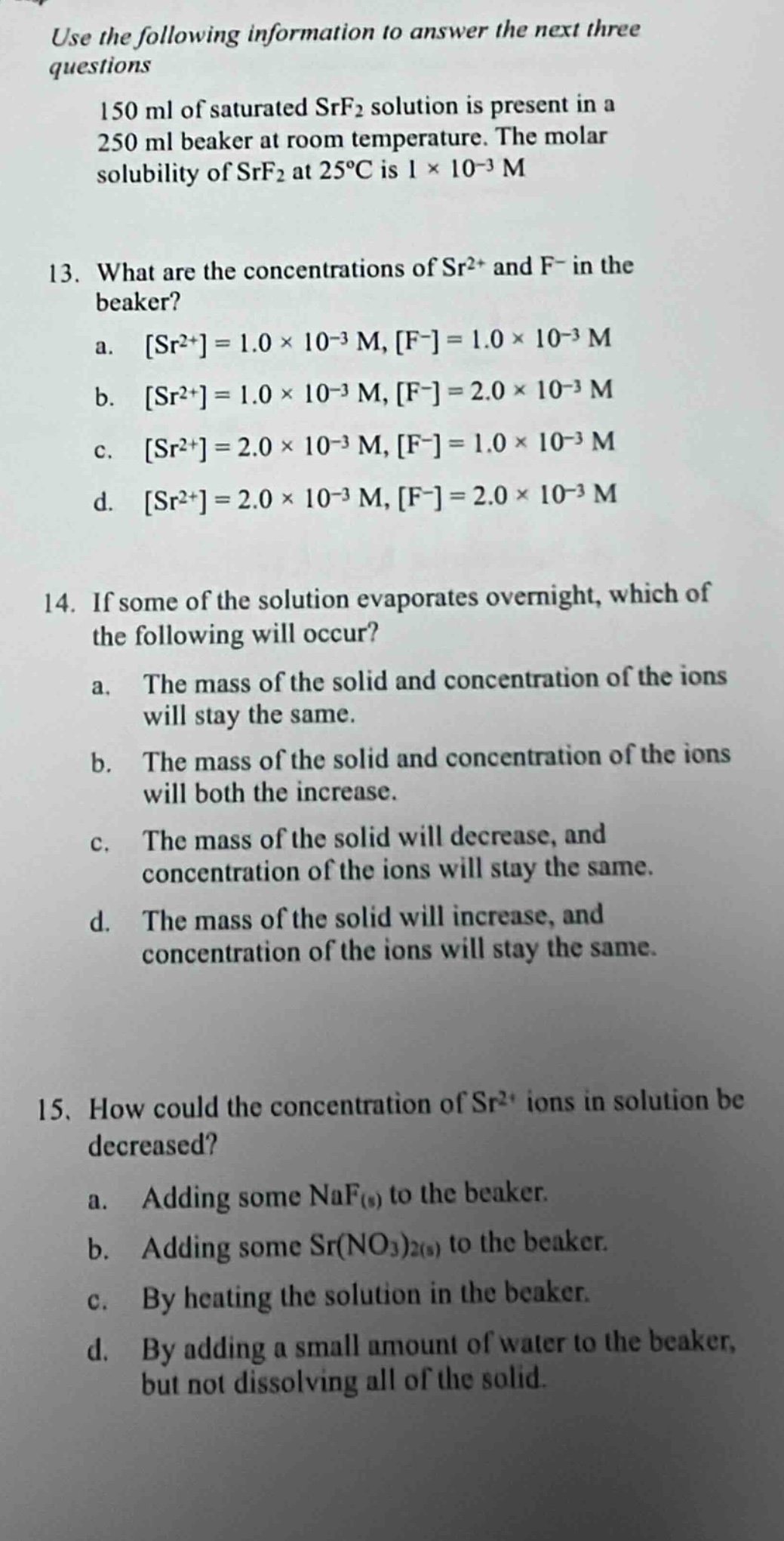
use the following information to answer the next three questions
150 ml of saturated srf₂ solution is present in a
250 ml beaker at room temperature. the molar
solubility of srf₂ at 25℃ is 1 × 10⁻³ m
- what are the concentrations of sr²⁺ and f⁻ in the
beaker?
a. sr²⁺ = 1.0 × 10⁻³ m, f⁻ = 1.0 × 10⁻³ m
b. sr²⁺ = 1.0 × 10⁻³ m, f⁻ = 2.0 × 10⁻³ m
c. sr²⁺ = 2.0 × 10⁻³ m, f⁻ = 1.0 × 10⁻³ m
d. sr²⁺ = 2.0 × 10⁻³ m, f⁻ = 2.0 × 10⁻³ m
- if some of the solution evaporates overnight, which of
the following will occur?
a. the mass of the solid and concentration of the ions
will stay the same.
b. the mass of the solid and concentration of the ions
will both the increase.
c. the mass of the solid will decrease, and
concentration of the ions will stay the same.
d. the mass of the solid will increase, and
concentration of the ions will stay the same.
- how could the concentration of sr²⁺ ions in solution be
decreased?
a. adding some naf₍ₛ₎ to the beaker.
b. adding some sr(no₃)₂₍ₛ₎ to the beaker.
c. by heating the solution in the beaker.
d. by adding a small amount of water to the beaker,
but not dissolving all of the solid.
Question 13
Step1: Analyze dissociation of \( \text{SrF}_2 \)
The dissociation equation of \( \text{SrF}_2 \) is \( \text{SrF}_2(s)
ightleftharpoons \text{Sr}^{2+}(aq) + 2\text{F}^-(aq) \). From the molar solubility (\( s \)) of \( \text{SrF}_2 \) which is \( 1\times10^{-3}\, \text{M} \), the concentration of \( \text{Sr}^{2+} \) is equal to the molar solubility, so \( [\text{Sr}^{2+}] = s = 1\times10^{-3}\, \text{M} \).
Step2: Calculate \( [\text{F}^-] \)
For each mole of \( \text{SrF}_2 \) that dissociates, 2 moles of \( \text{F}^- \) are produced. So \( [\text{F}^-] = 2s = 2\times(1\times10^{-3}\, \text{M}) = 2\times10^{-3}\, \text{M} \).
The solution is saturated with \( \text{SrF}_2 \). At a constant temperature, the solubility product (\( K_{sp} \)) is constant, so the ion concentrations remain the same. When solution evaporates, some water is lost, so more \( \text{SrF}_2 \) will precipitate out (mass of solid increases) to maintain the equilibrium, while ion concentrations stay the same.
- Option a: Adding \( \text{NaF}(s) \) increases \( [\text{F}^-] \), shifting the equilibrium \( \text{SrF}_2(s)
ightleftharpoons \text{Sr}^{2+}(aq) + 2\text{F}^-(aq) \) left, decreasing \( [\text{Sr}^{2+}] \).
- Option b: Adding \( \text{Sr(NO}_3\text{)}_2(s) \) increases \( [\text{Sr}^{2+}] \), not decrease.
- Option c: Heating generally increases solubility, so \( [\text{Sr}^{2+}] \) would increase or stay depending on solubility change, but not decrease.
- Option d: Adding water (without dissolving all solid) dilutes, but since it's saturated, after dilution, more solid dissolves to reach equilibrium, \( [\text{Sr}^{2+}] \) remains same (or increases slightly if solubility increases with temperature, but not a decrease).

Snap & solve any problem in the app
Get step-by-step solutions on Sovi AI
Photo-based solutions with guided steps
Explore more problems and detailed explanations
b. \( [\text{Sr}^{2+}] = 1.0 \times 10^{-3}\, \text{M}, [\text{F}^-] = 2.0 \times 10^{-3}\, \text{M} \)