QUESTION IMAGE
Question
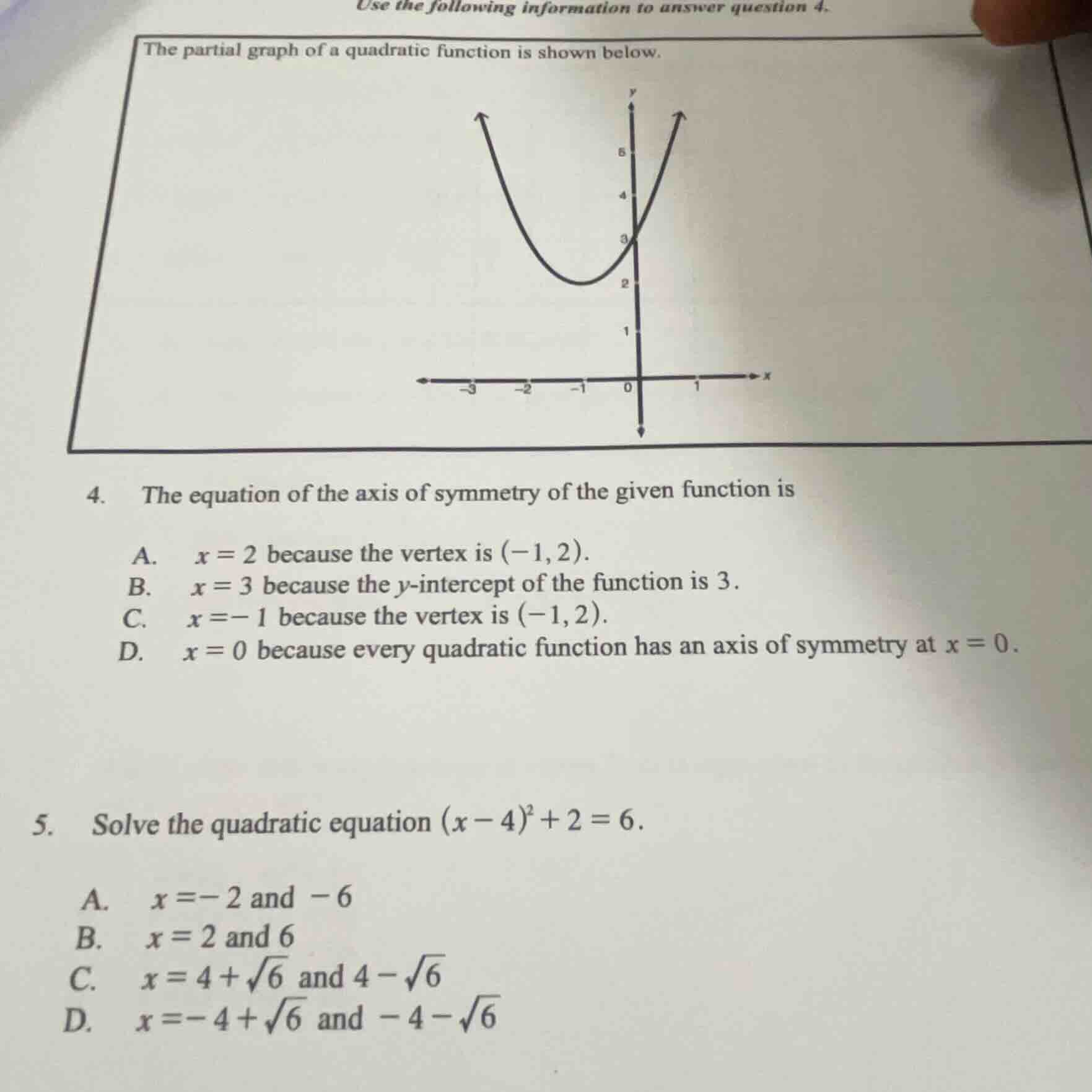
use the following information to answer question 4.
the partial graph of a quadratic function is shown below.
graph of a quadratic function
- the equation of the axis of symmetry of the given function is
a. $x = 2$ because the vertex is $(-1, 2)$.
b. $x = 3$ because the $y$-intercept of the function is 3.
c. $x = -1$ because the vertex is $(-1, 2)$.
d. $x = 0$ because every quadratic function has an axis of symmetry at $x = 0$.
- solve the quadratic equation $(x - 4)^2 + 2 = 6$.
a. $x = -2$ and $-6$
b. $x = 2$ and $6$
c. $x = 4 + \sqrt{6}$ and $4 - \sqrt{6}$
d. $x = -4 + \sqrt{6}$ and $-4 - \sqrt{6}$
Question 4
To determine the axis of symmetry of a quadratic function, we use the vertex. The axis of symmetry is a vertical line passing through the vertex \((h,k)\), with the equation \(x = h\). From the graph, the vertex is \((-1, 2)\), so the axis of symmetry is \(x=-1\). Let's analyze each option:
- Option A: Incorrect, as the vertex's x - coordinate is - 1, not 2.
- Option B: Incorrect, the y - intercept (\(y = 3\) when \(x = 0\)) has no relation to the axis of symmetry.
- Option C: Correct, since the vertex is \((-1,2)\), the axis of symmetry is \(x=-1\).
- Option D: Incorrect, not every quadratic function has its axis of symmetry at \(x = 0\); it depends on the vertex.
Step 1: Isolate the squared term
We start with the equation \((x - 4)^{2}+2=6\). Subtract 2 from both sides of the equation:
\((x - 4)^{2}+2-2=6 - 2\)
\((x - 4)^{2}=4\)
Step 2: Take the square root of both sides
Take the square root of both sides. Remember that if \(y^{2}=a\) (\(a\geq0\)), then \(y=\pm\sqrt{a}\). So for \((x - 4)^{2}=4\), we have:
\(x - 4=\pm\sqrt{4}=\pm2\)
Step 3: Solve for \(x\)
Case 1: When \(x - 4 = 2\), add 4 to both sides:
\(x-4 + 4=2 + 4\)
\(x=6\)
Case 2: When \(x - 4=-2\), add 4 to both sides:
\(x-4 + 4=-2 + 4\)
\(x = 2\)

Snap & solve any problem in the app
Get step-by-step solutions on Sovi AI
Photo-based solutions with guided steps
Explore more problems and detailed explanations
C. \(x=-1\) because the vertex is \((-1,2)\).