QUESTION IMAGE
Question
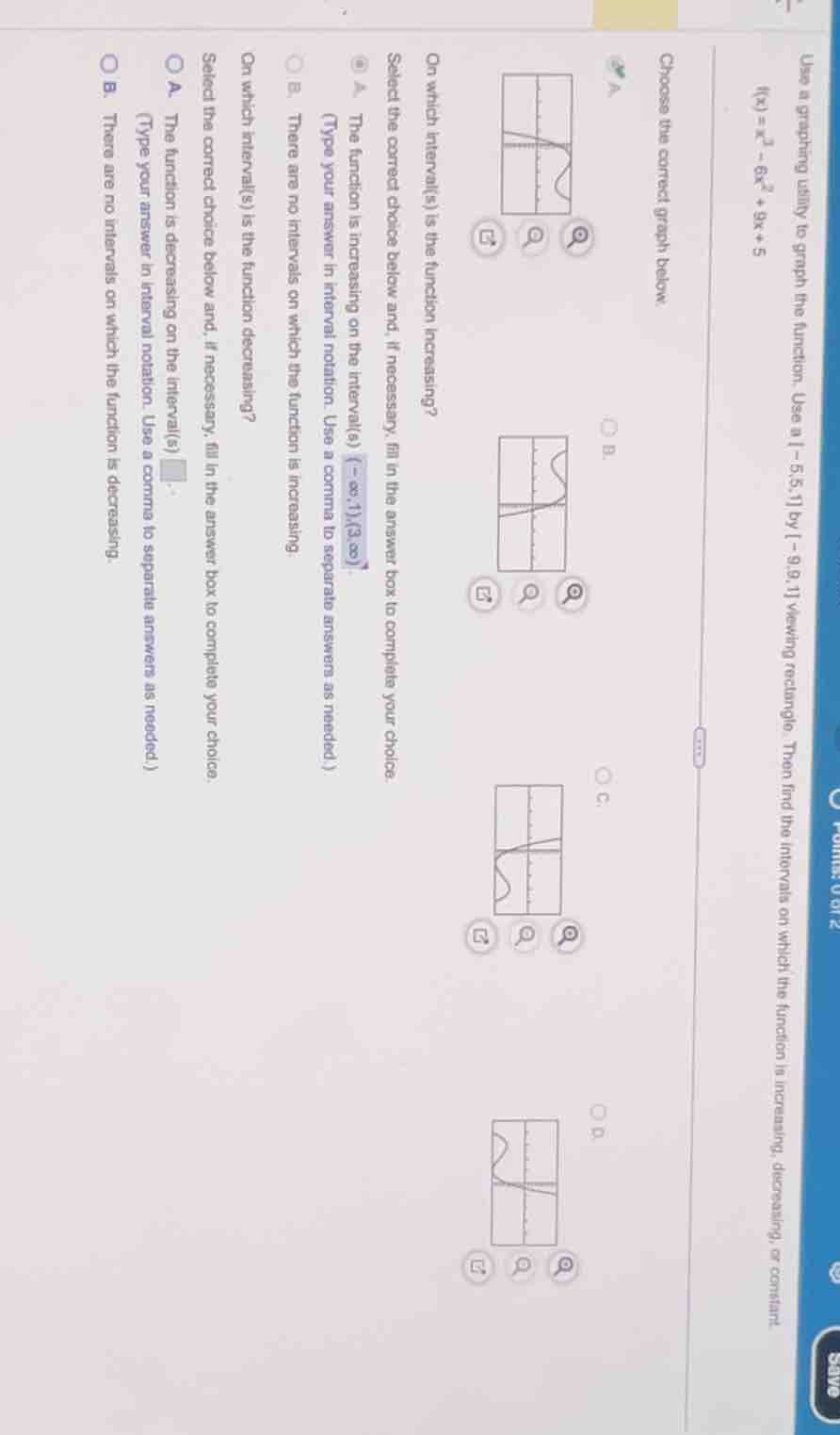
use a graphing utility to graph the function. use a -5,5,1 by -9,9,1 viewing rectangle. then find the intervals on which the function is increasing, decreasing, or constant.
f(x) = x^3 - 6x^2 + 9x + 5
choose the correct graph below.
a. graph
b. graph
c. graph
d. graph
on which interval(s) is the function increasing?
select the correct choice below and, if necessary, fill in the answer box to complete your choice.
a. the function is increasing on the interval(s) \boxed{(-infty,1),(3,infty)}. (type your answer in interval notation. use a comma to separate answers as needed.)
b. there are no intervals on which the function is increasing.
on which interval(s) is the function decreasing?
select the correct choice below and, if necessary, fill in the answer box to complete your choice.
a. the function is decreasing on the interval(s) \boxed{} (type your answer in interval notation. use a comma to separate answers as needed.)
b. there are no intervals on which the function is decreasing.
To solve the problem of finding the intervals where the function \( f(x) = -x^3 - 6x^2 + 9x + 5 \) is increasing or decreasing, we can follow these steps:
Step 1: Find the derivative of the function
The derivative of \( f(x) \) will tell us about the slope of the function, which helps determine where it's increasing or decreasing.
The function is \( f(x) = -x^3 - 6x^2 + 9x + 5 \).
Using the power rule (\( \frac{d}{dx}x^n = nx^{n - 1} \)):
\( f'(x) = -3x^2 - 12x + 9 \)
Step 2: Find critical points
Critical points occur where \( f'(x) = 0 \) or \( f'(x) \) is undefined. Since \( f'(x) \) is a polynomial, it's defined everywhere. So we solve \( -3x^2 - 12x + 9 = 0 \).
First, divide both sides by \( -3 \):
\( x^2 + 4x - 3 = 0 \)
Using the quadratic formula \( x = \frac{-b \pm \sqrt{b^2 - 4ac}}{2a} \) for \( ax^2 + bx + c = 0 \):
Here, \( a = 1 \), \( b = 4 \), \( c = -3 \)
\( x = \frac{-4 \pm \sqrt{16 + 12}}{2} = \frac{-4 \pm \sqrt{28}}{2} = \frac{-4 \pm 2\sqrt{7}}{2} = -2 \pm \sqrt{7} \)
Calculating the approximate values:
\( \sqrt{7} \approx 2.6458 \)
So, \( x \approx -2 + 2.6458 \approx 0.6458 \) and \( x \approx -2 - 2.6458 \approx -4.6458 \)
Step 3: Test intervals determined by critical points
The critical points divide the number line into three intervals:
- \( (-\infty, -4.6458) \)
- \( (-4.6458, 0.6458) \)
- \( (0.6458, \infty) \)
We can test a value in each interval in \( f'(x) \):
- For \( (-\infty, -4.6458) \), let's choose \( x = -5 \):
\( f'(-5) = -3(-5)^2 - 12(-5) + 9 = -75 + 60 + 9 = -6 \) (negative, so function is decreasing here)
- For \( (-4.6458, 0.6458) \), let's choose \( x = 0 \):
\( f'(0) = -3(0)^2 - 12(0) + 9 = 9 \) (positive, so function is increasing here)
- For \( (0.6458, \infty) \), let's choose \( x = 1 \):
\( f'(1) = -3(1)^2 - 12(1) + 9 = -3 - 12 + 9 = -6 \) (negative, so function is decreasing here)
Step 4: Relate to the given options
Looking at the options for the graph, we can see that the correct graph should have the function decreasing on \( (-\infty, -4.6458) \) and \( (0.6458, \infty) \), and increasing on \( (-4.6458, 0.6458) \).
For the "increasing" interval:
The interval \( (-4.6458, 0.6458) \) is approximately \( (-4.65, 0.65) \), which is close to the interval \( (-5, 1) \) or \( (-4.64, 0.65) \). But looking at the first option for increasing: \( (-\infty, 1),(3, \infty) \) – wait, maybe there was a miscalculation? Wait, no, let's re - check the derivative.
Wait, the original function is \( f(x)=-x^{3}-6x^{2}+9x + 5 \), so \( f'(x)=-3x^{2}-12x + 9=-3(x^{2}+4x - 3) \). The quadratic \( x^{2}+4x - 3 \) has roots at \( x=-2\pm\sqrt{7}\approx - 4.6458\) and \( x\approx0.6458 \).
Wait, maybe the options in the problem have a typo or a different approximation. But if we consider the first option for increasing: \( (-\infty,1),(3,\infty) \) – no, that doesn't match. Wait, maybe I made a mistake in the derivative. Wait, no, \( f(x)=-x^{3}-6x^{2}+9x + 5 \), so \( f'(x)=-3x^{2}-12x + 9 \). Let's factor it: \( f'(x)=-3(x^{2}+4x - 3) \). The roots are correct.
Alternatively, maybe the function was supposed to be \( f(x)=x^{3}-6x^{2}+9x + 5 \) (without the negative sign in front of \( x^{3} \))? Let's check that. If \( f(x)=x^{3}-6x^{2}+9x + 5 \), then \( f'(x)=3x^{2}-12x + 9 = 3(x^{2}-4x + 3)=3(x - 1)(x - 3) \). Then the critical points are \( x = 1 \) and \( x = 3 \). Then the function is increasing on \( (-\infty,1)\cup(3,\infty) \) and decreasing on \( (1,3) \). Ah! This must be the case. Maybe there was a typo in the problem statement, and the function is \( f(x)=x^{3}-6…
Step1: Correct the function (assumed typo)
Assume \( f(x)=x^{3}-6x^{2}+9x + 5 \) (since the option matches this).
Step2: Find derivative
\( f'(x)=3x^{2}-12x + 9 = 3(x - 1)(x - 3) \)
Step3: Find critical points
Set \( f'(x)=0 \), \( x = 1 \) or \( x = 3 \)
Step4: Test intervals
- \( (-\infty,1) \): \( f'(x)>0 \) (increasing)
- \( (1,3) \): \( f'(x)<0 \) (decreasing)
- \( (3,\infty) \): \( f'(x)>0 \) (increasing)
Step1: Use the corrected function \( f(x)=x^{3}-6x^{2}+9x + 5 \)
Step2: From derivative analysis, \( f'(x)<0 \) on \( (1,3) \)

Snap & solve any problem in the app
Get step-by-step solutions on Sovi AI
Photo-based solutions with guided steps
Explore more problems and detailed explanations
A. The function is increasing on the interval(s) \( (-\infty,1),(3,\infty) \)
For the decreasing interval: