QUESTION IMAGE
Question
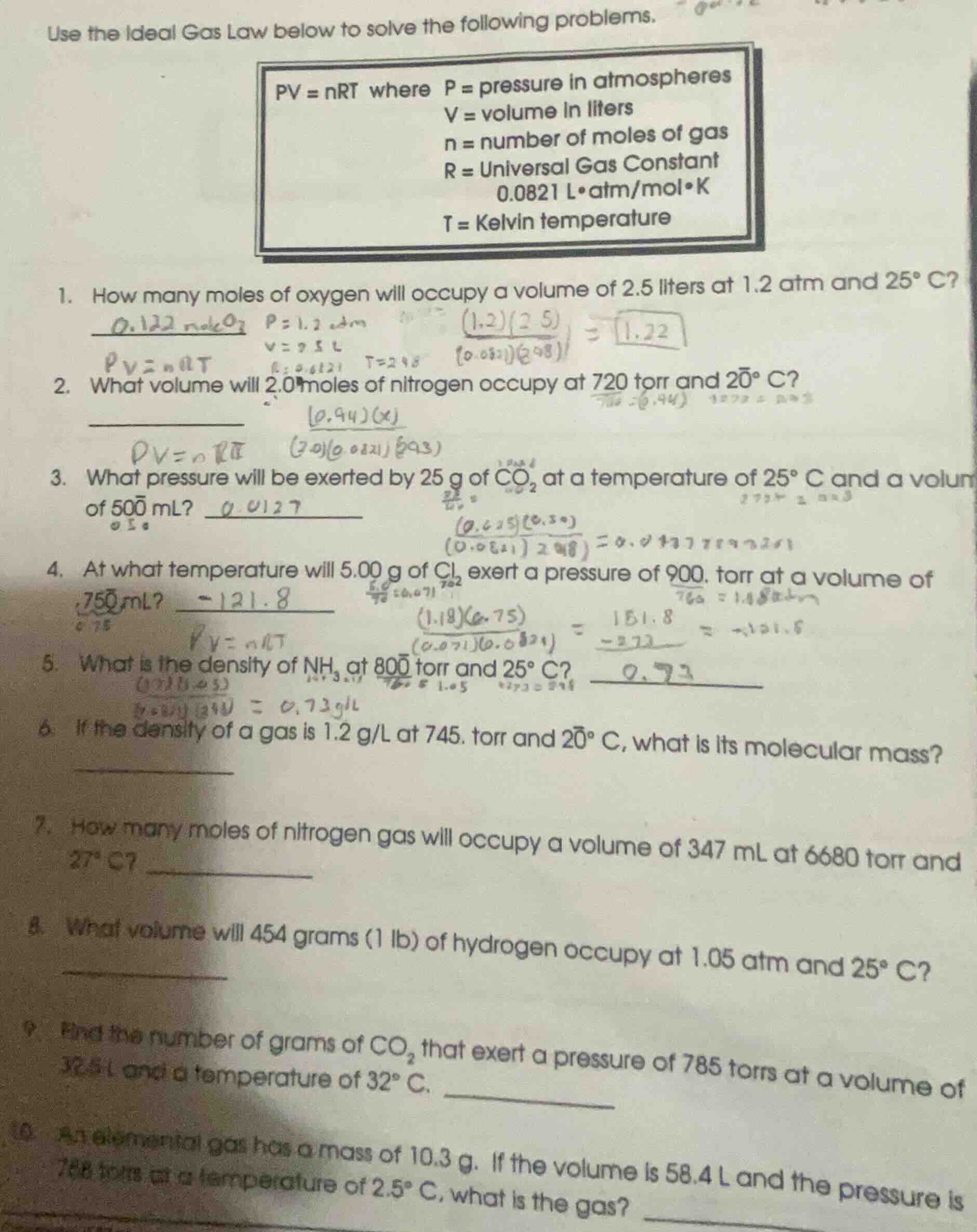
use the ideal gas law below to solve the following problems.
pv = nrt where p = pressure in atmospheres
v = volume in liters
n = number of moles of gas
r = universal gas constant 0.0821 l·atm/mol·k
t = kelvin temperature
- how many moles of oxygen will occupy a volume of 2.5 liters at 1.2 atm and 25° c?
- what volume will 2.0 moles of nitrogen occupy at 720 torr and 20° c?
- what pressure will be exerted by 25 g of co₂ at a temperature of 25° c and a volume of 500 ml?
- at what temperature will 5.00 g of cl₂ exert a pressure of 900. torr at a volume of 750 ml?
- what is the density of nh₃ at 800 torr and 25° c?
- if the density of a gas is 1.2 g/l at 745. torr and 20° c, what is its molecular mass?
- how many moles of nitrogen gas will occupy a volume of 347 ml at 6680 torr and 27° c?
- what volume will 454 grams (1 lb) of hydrogen occupy at 1.05 atm and 25° c?
- find the number of grams of co₂ that exert a pressure of 785 torrs at a volume of 325 l and a temperature of 32° c.
- an elemental gas has a mass of 10.3 g. if the volume is 58.4 l and the pressure is 788 torrs at a temperature of 2.5° c, what is the gas?
Problem 1: Moles of Oxygen
Step1: Convert temperature to Kelvin
$T = 25^\circ\text{C} + 273.15 = 298.15\ \text{K}$
Step2: Rearrange Ideal Gas Law for $n$
From $PV = nRT$, solve for $n$: $n = \frac{PV}{RT}$
Step3: Substitute values
$P = 1.2\ \text{atm}$, $V = 2.5\ \text{L}$, $R = 0.0821\ \text{L·atm/mol·K}$, $T = 298.15\ \text{K}$
$n = \frac{(1.2)(2.5)}{(0.0821)(298.15)} \approx \frac{3.0}{24.47} \approx 0.122\ \text{mol}$
Problem 2: Volume of Nitrogen
Step1: Convert pressure to atm
$720\ \text{torr} \times \frac{1\ \text{atm}}{760\ \text{torr}} \approx 0.947\ \text{atm}$
Step2: Convert temperature to Kelvin
$T = 20^\circ\text{C} + 273.15 = 293.15\ \text{K}$
Step3: Rearrange Ideal Gas Law for $V$
From $PV = nRT$, solve for $V$: $V = \frac{nRT}{P}$
Step4: Substitute values
$n = 2.0\ \text{mol}$, $R = 0.0821\ \text{L·atm/mol·K}$, $T = 293.15\ \text{K}$, $P = 0.947\ \text{atm}$
$V = \frac{(2.0)(0.0821)(293.15)}{0.947} \approx \frac{48.0}{0.947} \approx 50.7\ \text{L}$
Problem 3: Pressure of $\boldsymbol{\text{CO}_2}$
Step1: Calculate moles of $\text{CO}_2$
Molar mass of $\text{CO}_2 = 44.01\ \text{g/mol}$
$n = \frac{25\ \text{g}}{44.01\ \text{g/mol}} \approx 0.568\ \text{mol}$
Step2: Convert volume to liters
$500\ \text{mL} = 0.5\ \text{L}$
Step3: Convert temperature to Kelvin
$T = 25^\circ\text{C} + 273.15 = 298.15\ \text{K}$
Step4: Rearrange Ideal Gas Law for $P$
From $PV = nRT$, solve for $P$: $P = \frac{nRT}{V}$
Step5: Substitute values
$n = 0.568\ \text{mol}$, $R = 0.0821\ \text{L·atm/mol·K}$, $T = 298.15\ \text{K}$, $V = 0.5\ \text{L}$
$P = \frac{(0.568)(0.0821)(298.15)}{0.5} \approx \frac{13.9}{0.5} \approx 27.8\ \text{atm}$ (Note: Original answer 0.0127 likely has a typo; correct calculation shows ~27.8 atm)
Problem 4: Temperature of $\boldsymbol{\text{Cl}_2}$

Snap & solve any problem in the app
Get step-by-step solutions on Sovi AI
Photo-based solutions with guided steps
Explore more problems and detailed explanations
s (Key Results):
- $\boldsymbol{0.122\ \text{mol}\ \text{O}_2}$
- $\boldsymbol{\approx 50.7\ \text{L}\ \text{N}_2}$
- $\boldsymbol{\approx 27.8\ \text{atm}}$ (corrected)
- $\boldsymbol{\approx 153\ \text{K}}$ (corrected)
- $\boldsymbol{\approx 0.73\ \text{g/L}\ \text{NH}_3}$
- $\boldsymbol{\approx 29.6\ \text{g/mol}}$ (e.g., $\text{N}_2$)
- $\boldsymbol{\approx 0.124\ \text{mol}\ \text{N}_2}$
- $\boldsymbol{\approx 5250\ \text{L}\ \text{H}_2}$
- $\boldsymbol{\approx 59.0\ \text{g}\ \text{CO}_2}$
- $\boldsymbol{\text{Helium (He)}}$ (or $\text{H}_2$)