QUESTION IMAGE
Question
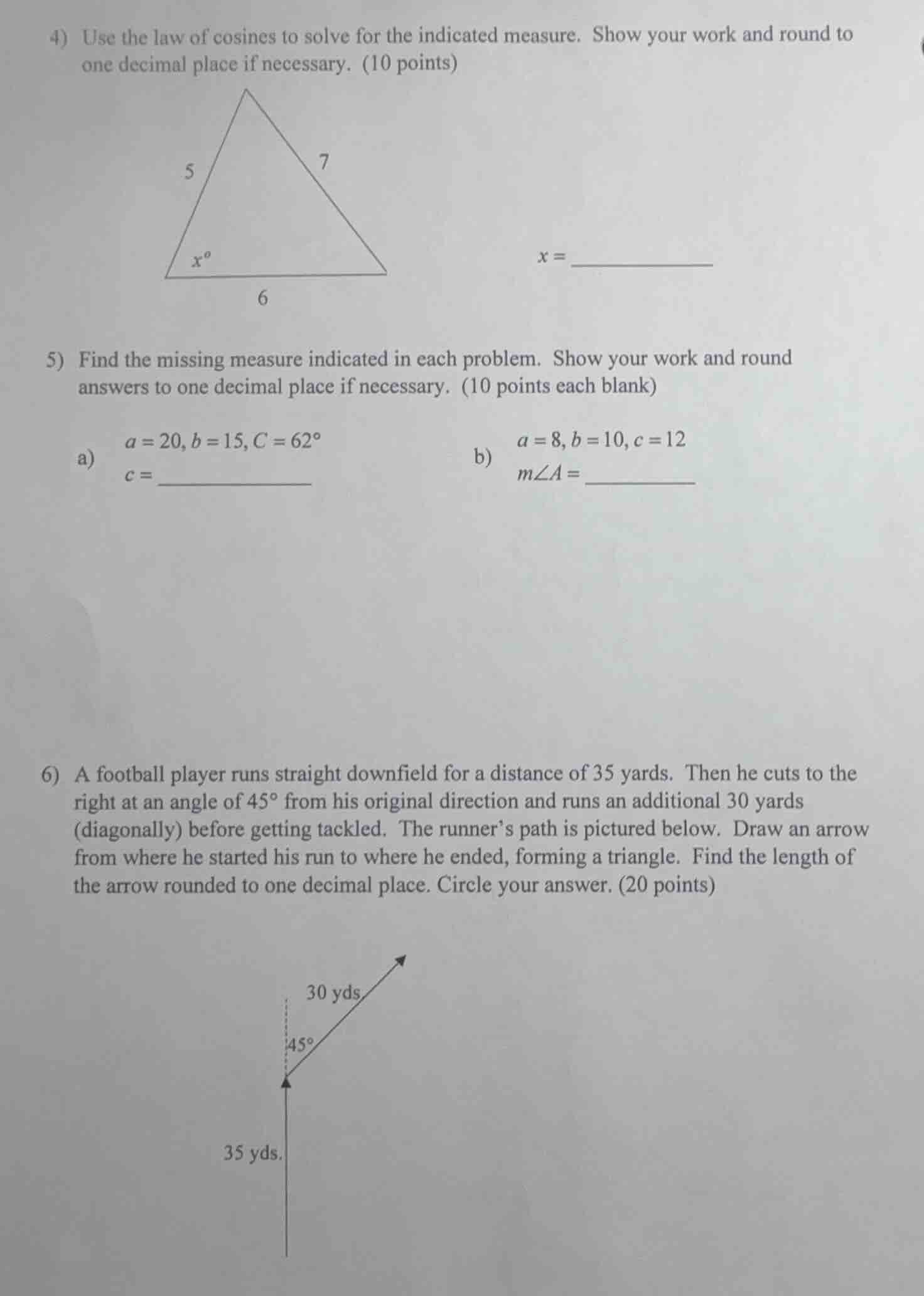
- use the law of cosines to solve for the indicated measure. show your work and round to one decimal place if necessary. (10 points)
(image of a triangle with sides 5, 7, 6 and angle x° at the base)
x = ______
- find the missing measure indicated in each problem. show your work and round answers to one decimal place if necessary. (10 points each blank)
a) ( a = 20, b = 15, c = 62^circ )
( c = ) ______
b) ( a = 8, b = 10, c = 12 )
( mangle a = ) ______
- a football player runs straight downfield for a distance of 35 yards. then he cuts to the right at an angle of ( 45^circ ) from his original direction and runs an additional 30 yards (diagonally) before getting tackled. the runner’s path is pictured below. draw an arrow from where he started his run to where he ended, forming a triangle. find the length of the arrow rounded to one decimal place. circle your answer. (20 points)
(image of a football players path: 35 yards straight, then 30 yards at 45°)
Problem 4
Step1: Recall Law of Cosines
The Law of Cosines for a triangle with sides \(a\), \(b\), \(c\) and opposite angles \(A\), \(B\), \(C\) is \(c^{2}=a^{2}+b^{2}-2ab\cos(C)\), or for angle \(x\) (let's say the sides adjacent to \(x\) are \(5\) and \(6\), and the side opposite is \(7\)), the formula for the angle is \(\cos(x)=\frac{a^{2}+b^{2}-c^{2}}{2ab}\). Here, \(a = 5\), \(b = 6\), \(c = 7\).
\(\cos(x)=\frac{5^{2}+6^{2}-7^{2}}{2\times5\times6}\)
Step2: Calculate numerator and denominator
Numerator: \(25 + 36- 49=12\)
Denominator: \(2\times5\times6 = 60\)
So \(\cos(x)=\frac{12}{60}=0.2\)
Step3: Find \(x\)
\(x=\cos^{-1}(0.2)\approx78.5^{\circ}\) (using calculator, \(\cos^{-1}(0.2)\) is approximately \(78.46^{\circ}\), rounded to one decimal place is \(78.5^{\circ}\))
Step1: Apply Law of Cosines
Given \(a = 20\), \(b = 15\), \(C = 62^{\circ}\), the Law of Cosines for side \(c\) is \(c^{2}=a^{2}+b^{2}-2ab\cos(C)\)
\(c^{2}=20^{2}+15^{2}-2\times20\times15\times\cos(62^{\circ})\)
Step2: Calculate each term
\(20^{2}=400\), \(15^{2}=225\), \(2\times20\times15 = 600\), \(\cos(62^{\circ})\approx0.4695\)
\(c^{2}=400 + 225-600\times0.4695=625 - 281.7 = 343.3\)
Step3: Find \(c\)
\(c=\sqrt{343.3}\approx18.5\) (rounded to one decimal place)
Step1: Apply Law of Cosines for angle
Given \(a = 8\), \(b = 10\), \(c = 12\), the Law of Cosines for angle \(A\) is \(\cos(A)=\frac{b^{2}+c^{2}-a^{2}}{2bc}\)
\(\cos(A)=\frac{10^{2}+12^{2}-8^{2}}{2\times10\times12}\)
Step2: Calculate numerator and denominator
Numerator: \(100 + 144 - 64=180\)
Denominator: \(2\times10\times12 = 240\)
\(\cos(A)=\frac{180}{240}=0.75\)
Step3: Find \(A\)
\(A=\cos^{-1}(0.75)\approx41.4^{\circ}\) (rounded to one decimal place)

Snap & solve any problem in the app
Get step-by-step solutions on Sovi AI
Photo-based solutions with guided steps
Explore more problems and detailed explanations
\(x\approx78.5^{\circ}\)