QUESTION IMAGE
Question
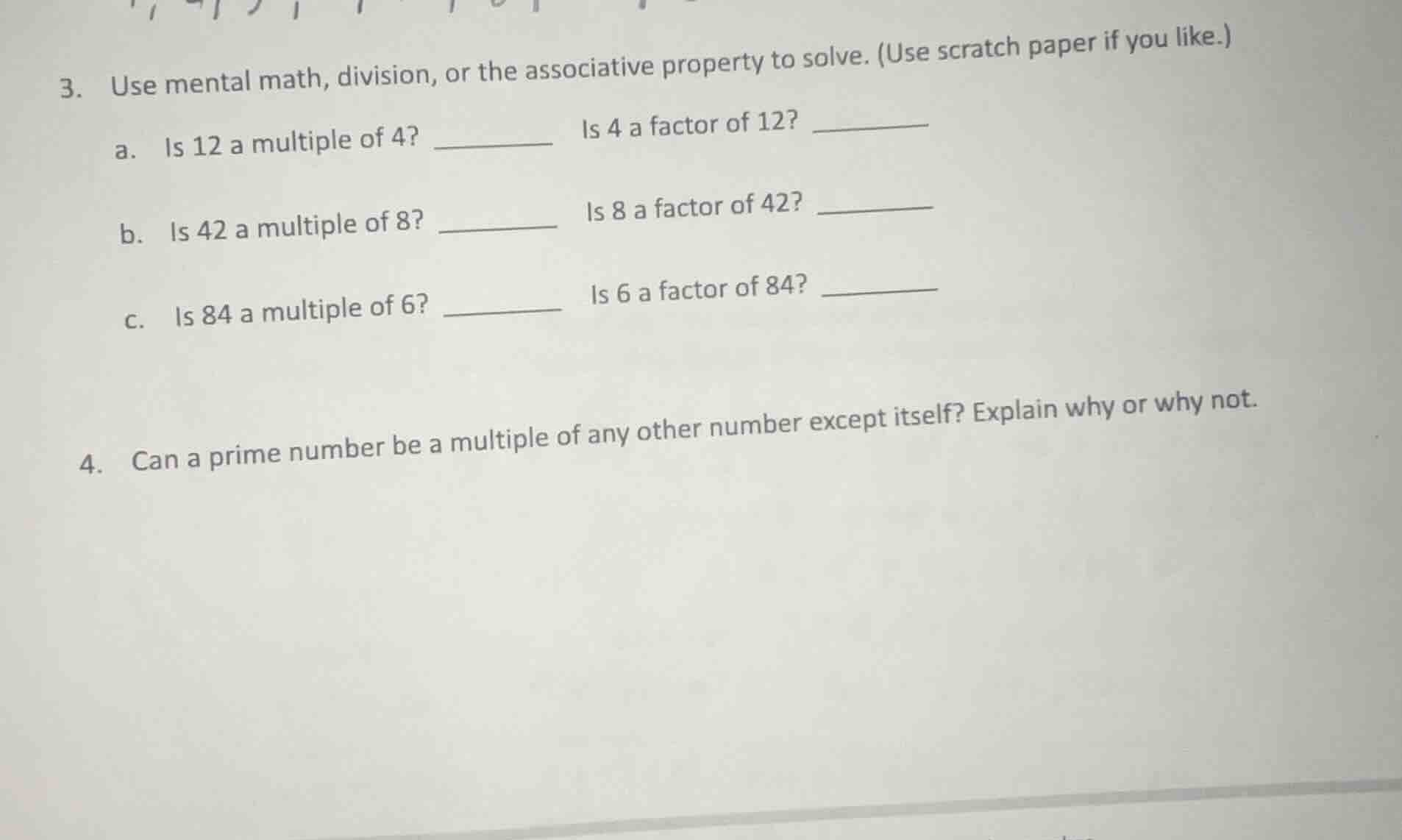
- use mental math, division, or the associative property to solve. (use scratch paper if you like.)
a. is 12 a multiple of 4? ____ is 4 a factor of 12? ____
b. is 42 a multiple of 8? ____ is 8 a factor of 42? ____
c. is 84 a multiple of 6? ____ is 6 a factor of 84? ____
- can a prime number be a multiple of any other number except itself? explain why or why not.
Step1: Check 12 ÷ 4 for part a
$\frac{12}{4}=3$, no remainder.
Step2: Check 42 ÷ 8 for part b
$\frac{42}{8}=5.25$, has a remainder.
Step3: Check 84 ÷ 6 for part c
$\frac{84}{6}=14$, no remainder.
Step4: Define prime numbers for question 4
A prime number has only 1 and itself as factors.
A prime number is defined as a number greater than 1 that has exactly two distinct positive divisors: 1 and itself. For a number to be a multiple of another number, that other number must be a divisor. The only divisors of a prime number are 1 and itself, so it can only be a multiple of 1 and itself.

Snap & solve any problem in the app
Get step-by-step solutions on Sovi AI
Photo-based solutions with guided steps
Explore more problems and detailed explanations
3.
a. Is 12 a multiple of 4? Yes; Is 4 a factor of 12? Yes
b. Is 42 a multiple of 8? No; Is 8 a factor of 42? No
c. Is 84 a multiple of 6? Yes; Is 6 a factor of 84? Yes
4.