QUESTION IMAGE
Question
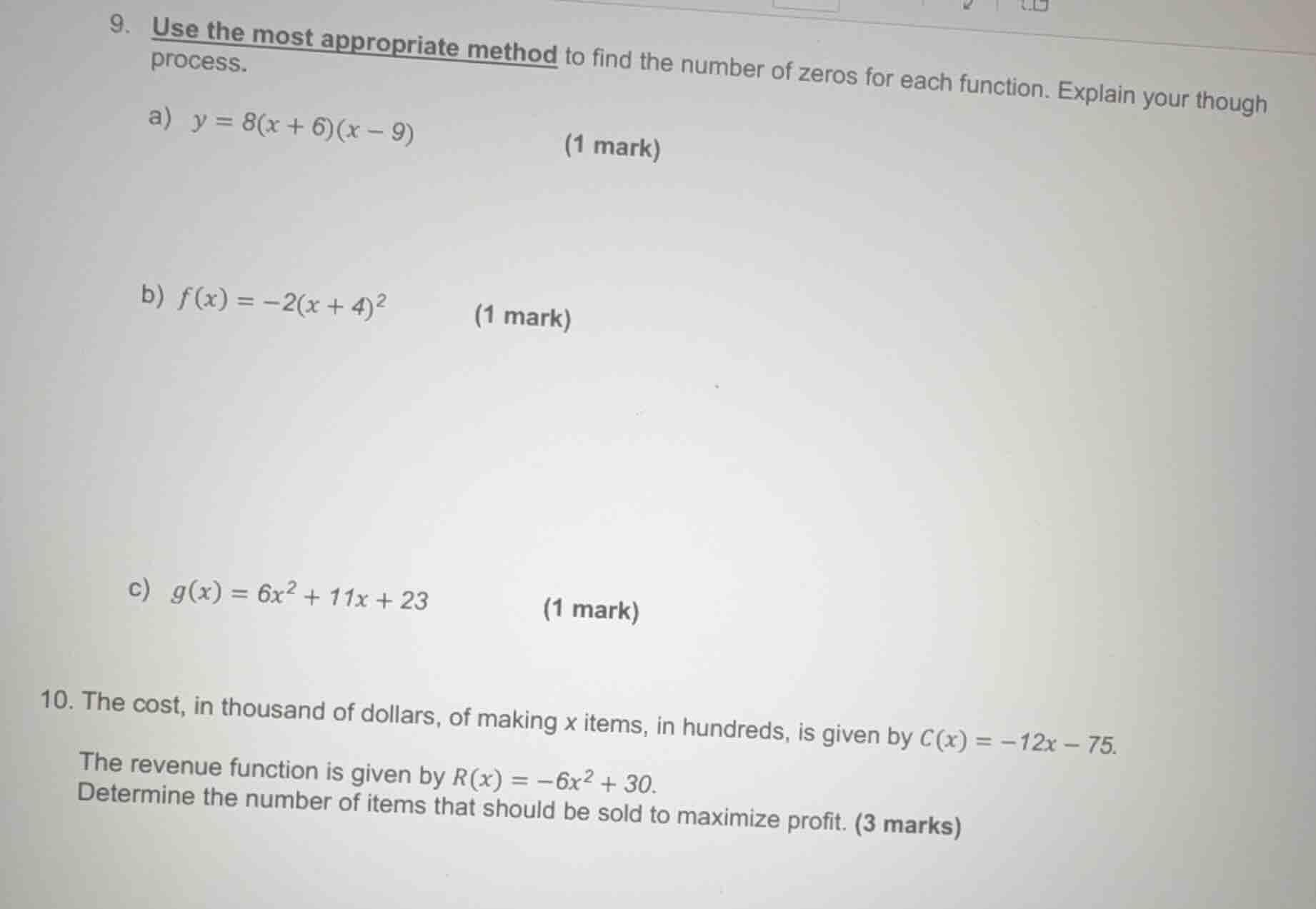
- use the most appropriate method to find the number of zeros for each function. explain your though process.
a) $y = 8(x + 6)(x - 9)$ (1 mark)
b) $f(x) = -2(x + 4)^2$ (1 mark)
c) $g(x) = 6x^2 + 11x + 23$ (1 mark)
- the cost, in thousand of dollars, of making $x$ items, in hundreds, is given by $c(x) = -12x - 75$.
the revenue function is given by $r(x) = -6x^2 + 30$.
determine the number of items that should be sold to maximize profit. (3 marks)
9a)
Step1: Recall zero - product property
The zero - product property states that if \(ab = 0\), then either \(a = 0\) or \(b=0\) (or both). For the function \(y = 8(x + 6)(x - 9)\), we set \(y = 0\). So we have the equation \(8(x + 6)(x - 9)=0\).
Step2: Analyze the factors
Since \(8
eq0\), we can use the zero - product property on \((x + 6)(x - 9)=0\). This gives us two equations: \(x+6 = 0\) or \(x - 9=0\).
Solving \(x + 6=0\) gives \(x=-6\), and solving \(x - 9 = 0\) gives \(x = 9\). So there are two distinct zeros.
Step1: Recall zero - product property for repeated roots
For the function \(f(x)=-2(x + 4)^{2}\), we set \(f(x)=0\). So we have the equation \(-2(x + 4)^{2}=0\).
Step2: Analyze the factor
Since \(-2
eq0\), we consider \((x + 4)^{2}=0\). By the zero - product property (for a square), if \((x + 4)^{2}=0\), then \(x+4=0\) (with multiplicity 2). So the root \(x=-4\) is a repeated root, but we count the number of zeros (distinct or repeated, but in terms of the number of solutions to \(f(x) = 0\), here we have one distinct zero with multiplicity 2. But when we are asked for the number of zeros (in the sense of the number of values of \(x\) that make \(f(x)=0\), considering multiplicity or not? In the context of quadratic functions, for \(y=a(x - h)^{2}\), the zero is \(x = h\) (a repeated root). So the number of zeros (counting multiplicity or as a distinct root) - in the case of a perfect square, we have one zero (even though it has multiplicity 2). Wait, actually, the number of real zeros: for \(f(x)=-2(x + 4)^{2}\), when we solve \(f(x)=0\), we get \((x + 4)^{2}=0\), so \(x=-4\) (a single real zero with multiplicity 2). So the number of real zeros is 1.
Step1: Use the discriminant formula
For a quadratic function \(ax^{2}+bx + c\) (\(a
eq0\)), the discriminant \(\Delta=b^{2}-4ac\). If \(\Delta>0\), there are two distinct real zeros; if \(\Delta = 0\), there is one real zero; if \(\Delta<0\), there are no real zeros. For the function \(g(x)=6x^{2}+11x + 23\), we have \(a = 6\), \(b = 11\), and \(c = 23\).
Step2: Calculate the discriminant
\(\Delta=(11)^{2}-4\times6\times23=121-552=-431\). Since \(\Delta=-431<0\), the quadratic function \(g(x)\) has no real zeros.

Snap & solve any problem in the app
Get step-by-step solutions on Sovi AI
Photo-based solutions with guided steps
Explore more problems and detailed explanations
The number of zeros of \(y = 8(x + 6)(x - 9)\) is \(2\).