QUESTION IMAGE
Question
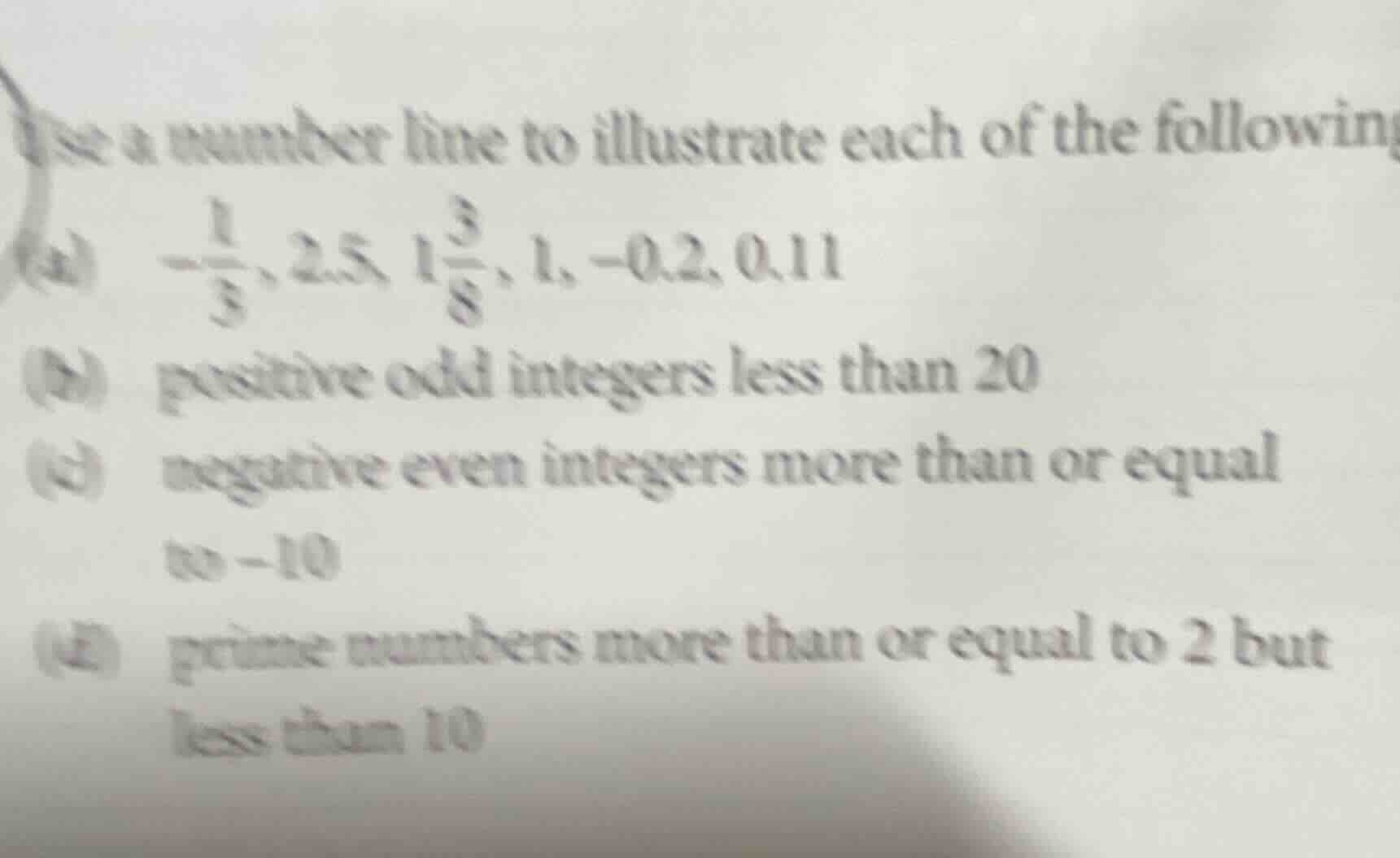
use a number line to illustrate each of the following:(a) $\boldsymbol{-\frac{1}{3}, 2.5, 1\frac{3}{8}, 1, -0.2, 0.11}$(b) positive odd integers less than 20(c) negative even integers more than or equal to $-10$(d) prime numbers more than or equal to 2 but less than 10
Step1: Convert to decimals for ordering
$-\frac{1}{3} \approx -0.33$, $1\frac{3}{8}=1.375$, so the set is: $-0.33, 2.5, 1.375, 1, -0.2, 0.11$
Step2: Order the values left to right
From smallest to largest: $-0.33 < -0.2 < 0.11 < 1 < 1.375 < 2.5$
Step3: List positive odd integers <20
Positive odd integers start at 1, increment by 2, stop before 20.
Step4: List negative even integers ≥-10
Negative even integers start at -10, increment by 2, stop at 0.
Step5: List primes 2≤p<10
Prime numbers have exactly two distinct positive divisors.

Snap & solve any problem in the app
Get step-by-step solutions on Sovi AI
Photo-based solutions with guided steps
Explore more problems and detailed explanations
a) On a number line, mark the points from left to right: $-\frac{1}{3} \approx -0.33$, $-0.2$, $0.11$, $1$, $1\frac{3}{8}=1.375$, $2.5$
b) Positive odd integers less than 20: 1, 3, 5, 7, 9, 11, 13, 15, 17, 19 (mark these on a number line)
c) Negative even integers more than or equal to -10: -10, -8, -6, -4, -2 (mark these on a number line)
d) Prime numbers more than or equal to 2 but less than 10: 2, 3, 5, 7 (mark these on a number line)