QUESTION IMAGE
Question
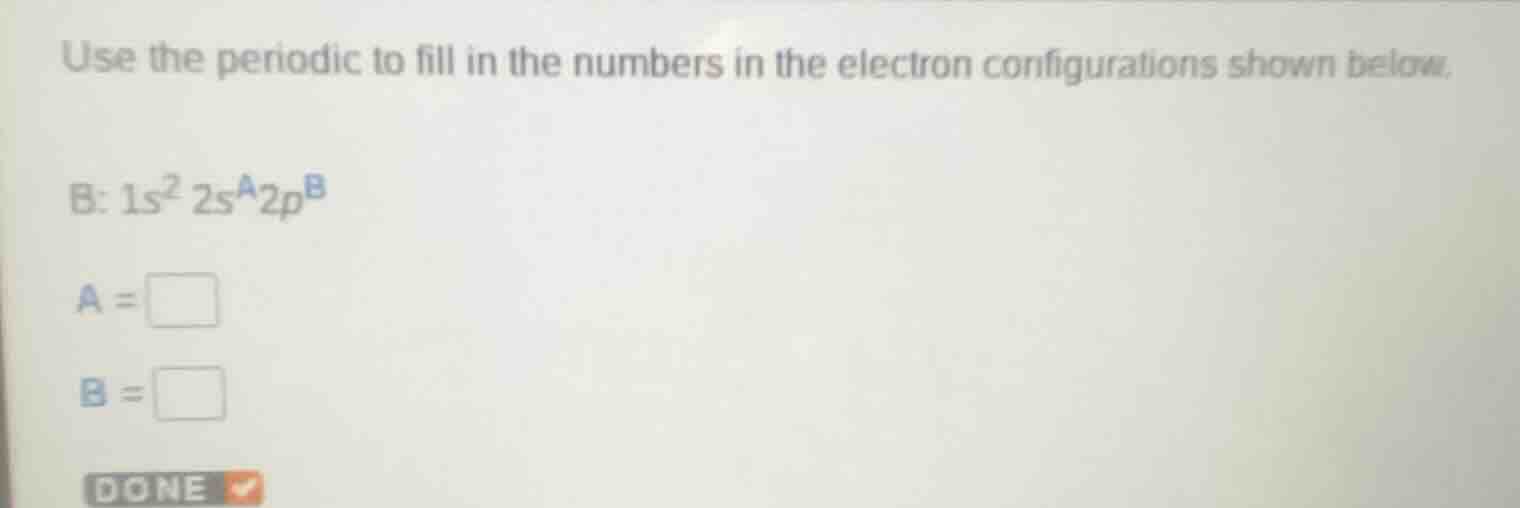
use the periodic to fill in the numbers in the electron configurations shown below.
b: $1s^2 2s^a 2p^b$
$a = \square$
$b = \square$
Step1: Recall electron configuration rules
The s - orbital can hold a maximum of 2 electrons. For the \(2s\) sub - shell, the number of electrons (A) should follow the Aufbau principle and the capacity of the s - orbital. So, for the \(2s\) sub - shell, the maximum number of electrons it can hold is 2. So \(A = 2\).
Step2: Determine the number of electrons in B (boron)
Boron has an atomic number of 5, which means it has 5 electrons. We know from the electron configuration \(1s^{2}2s^{A}2p^{B}\), and we found that \(A = 2\) (since \(2s\) has 2 electrons). The number of electrons in \(1s\) is 2, in \(2s\) is \(A = 2\). Let the number of electrons in \(2p\) be \(B\). Then the total number of electrons is \(2+A + B=5\). Substituting \(A = 2\) into the equation: \(2 + 2+B=5\). Solving for \(B\), we get \(B=5-(2 + 2)=1\).

Snap & solve any problem in the app
Get step-by-step solutions on Sovi AI
Photo-based solutions with guided steps
Explore more problems and detailed explanations
\(A=\boxed{2}\)
\(B=\boxed{1}\)