QUESTION IMAGE
Question
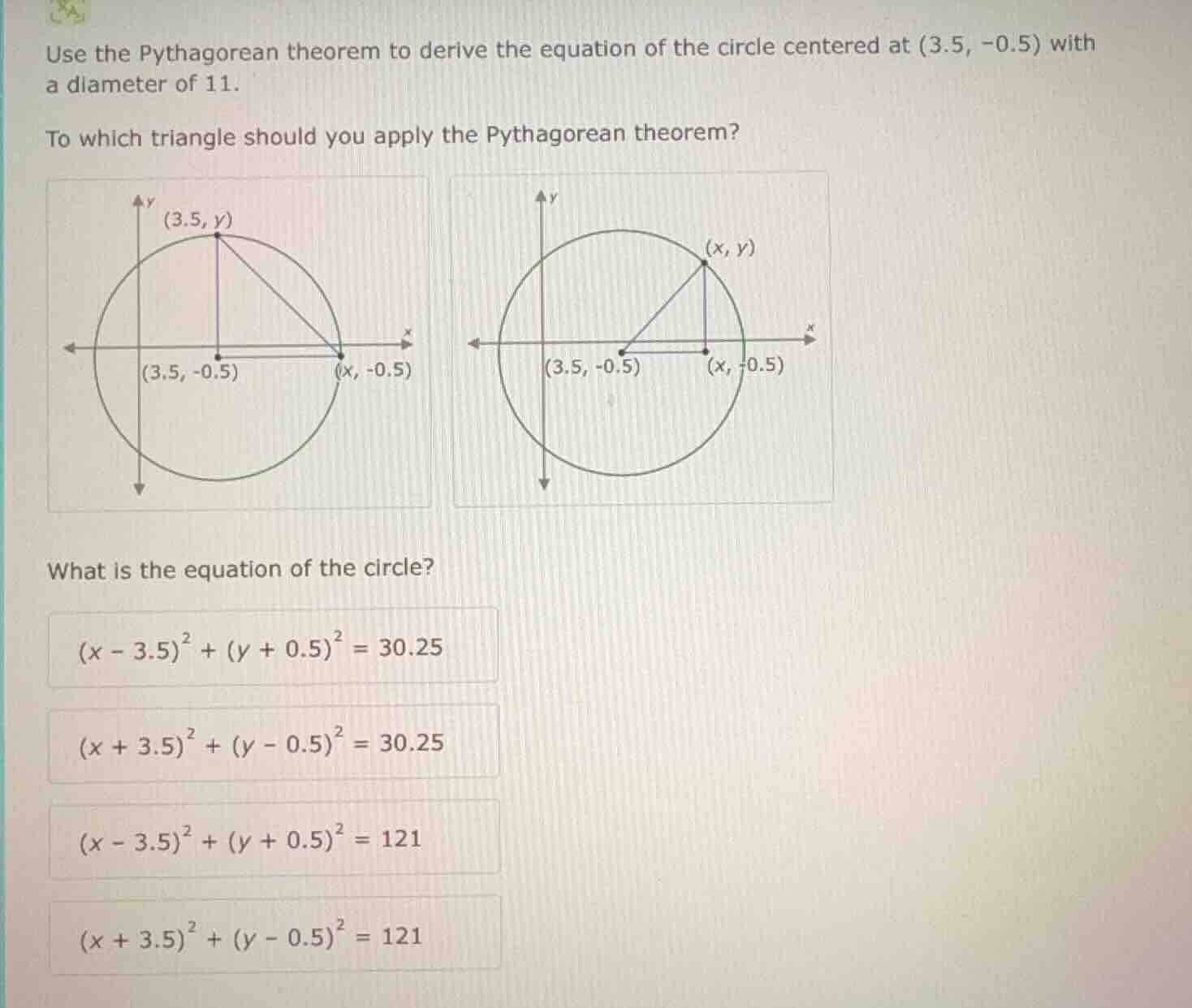
use the pythagorean theorem to derive the equation of the circle centered at (3.5, -0.5) with a diameter of 11. to which triangle should you apply the pythagorean theorem? two images of circles and triangles what is the equation of the circle? options: (x - 3.5)² + (y + 0.5)² = 30.25; (x + 3.5)² + (y - 0.5)² = 30.25; (x - 3.5)² + (y + 0.5)² = 121; (x + 3.5)² + (y - 0.5)² = 121
Step1: Identify correct triangle
The right triangle has vertices at the circle's center $(3.5, -0.5)$, the point $(x, -0.5)$ (horizontal projection of a general circle point $(x,y)$), and the general circle point $(x,y)$. This is the second (right-hand) diagram's triangle, as it uses a general point on the circle to derive the general equation.
Step2: Calculate the radius
Radius $r$ is half the diameter.
$r = \frac{11}{2} = 5.5$
Step3: Apply Pythagorean theorem
Let horizontal leg = $x - 3.5$, vertical leg = $y - (-0.5) = y + 0.5$, hypotenuse = $r=5.5$.
By Pythagoras: $(x - 3.5)^2 + (y + 0.5)^2 = r^2$
Step4: Compute $r^2$
$r^2 = 5.5^2 = 30.25$

Snap & solve any problem in the app
Get step-by-step solutions on Sovi AI
Photo-based solutions with guided steps
Explore more problems and detailed explanations
- The triangle in the right-hand diagram (with vertices $(3.5, -0.5)$, $(x, -0.5)$, $(x,y)$)
- $(x - 3.5)^2 + (y + 0.5)^2 = 30.25$